Chandrasekhar Jayarama Krishnan

Head of Cricket – The CouchExpert

September, 2011


India’s battle with England this summer, thus far, has hardly possessed any dramatic interest. In the past, when Indian cricket had been through plenty of such phases, there would always be an instance of one player whose image would bring to mind a personal battle of absolute resolve. The truth, however in this series, is more prosaic; while there were a few performances that had glimpses of excellence, the overall picture, though, was seemingly fogged.

With absolutely nothing to lose henceforth, it would make sense for India to adopt Admiral Farragut’s ‘damn the torpedoes’ approach during the Battle of Mobile Bay. The influx of youth has helped the unit remove scarred egos, with Rahane’s good run of form being a huge positive. He has looked comfortable for someone who’s just arrived in to International Cricket. Coupled with Parthiv’s blitzkriegs at the top of the order, there have been plenty of positives to derive from the approach.

While some of the players handled the English attack with grace, the overall result has been the same – odd emotional moments in a failing quest that few people are taking seriously. The seriousness debate could have half a point – there were always going to be questions about the crowd that otherwise would have been generated had injuries not affected the celebrity stars.

The success of Rahane would surely give young Aaron a boost in confidence. He must be handed his debut soon.

Despite various signs that indicate a depleted level of interest, thanks more to the weather than the lack of stars, the battle might not be joined until the reverse fixtures commence in India later this year. But what can currently generate interest is to expose some of the young stars and offer a glimpse of what the future has in store for Indian cricket. The failure, to say hand a debut to young Varun Aaron would end up demonstrating the chronic weakness of Indian selection.

It is easy to forget that change in fortunes can still fetch silverware for the Indians this series. The Indian cricket fan’s substantive liability is to forget the opportunities that still lie ahead when times are bad – he becomes besotted with pessimism. The response so far from the team has been forceful, but grossly inadequate.

England, on the other hand has lost its One Day talisman with Irish roots to injury. Morgan’s injury could prove a blessing in disguise for ex outcast Ravi Bopara, who is trying is hardest to cement a place in a side which once struggled to pick a squad on credit alone. It is strange to observe how a chunk of past memories are formatted when times change for the good.

England must ride on this wave while it still lasts, and their current opponents are prime examples of what dark times can do. With a bunch of youngsters being given a fair run this series, Dernbach and Stokes have opportunities to pose additional headaches to the English selectors.

Bopara will slot in to fill the injured Morgan's place in the England XI

Alastair Cook’s doubted limited over skills were put to rest with the innings at Southampton, additionally backed by a few good performances in the same format against the Sri Lankans prior to the Indian series. His success has set a predicate that Cook, as a batsman, can now be relied on in the shorter formats of the game and practically, on incommodious leadership issues, if they may exist, along the way to definitive deal.

The trouble is, success will not always walk into the hands of the Englishmen. If England’s new found aggression is about ruthlessly wiping out enemies, as they’ve demonstrated in the recent past, it probably wouldn’t be a bad idea for even Captain Cook to take a leaf out of Admiral Farragut’s book: Damn the Torpedoes, full speed ahead! Weather permitting, of course.

Why reduce overs in cricket?

Posted: September 7, 2011 by Editor in Cricket, Opinion
Tags: , ,

Srikrishnan Chandrasekaran

You never have a football match reduced to 15 minutes a half because of rain or a Grand Slam final reduced to best-of-three sets because of rain or inclement weather. When was the last time you saw a badminton final reduced to a one game affair? Or do you reduce the golf major reduced to a 6-hole final round? So, why only cricket? Who gives them the power to reduce a 20-overs per side game to a 5-over contest and call it a game? Are they afraid of refunds? Or, are they worried that the TV crew will have to work a day extra to set-up their cameras and have less time to move to the next stadium?

Cricket is unique because it has three distinct formats. When overs are the distinguishing factor from one format to the other, how do you call a 20-overs per side game as a T20 game one day and a ODI the other?

The ICC should come up with a new set of rules for the game of Cricket. The teams travel to a cricket country once in 4 years to play a full series. During that time there might be unavoidable circumstances that rules out the entire match irrespective of the purpose of the series. The first ODI between India and England was washed out because of rain. The series will be decided only with the remaining of the 4 matches. The system doesn’t look meaningful. At any cost the series should happen as is either by extending the schedule or reducing the number of days between the next match.

The farce of calling a 20-over per side game as ODI is unique to cricket

There are a lot of other things involved in a series, like preparing the ground, infrastructure to the players and other officials, facilities to the fans and visitors to be handled by the home board. But there should be a backup plan from ICC or respective boards in the case of a match not being held for a reason, and then it should be compensated with in that stipulated period. The 2nd ODI between the teams had been reduced to 23 overs due to heavy rain. The match should be played as per the number of over scheduled. A 50 over game or a 20 over game at any cost should not be reduced. How can a 50 over match be reduced to 23 overs and it is considered as ODI match?

It doesn’t happen in many of the other sports as well as space. Take an example, due to unexpected circumstances a 10th standard public exam can be cancelled and it will be rescheduled. It will never be reduced from 100 marks to 5 marks exam. When a match is measured between 2 teams over 50 overs, how can it suddenly change to 23 overs and measure that performance as an ODI? It doesn’t make any sense.

Even during the last IPL final, the 20 over match was reduced to 17 overs per side. Why should the final of a tournament to be reduced due to rain. To bowl 6 overs it hardly takes about 30 minutes. For 8 PM IST IPL matches, the fans used to arrive at the ground by 6 PM and they will be very happy leaving the ground 30 minutes after the schedule by the playing the quota for a 20 overs match rather than have number of overs reduced.

In case the stipulated overs are not complete on the given day, the ICC/home board should schedule the match to a next day bearing all the cost and other infrastructure. For every space, there is back up plan for execution, why is it there not in cricket? Whether fans, reporters, advertising agencies and etc will be available or not, there should be at least few camera troops from ICC/home board to record the match and telecast it later. ICC can still earn their broadcast charges form their respective vendors / advertising companies by broadcasting the match next day.

The current system looks like ICC/home board want to run the matches because they doesn’t have a backup plan and they want to ensure their profits are met irrespective whether the players / teams / billions of fans across the globe will feel happy or not. Let’s try to play the games as is instead of reducing the overs for any unavoidable circumstances and changing the reality of the game thus reducing the spirit of the game.


Goutham Chakravarthi

It is hard to judge the quality of the English one-day batting given the appalling standard of Indian bowling. None of their front line bowlers had a clue in a shortened game, flat tract, with the night chilly winds and near freezing temperature. There was no swing on offer for Praveen Kumar and Kieswetter and Cook took the Indian bowling apart – walking inside the line and tucking it over fine leg, or giving themselves room to smash it over the off-side. Given what was on offer, England romped home chasing a stiff target with plenty to spare. They were close to 60 without loss after 5 overs and close to 100 after 9 overs. The game was over!

India’s reluctance from moving from their preferred combination of 7 batsmen and 4 bowlers is hurting them more with none of the part-time bowlers good enough to bowl more than a couple of overs unless the conditions favour them. India’s best hope with this combination is to chase.

Bell feasts on Raina's part time offies

Dhoni’s reliance on the skill of Ashwin is coming to a nought in these conditions with the wickets greasy and not providing enough bite for the Chennai spinner with the new ball. Kieswetter went after him straight away and tonked him for 16 in his first over and with it Dhoni seemed short of bowlers and ideas as all bowlers and combinations he tried didn’t work. Perhaps, it is time he played Jadeja in the side at seven for it gives him some tight overs from the left-armer in the  middle overs and he is a fair tonker of the cricket ball down the order.

The sameness of the Indian bowling in their seam department in terms of pace (or the lack of it) is making it easy for batsmen to line them up on good wickets. There is little chance this bowling side will bowl decent batting sides out on good wickets. It may not hurt them to give the leg-spinner and Varun Aaron a go in the remaining matches as they tend to be wicket taking options.

There is no such problem in the batting. Parthiv Patel looked poised for another big score as he went after the English bowlers who can’t seem to shed their love for short-pitched bowling. Parthiv cut and pulled with great relish. For second time in successive games, Anderson got him on the drive. Perhaps there is a lesson in it for Bresnan and Broad.

Ajinkya Rahane is doing his reputation no harm. There are enough talks going on back home that he should be the reserve Test opener going forward with Cheteshwar Pujara being the first choice no.6 batsman. He has looked at ease playing swing, pace and spin and again showed why he is rated so highly in the Indian domestic scene. He has made the most of his opportunity at the top of the order. In this form, it will be difficult to leave him out even in a full strength Indian side. It has been quite an impressive start.

Suresh Raina has to be among the most impactful limited overs players. To do what he does and with such consistency at the end of the batting innings takes for great confidence and skill. His cover drive for six off Bresnan is testament to his skills of ball striking and improvising abilities. There is little doubting his reputation or his future in this format.

It is a case of issues for both teams. England’s victories will for the moment hide their light batting with their middle order not being tested as India continues to find it difficult to get their batsmen out. England’s bowling lacked planning and imagination it showed in the Tests.

Truth is to say that Indian batsmen would fancy their own attack and England’s bowling attack would definitely test their own top order. Two teams working out a combination for the moment and the future might still churn out a tight series. Only if India pick enough bowlers to pose a challenge.


Rajat Jain
Head of Tennis, The CouchExpert
7 September 2011


The fact that serve-n-volley is practically dead today has been a common discussion point among tennis afficianadoes. While it is true that it is now an extinct art, I do not miss that aspect of the same so much. There is still great baseline tennis on offer and the spectacular winners from the far court than makes up for that. In fact, I enjoy the occasional serve-n-volley points that players do today as an element of surprise, which is why I enjoy watching players like Roger Federer, Mardy Fish, Jo Wilfried Tsonga (coupled with Michael Llodra).

An aggressive slice is becoming a lost art

An aggressive slice is becoming a lost art

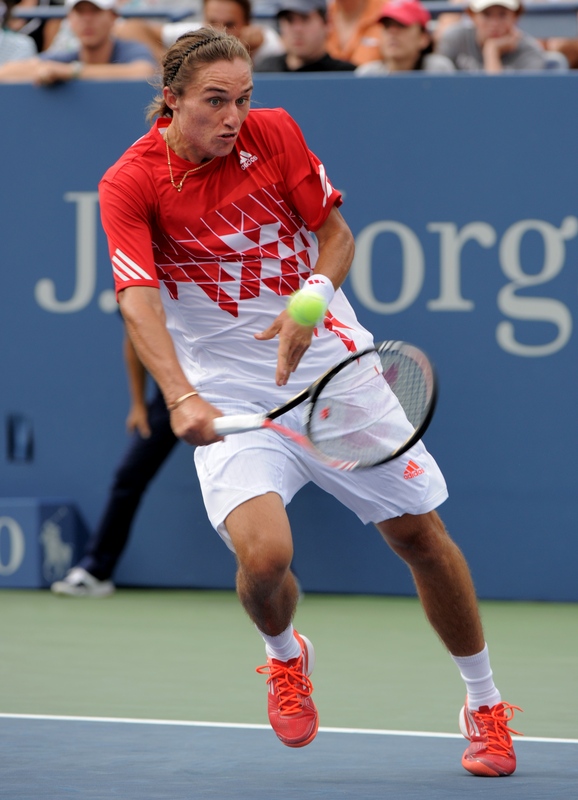
The side effects of the above has been more telling, in my opinion. One of them is the slow decay of the backhand ‘slice’. I know what you are saying. Don’t players today use slices a lot? Rafael Nadal and Andy Murray have a great slice, Novak Djokovic does it sometimes, and Andy Roddick has modeled his backhand purely on the slice as the zip on his two hander has declined over the years. In fact, youngsters like Dolgopolov use it heavily, and yesterday’s match against Djokovic was a great example. The Ukranian troubled the Serb for the greater part of the first set with the lack of pace generated through the slice.

But the common pattern among all of these players is the exclusive use of defensive slice. Most of them use slice only when they are not in a position to hit a strong two hander. In fact, the aggressive slice down-the-line, one of the more difficult shots in the game, is almost absent in the game. There were countless times in yesterday’s match, when I yelled from my seat, “Slice to the forehand!” It never came. Or it came only when Djokovic was present mid court, and was in a great position to make a decent pass. Just like the backhand down-the-line is used to open up the court, the slice up-the-line was a great ploy used by serve-n-volley players which either resulted in some of the best running forehands or in a makeable volley at the net.

Dologopolov’s used heavy cuts on the slice, which were devoid of any pace and stayed very low even on these courts which have more bounce than in the previous years. For some time it troubled Djokovic, but it was only a matter of time before this pattern became routine, and Djokovic, with arguably the best backhand of all time, started handling it easily.

The other side effect has been the inability to recognize a good approach shot and closing the net. The sight of Roddick becoming a dead duck at the net against Federer occurs frequently in their encounters. Yesterday, Kuznetsova was passed time and again against Wozniacki. Part of it was because she made wrong approaches by hitting to Wozniacki’s stronger wing, the backhand. The inability to hit a good slice up-the-line to Wozniacki’s forehand. And because she was passed so frequently, she did not come forward on a potentially good approach. The other part of it was the lack of confidence to take the net which usually resulted in her in no (wo)man’s land in the mid-court. She took a lot of difficult half volleys as a result which were easy pickings for the Dane.

The very fact even Federer, the best aggressive player of this era, has hired Paul Annacone to improve his chip-n-charge tells the current condition of the game.


Goutham Chakravarthi

England have moved on from the world cup with a new captain and are investing in a new set of ODI specialists in the hope to build for the next world cup in 4 years’ time. India, on the other hand, would put their world cup winning team on the park if they had the option. Injuries have forced them to try out some youngsters. It cannot be bad from that stand point.

Manoj Tiwary can be an explosive player on his day.

Expectedly, Tendulkar is advised rest and India are another two men down. It is a call up for Tiwary who made the whole of India stand up and take notice of him in a Ranji final in Mumbai against Mumbai few years ago. He took on Zaheer at his peak and had the better of him and a lot was expected out of this youngster. He was ahead in the pecking order that constituted names like Raina, Rohit Sharma and Badrinath back then. Virat Kohli hadn’t yet taken India to the U-19 world cup win. He was the next big thing. He had lost his way a bit and had even become a movie producer once. Times change, and with consistent runs in the domestic competition last year, he landed a spot in the Emerging Players’ Tournament in Australia. He made his debut there and Brett Lee knocked him back several years with the two card trick – bouncer followed by a searing Yorker. He has taken a good 3-and-half years to get back from that set back.

A confident Tiwary is a sight to behold. He has tremendous range of strokes and is a dominating batsman. He rolls his sleeves up and goes after the bowling. He likes center stage and wants success. He wants to be the aggressor and can be a bully when on top. He will walk down to quicks, move inside the line and hit over the leg-side and will go after the spinners with sweeps and will also step out and hit over the top. In short, he is the ideal limited overs player who can control the middle overs with his tempo. If he gets into the team and settles in, he can be quite a sight in full flow. He will be tested by bumpers by the English bowlers of course.

It might not be a bad thing for India if they give Varun Aaron a game at some stage. There is not much of an unknown factor with the Indian seamers. While the top-order is still coming to grips with Praveen Kumar’s swing with the new ball, there is little left once the ball is old. No Zaheer Khan either to reverse the old ball. It puts too much pressure on Ashwin to control the middle overs if there is nothing in the wicket for the seamers. The extra pace of Varun is hope for a captain to force for a play in the middle overs. He tends to be expensive when it is not his day, but he can also be a handful when he gets it right for a couple of overs. Those might be the match-turning overs. Dhoni might punt on him especially with Vinay Kumar not proving to be effective in the two games he has played so far.

It is still a land of unknowns for both teams. Both teams are trying out combinations for two separate reasons. It might be the unknowns across both teams that might still give us some close contests. India needs all the help it can get from its youngsters to win their first game against England this tour. Let’s hope Tiwary and Aaron make it to the team for the 2nd ODI.