Goutham Chakravarthi

Just two days after Rajasthan Royals appointed Rahul Dravid as the captain for the fifth season of the IPL, Shilpa Shetty roped in Warne for a whopping $250,000 as the Royals’ bus driver.

In a press conference, Ms. Shetty said, “Warne, who has been integral to our successes over the first four seasons of the IPL was keen to be associated with the Royals for season 5, but not as a player. Of course he has famously quoted that cricket coaches are only bus drivers, but, let me make it clear that he will be just a bus driver and not a coach. That said, he is given full authority to do so as he likes whence the players are in the bus though.”

Shilpa Shetty announced Warne’s appointment as Royals’ official bus driver

When contacted, Warne said, “The role of a bus driver is highly underrated, especially in India. If anything they are crucial to any team’s mental state before a game. With me having driven the team bus during my playing days (in a race with Buchanan in New Zealand), I bring in a lot of experience. I can cut through signals and drive on the wrong side of the road which is key for success on the road and on the cricket ground.”

Asked how his bus driving was going to be different from the rest and why one should pay him a quarter million dollars when there could be more skillful drivers around and available at a fraction of the price he is contracted for, Warne said, “Sports psychologists insist that players should visualize success and practice it as part of their training program for them to be ready to be able to do so when they are really out in the middle. It becomes my responsibility to prepare them mentally and get them to that mental state before they get on to the ground. That’ll be high on my agenda when I’m driving them from the hotel to the ground.”

Warne gave insights into his methods further by comparing bus driving to sports psychologists and how this methods were better. He explained, “Visualization is not for all. It takes imagination and not all are blessed with it. Visualizing strategy and success are key for player preparation and on field performance. Quick bowlers need to stick to length and line or throw in those changers. I will get the bowlers to sit on the front row of the bus and give them a demonstration of driving the bus at 60kmph but then screech to a halt all of a sudden. Some will fall, others will be startled. But, it demonstrates how batsmen will be unprepared for such events and how change of pace can do the trick! Similarly for spinners, I might spin the bus at right angles to show how it is done or drive the bus through a very narrow lane at an angle to demonstrate how to sneak one through bat and pad!”

Warne also demonstrated how he intends to help the batsmen. He said, “Batting in T20 cricket is all about adventure and risk taking. It’s overs versus a certain number of runs. I intend to demonstrate how you drive 20 kms in peak Mumbai traffic in 10 minutes. You have to take that calculated risk. You jump a signal here or charge on the wrong side of the road when there is a traffic pile up. You take risks, but you know where you can jump signals and where you drive on the wrong side of the road. Sometimes you can honk your way out of trouble on Indian roads. You drive fast and keep honking, and because of the size of your vehicle the others make way out of sheer fear. It translates to intimidation on the cricket pitch.”

Warne insisted that his position had great accountability. He said, “I take accountability for my actions. Next time a commentator says one of our batsmen is shifting through the gears swiftly you know who was responsible for it. Similarly, when they say a batsman cannot find that extra gear, you can rest assured that the batsman concerned will spend enough time with me on the bus learning to go through the gears well.”

Warne signed off by saying, “I have already helped Rahul Dravid find the fifth gear. He might slip into that mode on the Boxing Day at the MCG and smash a triple hundred on the morning session alone. And then you’ll know what I’m talking about!”

Goutham Chakravarthi

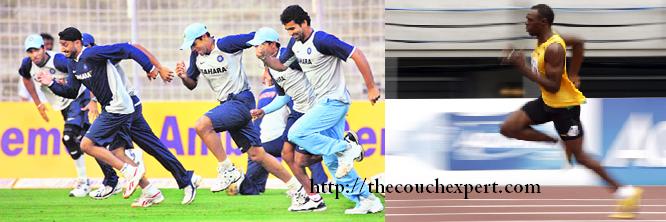
In an attempt to make India a fitter unit, BCCI has roped in the services of Usain Bolt as India’s running coach with immediate effect. Indians are expected to train with the world 100 meter record holder for a week in their quest to give them an added edge before they head to Australia for a 4-Test series. Talking of the appointment, K Srikkanth said, “Taking a leaf from Gavaskar’s famous commentary usage of converting ones into twos and twos to threes, Bolt will help team India convert each single into a three at least – and in some cases to a five or even a seven – and thereby helping our batsmen increase their scores three-fold!.”

Talking of his appointment, Bolt, who joined the team at Vishakapatnam, said, “The last day of the third Test at Wankhede had the whole island interested and I had a couple of friends wake me up at the dead of the night to catch the game when my phone rang. N Srinivasan was on the line and I told him the super slow motion pictures were outstanding and I congratulated the BCCI on the quality of their TV production when Srinivasan told me that it wasn’t super slow motion pictures I was seeing, but Ashwin running in full throttle!”

India train to sprint their way to success in Australia under the supervision of Usain Bolt

He added, “I couldn’t believe someone could actually sprint so slowly. When asked if I would help them fix the problem, I was skeptical. But when they dangled a 2 million dollar contract for a week’s training, I couldn’t resist. I asked Fletcher to send me tapes of their running training, and now I am here in India for a week to help them train.”

Of all Indians, Laxman and Ashwin seemed the most excited after their first training stint with Bolt this morning. Laxman said “I sprint the 100m in just a little under 44 seconds just behind Ashwin who does it in 41.43 seconds. Bolt has given us specific training routine that should ensure both Ashwin and I break the 40 second barrier by the end of the week. Finally, there is hope for us to look for the quick second run.”

Ashwin added, “He seemed to be able to point to the mistakes in my technique straight away. He could pin point to my technique that I seem to have followed from my childhood subconsciously – that of Rajnikanth running in slow motion in his high adrenaline fighting sequences. I am unlearning the technique and move towards the modern running method of complicated leg strengthening exercises that will give us enough power to our legs. Also the key is to ensure that the feet not being in contact with the ground for more than 0.2 seconds while in full sprint. Laxman and I, the smarties that we are, have already come-up with a formula that’ll help us get there. Expect us to run like the wind in Australia.”

Bolt is also introducing the sprint runners’ set block positioning for the non-striker while backing up. You will see the likes of Suresh Raina now crouched on one knee without the bat and both hands just behind the popping crease with his upper body in a 45 degree angle that the sprinters use to generate pace off the starting block. Bolt claims that Raina this way is able to run his twos in one-sixth of time he would take otherwise – in the traditional method. Bolt claims that this technique will ensure that there will not be many dot balls as it ensures players are quick enough to run a single even when the batsman lets go of a delivery to the keeper. He insisted that in places like Perth where the keeper tends to stand far back, Raina, Kohli and Dhoni would be able to run twos to the keeper and promised that we will see byes contributing more to team scores going forward. If the wicket-keeper is slightly slack, batsman might run a bye to him even off spinners!

Duncan Fletcher, the Indian coach said “Bolt’s insight into running and the transformation that is possible with his inputs is quite amazing. Even I have been able to move from one side of the ground to the other in less than 20 minutes now. Munaf Patel, Aashish Nehra now run quicker than they bowl. That was the easy part. We are now trying to translate this to field positions as well. The increased agility of the fielders will ensure that each fielder can now control two positions. Jadeja will now man both point and covers and Kohli mid-off and extra-cover, where as, Raina will cover the whole of the on-side and Dhoni alone now will cover for the keeper and three slips. Our not-so quicker fielders will stand on the boundary and strategize thereby giving us an unprecedented edge over all teams that have played cricket before us. Sehwag now can charge down to spinners and hit it almost off the bowlers’ hands as he is now that quick!”

With the whole of the nation very excited by this development, Bolt was convinced that India would start favourites in Australia this time. He signed off by saying, “India will run away with the cup in Australia. I think they should. If they did, don’t think there is anyone in Australia quick enough to chase them down. Let’s just hope they don’t assign the task to Laxman or Ashwin yet. They will get chased down for they are not quick enough just yet”


Prasad Moyarath

An Australian tour always provided an ultimate test of character for any cricketer and remained a tough frontier to conquer for any team. The pace and bounce of the Australian pitches combined with its bigger boundaries intimidated the batsmen from the subcontinent to such an extent that a big innings in Australia is epitomised as his ability to play quality fast bowling. Off-spinners struggling, fast bowlers bowling a wrong length, fielders struggling with their throw from the boundary, wicket-keepers fumbling are all common problems faced by the teams from the subcontinent in Australia. The Australian media are well known for their attack on opposition captain and almost all sub-continental teams have had some bitter experience in the past.

Yet another Australian tour is round the corner for the Indian cricket team. Indian selectors have announced a 17 member squad for the four test series which looks strong and well balanced in paper. But for any cricket connoisseur, this team does not inspire any confidence. Though this team has a set of talented youngsters and established stars, the way this team has been groomed as a unit and its preparation for this tough tour has raised the eyebrows of many. Having followed many Indian tours of Australia particularly the last two in 2003-04 and 2007-08, this team for me, does not look strong enough to conquer Australia even with their new look side.

Sreesanth and Harbhajan are known to get under the skin of the Aussies. They might be missed. © The Indian Express

India drew the series 1-1 in 2003-04 and lost 2-1 in 2007-08. Sehwag, Dravid, Tendulkar, Laxman and Zaheer who were part of those two tours are still there in this team. Dhoni toured Australia in 2007-08. Team with 6 experienced players should have an upper hand against a new look Australian squad. But a look at the performances of the 6 Indian experienced stars makes me jittery. Zaheer is coming out of an injury. Though Sehwag has scored a few half centuries after his come back, his performances have not been convincing. But Sehwag is unpredictable and can fire any time and India’s performance in Australia depends to a great extent on the innings he plays there. Dravid has been in great form and should continue his dream run in Australia. The whole nation is waiting for a century from Tendulkar and this expectation seems to affect the great master. Despite his big knocks in India, Tendulkar does not look to be in a good rhythm. Laxman has always produced some wonderful performances against Australians, but age seems to have caught up with him. His feet are not moving like in his younger days and with his slow reflexes, he can be a burden on the field in Australia. Dhoni has a dubious batting record outside the sub continent and his keeping has also not lived up to the expectations recently. Australians are well known for their meticulous planning and they are sure to exploit the above weaknesses of Indian stars.

It will be the first test series in Australia for Gambhir (though he impressed in the one-day series there back in 2008). Kohli is yet to cement his place in the test squad and his weakness against short pitched balls which became evident in West Indies will be exploited by Australians. He needs to display how he has rectified this short coming. Rahane and Rohit Sharma are yet to make their debut in test cricket and don’t expect to play any part in the test team unless any of the batsmen gets injured. Only one among the two spinners will play in 3 test matches except in Sydney. Praveen Kumar, Umesh Yadav and Varun Aaron will relish the conditions and it is up to them to make their presence felt. Saha will be a mere passenger unless Dhoni gets injured. India needs to play Umesh and Varun in all the test matches and knowing the leadership style of Dhoni, it looks a distant dream.

What is lacking in this “strong” team compared to the previous tours? To be honest, this Indian team lacks characters, those who have the guts to fight it out in the middle and those who can inspire others with their cameo. India will surely miss players like Saurav Ganguly, Sreesanth and Harbhajan. It is not that these players should be included in this squad, but this team lacks “something” which these players have which will help them fight against all odds.

What could have been done to improve India’s chances? The West Indian tour to India ahead of this Australian tour is a big blunder. The flat pitches here did not help the cause either. The Indian selectors and the team management never bothered to groom the players. Rohit Sharma was identified as a test batsman very late and the captain did not have the courage to play him in place of an established star even after winning the series. Same is the case with Rahane. The Indian selectors have still not identified the players to replace the 3 greats. They should have played Rahane and Rohit by resting Dravid, Tendulkar and Laxman in rotation. Now it is suicidal to blood these batsmen in trying conditions in Australia in case of a crisis. Parthiv Patel as a reserve keeper would have solved the batsmen’s injury worries considering his experience in Australia. Why the selectors don’t consider him as a batsman despite some crucial knocks against Brett Lee and Shoaib Akhtar is still a mystery. By denying a chance for Umesh Yadav and Varun Aaron to bowl in tandem in Mumbai, the Indian team management missed a golden opportunity to groom a new fast bowling pair. With a captain who wants the Indian test pitches to assist spinners from the first day onwards, this was not unexpected.

The years 2003 and 2007 left the Indian cricket lovers broken hearted due to the Boxing Day test matches in Melbourne. The year 2011 seems to end in the same note. Unless the Indian openers give a sound start and our team management gives up their defensive thinking and our new fast bowlers rip through the Australian batting line up, this Indian team don’t seem capable of presenting a happy 2012 to its fans. Good Luck Dhoni and team.


Chandrasekhar Jayaramakrishnan

It is clear from the summary of events over the last five days that the Wankhede wicket was not as much at fault as anything in bringing about the scale of the expectations surrounding Tendulkar’s milestone. Yours truly, for one, believed otherwise while witnessing a West Indian unit, with due respect, amass 591 runs. What followed was a non-verbal war between the accuser and the accused – the wicket spoke for itself, and so did the result.

The excesses of expectations throughout the cricketing fraternity have become a national problem. The media fails to see beyond the much awaited milestone, while commendable performances on the field by others have become sub-headlines to a more eye-catching, heart-on-sleeve title.  Every headline seems a verbose isomer of the other.

Hard not to associate the man with the number

The obsession with the milestone is understandable. It is easy to overstate the problem, but it is a lot easier to come to terms with the fact that it will happen, and that time will show us when and how. One would argue that it would have been befitting for the greatest batsman of the modern generation to have achieved this milestone in the same home ground in which his nation lifted the coveted World Cup – a ground in which he started playing as a young teenager.

But certainly, history would want to remember this milestone as one achieved under non-ideal conditions in an arena and environment that challenges the abilities of a batsman. Just like how Euclidean geometry had taught us as kids that the three angles of a triangle sum up to one hundred and eighty, the sport has continuously taught us that records and numbers do not matter if they don’t shape up for a team’s cause, under trying circumstances. There is a reason why his 114 as a young kid on a Perth wicket is remembered as one of his best innings of all time. A few others, like Anton Tchekov’s characters, at the end, have vanished into life.

That he has 99 centuries till date is a catalog of his virtues – and that he has sustained for over 22 years a tribute to his consistency. And that glaring countdown:  fully armed with preconceptions portrayed by the recalcitrant media and frenzy – a mark of disrespect to a man, who at times, has wielded more responsibility than the Prime Minister of a nation.  The game of cricket has challenged every champion in disproportionate measures – from the meager run bucket of Ricky Ponting this year to the branding of anything less than a Tendulkar hundred a failure. It is about one man’s recent past, and another’s future. And not to forget the Turbanator, who is going through a lean patch after being a fulcrum in the Indian attack for close to a decade.

As fans, every one of us has a role in mediating the mayhem that surrounds a player’s personal glory. A series victory down under would mean a lot more to Tendulkar than achieving his milestone. And it is important to remember, given the circumstances down under, that there may not be a better time to tour Australia with the hope of obtaining a result. And if both happen, well – what is left to say here? Life isn’t a movie script that one can write in advance.

After all, the inevitable day is just about adding another one to his monumental tally of tons, and not even remotely close to that day when Canadian sensors hope to detect microbial life in Mars. Why all this fuss then?


Goutham Chakravarthi

Cricket Australia’s decision to rotate players to ensure that there is a good pool of players available at any time to mitigate problems arising out of injuries, players falling out on issues of when to sing the team song and when to pop a beer. The new rotation policy looks beyond mere player rotation and looks at rotating most things associated with Australian cricket to give itself a wider pool to choose from.

It is learnt that Micky Arthur, the new Australian coach, wants the team to try a new team song this time. Under the Southern Cross I Stand, the traditional team song has resulted in at least one team member falling out with the current captain. He said, “In order to have better options, I have proposed the latest internet rage pa pa pa paen Kolaveri song to be our new team song. Already, the team is hooked to it and cannot wait to sing it as a team. The strict rule is of course that we can sing as a group only after we win games. With the team desperate to sing it all the time, you can expect them to demolish the Kiwis swiftly in the first Test and sing the song.”

The proverbial fat lady who sings has appealed to Cricket Australia that they cannot sing the song as she has obtained the rights of singing the song for all sports. The news was received with broken hearts in the Australian dressing room. Pat Cummins, the new pace sensation, tweeted “We are absolutely devastated. We so much wanted it to be our team song. Looks like the fat lady has sung! we’ll fight her in court for the rights on this song.”

Australian players to sport boxing gloves to give them the extra punch.

Among other rotations to be part of their plan this Australian summer will be the rotation of batting gloves. As mark of respect to the Boxing day, all Australians will sport boxing gloves while batting. Justin Langer who used to box as part of his preparation has justified the move saying that this will give his batsmen the added punch and a sense of additional security while facing the menacing Indian quicks like Praveen Kumar. Langer also pointed out that the benefits included shooing away of close-in fielders against spinners. He said, “We have been found short playing good spin recently. Now this gives an option for the batsman to skip down and punch the short-leg or silly-point fielders while pretending to play a punchy stroke.”

“Hockey sticks and baseball bats will also be used on freehits in ODIs and T20 games,” said selector Rod Marsh. He reasoned, “It both confuses the opposition and also makes our players more versatile. Should some of them not cut it as successful cricketers, they can fancy becoming hockey drag-flickers and fancy Major League Baseball aspirations. It is a win-win situation through and through.”

Kiwis to perform Haka during the toss to distract the Australians

John Buchanan, the former Australian coach and the current Director of Cricket for New Zealand expressed admiration for such theories. He said, “I’m finally beginning to believe that they have got a hang of what I was trying to achieve in my time with them. Still, they can look to rotate captains or have multiple ones. They do rotate their spinners either by plan or accident. But as part of the Kiwi set-up now, we are well prepared to face any challenges the new Australian management will throw at us. We have tricks of our own too that we look to put to practice.”

When asked for specifics, Buchanan explained, “We want to carry some of our practices from our recently crowned rugby champions. You will see Ross Taylor and boys performing the Haka before the toss for one. Am sure they might throw puches with their boxing gloves and all, but we tackle and scrum better. That way get into them even before the game begins. You will also see the young quickie Trent Boult taking the art of bowling to the next level. You will see him perform a couple of cartwheels in his run-up before he delivers. It gives him the leverage to release the ball at any point in his cartwheel which means his release point ranges from a maximum height of 14 feet to a minimum height of 3 feet. He might have a career in circus once his cricketing days are over. He is that good.”

It is also being speculated that there could be rotation policy for the selectors and spectators too. And also for retirements. Pat Cummins is expected to announce his one-day retirement first before Haddin retires from dancing down the wickets to quicks and Ponting from playing the hook shot. Written press releases are expected on these lines before Thursday from the players to show their commitment to this new initiative.