Archive for the ‘Opinion’ Category


Srivathsa Munirathnam

Before I begin this piece let me make one thing clear; I like the Dutch football team – in fact they are my second favorite after Spain and I just love watching them play. Any team that plays attractive football catches my eye and Holland have always done so. Also when a side plays such sublime and delightful football it is hard not to like them. Another reason why I root for them is their galaxy of stars which comprise of the likes of Arjen Robben, Wesley Sneijder, Rafael van der Vaart, Robin van Persie in the side and coached by Bert van Marwijk – who led them to the 2010 FIFA World Cup final. So it comes as a major disappointment and a shock to see such a talented side crash out of the 2012 UEFA Euro 2012 without a single win to their name. What went wrong to such a star-studded bunch? Why didn’t they perform as a group? The answers lie in the below mentioned paragraphs.

The Dutch have always been a mercurial and unpredictable side. On their day they can beat the best in the world and lose to the absolute minnows when things aren’t going to plan. In a way they can be compared to the Pakistan Cricket team – a similar bunch of talented individuals who have rarely done justice to their immense potential. In fact the Dutch side have a lot in common with the Pakistan side – both teams have match-winners but are driven by their huge egos which makes it impossible for them to gel as a team and get it right on a consistent basis. But one thing is assured when both of them play as a unit they are nigh impossible to stop.
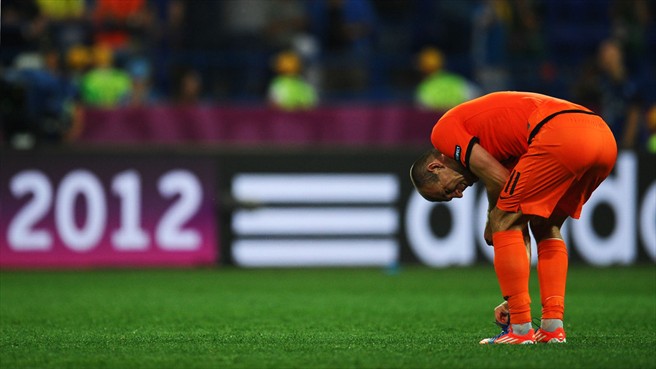
Arjen Robben reacts as Netherlands lose their first UEFA EURO 2012 Group B match ©Getty Images

Consider this line-up: two creative playmakers in Robben and Sneijder who can be compared to the likes of Xavi and Iniesta in terms of their playmaking skills. The English Premier League’s player of the year in van Persie who is one of the best strikers in the world and who has built a fearsome reputation with Arsenal. Then you have the likes of van der Vaart – another talented mid-fielder and complemented by the likes of Ibrahim Afellay, who plays for Barcelona and Klaas-Jan Huntelaar who had a brilliant season with Schalke. Stekelenburg in goal is another top goalie and you have the perfect recipe for a successful side. But in a team sport such as football it is not always the most talented side that ends up winning, but the most co-ordinated one.

Bert van Marwijk’s bizzare selections cost the Dutch:

van Marwijk came into the tournament as one of the best in the world and by the time the tournament was done his reputation had taken a beating. He made some bizzare tactical decisions which eventually cost the Dutch. Some of his moves included starting with a defensive mid-fielder like van Bommel in place of a more attacking minded van der Vaart proved costly. In the opening game against Denmark Marwijk started with Afellay on the left hand side who failed to create any sort of impression.

Perhaps Marwijk’s biggest mistake was to play van Persie behind the lone striker, van Persie, was a mere shadow of his former self playing out of position and proved to the biggest disappointment of the competition. RVP as he is called, likes to play alone as a lone striker and has done so with deadly effect for Arsenal. What made Marwijk to play him like Messi? When RVP has two creative playmakers in Sneijder and Robben to feed him one-on-one balls why wasn’t he allowed to play alone? RVP proved so inefficient in the game against Portugal that he was almost playing as a defensive mid-fielder trying to set up Huntelaar and was even back defending when his side needed.

Also the decision to play Huntelaar and Afellay certainly lacked any logic and the results were there to see. In fact Huntelaar was almost a non-entity in the game against Portugal and had only one shot on target – which came when the game was almost over. Also the move to start with van Bommel who clearly is past his prime angered Van der Vaart and by the time Marwijk realised his folly the Dutch were staring at elimination.

Another big decision that Marwijk took was to blood the 18 year old Jetro Willems at left back – incidentally the youngest ever player to play in the European Championships . Willems was like a rabbit caught under the head-lights and made blunder after blunder. In the game against Germany he was caught out of position repeatedly and his inexperience on the biggest stage showed. Why did Marwijk go in with such a rookie into such a big tournament? Even if he did why did he play him when there were far more experienced personnel on hand. Clearly this was one decision that backfired badly and by the end of the Portugal game the Dutch defence was in shambles.

Marwijk failed to control the dissensions in the Dutch camp which allowed things to go out of hand. When Robben was substituted in the second game against Germany he went the other way and jumped over the hoardings to show his displeasure. Agreed that the Dutch are a difficult side to manage with such an array of stars but Marwijk’s man-management skills left a lot to be desired. Is it the end of the road for him? Most certainly yes would be the answer.

Disunity and disharmony cost the Dutch big time:

Any side which has superstars often are difficult to deal with. Their big egos need a lot of careful managing. The Dutch side’s failure to win a big tournament apart from the ’88 European Championships can be attributed to one thing – lack of team unity. In fact some of the Dutch side openly accept the fact that they all are not friends with each other. But once you step on the field the common goal is to perform as a team which the Dutch failed to do so.

Reportedly Van der Vaart was unhappy that he was sidelined in favor of van Bommel and was the one who started it all. One can never be sure how much truth was there in those rumors but the Dutch certainly didn’t play as a team. This quote from van Persie sums it up – ‘when he plays for Arsenal, all the others play for him whereas the reverse is true when he dons the Oranje strip.’ The sight of Robben not passing the ball when his team-mates were in a favorable position doesn’t speak highly of the skilled winger. Robben wasn’t the only one, even Afellay was guilty of selfish play in the game against Denmark which surprised one and all as Afellay plays for Barcelona – a side whose primary goal is unselfish play and who teach their wards to pass the ball and not go for personal glory.
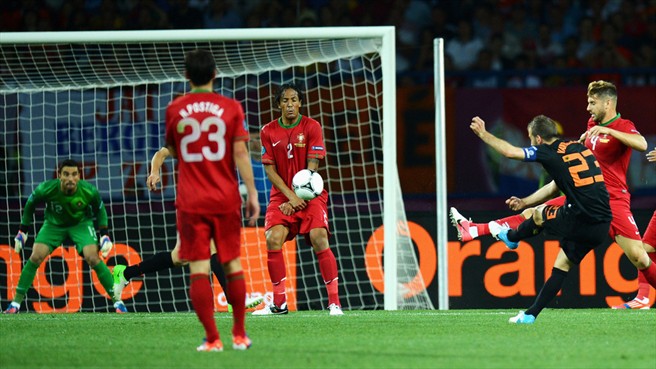
Rafael van der Vaart scored a wonderful opening goal against Portugal but the Dutch still went on to lose 2-1. ©Getty Images

When players like Robben don’t fall in line with the team ethos then there is little a team can achieve. In fact it was quite perplexing to see the majority of the Dutch players aiming for personal glory when a simple pass to the unmarked striker could’ve produced a goal. What does this prove? That no matter how talented a team is, if it doesn’t play as a team then there is only one way it can go and that is go downhill.

Failure of the big stars proved to be the end for the Dutch:

If van Persie was a huge disappointment, then the much hyped Robben and Huntelaar were a complete disaster. Robben who is known as the ‘selfish Dutch’ for his penchant to go for personal glory unmindful of the team’s needs barely managed to create any sort of impression. Either he hung on to the ball too long or dribbled unnecessarily without delivering his killer crosses. And his act after being substituted in the Germany game was a disgrace. Robben may be one of the best wingers on the right hand side but his showing in this tournament was nothing short of mediocre.

Another huge disappointment was van Persie. Having come into the tournament on the back of an award winning season with Arsenal, much was expected of the big man. But he rarely touched those heights as he failed to lift his game. Maybe he was tired after a long season with the Gunners or he was played terribly out of position, but still he did his reputation no good with two ordinary efforts against Denmark and Portugal. The same RVP who would bury chances with Arsenal was now fluffing simple one-on-ones with the keeper. His failure to put away at least three golden chances against Denmark proved to be the final nail in the coffin for his side.

With one of the best sides gone out of the tournament – they were in fact rated third best to win the tournament after Spain and Germany – it remains to be seen when this talented bunch can finally do justice to their talent. But one positive to come out of this disaster is that all the aforementioned players are more or less in the same age bracket (25-28) and two years down the line they have another chance to redeem themselves at the 2014 FIFA World Cup. Will they do so? As the cliche goes – only time will tell.

Niranjan K

By the time you read this, IPL’s relevance would have been long gone. And its only 3 days since the great Indian circus got over. Ever wonder why IPL is losing popularity? It is because of the controversies that when it’s over, people gasp with a ‘Finally!’. So, movie channels can now shift their premier movies to their original prime time of 9pm. New programs are launched in various channels. People start reading books again. We don’t have to endure Navjot Singh Sidhu and an array of stupid presenters in MAX who sell products rather than call the match. (I wonder how IPL will look like if ESPN broadcasts it with Harsha as the host).

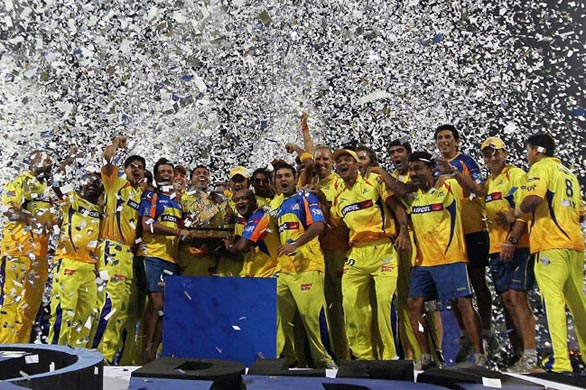
IPL has a new champion in KKR and deservedly so. In fact the four teams that made it to the playoffs took their rightful place. I know a lot of you will go bonkers that CSK didn’t deserve to be there. True CSK had a lukewarm season in their standards but then none of the 5 eliminated teams grabbed their chances did they? KKR and Delhi looked like finalists from the first weekend. In the business end, one team choked and the other kept its resolve. MI were their usual underachievers self while CSK showed in the end why they are a champion side, brushing aside MI and DD in the playoffs with such disdain. I can hear a lot of “fixing” groans already. Let’s debate it in the end and keep Cricket first shall we?

The question doesn’t seem to have a conclusive answers

The Kolkata Knight Riders had but one agenda when they started the campaign. Win it. It is not like other teams did not but they had that resolve about them. DD were lazy at times I thought, just like their captain. KKR flourished with a captain who was all out to prove, both about his leadership and his team’s capability. Sunil Narine was their trump card while Kallis and Balaji contributed immensely. But if Gambhir struggles then KKR will struggle big time. That they won despite Yusuf Pathan woeful form tells something. Mumbai Indians faltered to deceive while CSK didn’t really set the tournament ablaze like how they were supposed to. They were poor by their own standards (except fielding that is) and didn’t really deserve the hat-trick.

But the real questions lay outside the cricket ground. That IPL needed controversies to improve RATINGS is a shame on the game itself. Initially, IPL was driven by the frenzy of cricket madness. With 5 seasons behind, there is still not a single defining rivalry in IPL. CSK-RCB has the potential but will take years to reach where a Liverpool-Manchester United rivalry is now. Both neighboring cities and both have beaten each other in crunch games, though CSK is ahead in the rivalry. But when are we going to see an El Classico types? That improves ratings, not some SRK bullshit. Ever consider why people don’t talk about IPL weeks after it’s gone like the Ashes or an Indo-Australia series? I guess the onus for this soon-will-be failure of IPL has to be put on both the organizers and the people. The organizers are happy with providing what people want rather than what they should have. And people are dumb enough to care about gossips. Is it because more women watch cricket these days? Just kidding!

Now the whole “fixing” game… With so much money involved and that too in India, it is so much easy to connect the dots to match fixing. Sure one can’t refute it. But people tend to get over emotional about the whole fixing part. See the thing with high octane matches is, you can really have a plan. So if it is about a bowler bowing low full tosses and it turns out to be a yorker, where is your planning there? The best thing about cricket is its unpredictability, even for the players. And people talk about how CSK got into the finals despite being out of form. They point to the fact that Chepauk is the venue for the final and a “crowd“ is needed at the ground. CSK played their first qualifier in Bangalore and the stadium was full, filled three quarters with yellow. Last year I watched the 2nd qualifier and the final at Chepauk. The 2nd qualifier between MI and RCB was watched by over 30000 people and the ground was buzzing for Gayle and Sachin. So I don’t see the stadium-full theory as convincing from people who are quick to post “IPL is fixed”.

Here’s my point. If IPL is fixed, then logically the players are the cheaters. Those include the likes of Dravid, Ganguly (Who famously lead India with distinction after the match fixing era), Hussey, Steyn, Kallis, Fleming and a certain Mr. Sachin Tendulkar. Are these great players, cheaters in their country colors too?  N Srinivasan heads the most influential cricketing board in the world whose country won the World Cup last year. So the ones who are quick to brandish him as a fixer, are they ready to say that him and Sharath Pawar scripted the World Cup win for India? There is only so much in sport that is run by the brain. Mostly it is the heart and instinct that fuels the players in that less-than-a-second time to react to a ball. Can’t cheat that can we?


Niranjan K

There is a lot of bullshitting about the Chennai Super Kings over how they make it to the playoffs every season. N Srinivasan scripts all of CSK’s wins from his bathroom, politics, blah blah blah. While there is no denying that the IPL is full of controversy, why is that CSK always paraded as the team to hate just because they are so good? Now, I am from the same state but that’s not the reason why I like the CSK.

So for all those who hate CSK, read this if you have any idea how a premier league has to be played. For those who love CSK, here are tem seasons to know why.

CSK: Giants of the IPL

1. CSK is the only team to embrace the concept of a domestic league in the right way. There is a very CHENNAI flavor in every aspect of CSK. The ‘Whistle Podu’ theme belongs to Chennai. Isn’t there one flavor that you can connect to a Mumbai or a Kolkatta or a Jaipur? Do Punjabis really need Priety Zinta to dance for them..?

2. CSK is the only team to have embraced the concept of a club properly. Faf Du Plessis was an unknown when CSK signed him 2 years ago. Now he’s our leading scorer. That’s what successful EPL teams to. That’s what we do.

3. The dressing room of CSK is widely known as the happiest of all if IPL teams. The pranks, the way newcomers are made comfortable is a mark of great teams.

4. When CSK plays and a batsman hits a four, they don’t have to show Shah Rukh Khan clapping, when a six is hit, they don’t have to show the Shetty sisters hugging or when a batsman gets out they don’t have to show Priety Zinta cussing and discussing strategy with the coach. It’s strictly the players and the fans and that’s how it should be. The lesser the distractions, the better the team.

5. After the recent incident involving Shah Rukh Khan at the Wankhede Stadium, Juhi Chawla was quoted as saying “If today Shah Rukh Khan were to get upset and quit the IPL I wonder if there’d be any people watching the matches… in Wankhede or any stadium.” Seriously, if Wankhede comes to watch Shah Rukh Khan rather than Sachin’s batting, then God save cricket.

6. Despite the dash of IPL, Chennai still and will remain the most knowledgeable of all crowds in India. That’s a mark of fans who will remain loyal to CSK all life. If you think about it you will understand what I am saying. Remember, Sachin was booed once in Mumbai. That will never happen to any cricketer in Chennai (Except Virat Kohli when he plays for RCB)

7. As a team, CSK is not dependent on one player like how RCB have in Gayle and Kolkatta in Gambir. Every time we find some player finishing it in tight situations. Morkel, Bravo, Dhoni, it’s a finishing line up to dream.

8. One of the most important factors is how well the local lads and generally the Indian players have played for us. Vijay, Badri, Anirudha, Ashwin and Balaji have all won games for us. Name one team that has so many local lads in their team and doing well. Add to that Raina and Dhoni. So the over dependence on overseas players is negated in CSK.

9. Harsha Bhogle tweeted this after the last season win he said “Eventually the best team, the best organized, the best selected and the best led won the IPL and that is how it should be”. Need anything more to say.

10. Actually, there is one more thing to say… “We are the Bloody Champs”! Distracters talk about N Srinivasan’s role in the team and his influence as the BCCI’s big fish. Let me clarify. His India Cements Company is involved with cricket for 60 years now. They are responsible for bringing up players like Rahul Dravid. So here’s the thing… N Srinivasan is the president of the most powerful cricket board in the world. Would you credit every Indian Win as his script?

The truth is CSK, even for IPL’s short history has to go through these phases like how great teams go through. Barcelona is constantly accused of diving despite the beautiful football they play. The Australian Cricket Team was accused of too much sledging when they dominated world cricket. But didn’t they change the way cricket was played? Like those great teams, we will endure and play the way like only we can and whistle the way like only we can. Go CSK Go..!


Chandrasekhar Jayaramakrishnan

In some way, this is a narrative of a crisis foretold. The Fenway Sports Group claims to have made its decision based on ‘footballing reasons’, contrasting to those made by Hodgson as to the exclusion of Rio Ferdinand from the England squad. They’ve decided to take matters to their own hands for the problem, as obvious as it is in prospect now, is that Liverpool, presently, lacks some of the key attributes that other successful clubs have.

Primarily, FSG needs to address the central problem of the 2011-12 season debacles: a handful of players had cost so much money that they should not be allowed to fail, lest the perennial problems will sustain – lack of goals, and lack of imagination. A few pessimists, half way through the season, had already begun lamenting that the owners weren’t bolder – that a club like Liverpool simply couldn’t afford to wait and watch.

What makes FSG’s emphasis even more compelling is that it is part of a vision that draws on their (ill-fated) experience in managing the Boston Red Sox – a team that finds itself several rungs below where it once was. They didn’t even make it to the playoffs last time around – as one journalist had put it: ‘a far greater failure than Liverpool’s inability to make it to the Champions League.’

Happier Days: John Henry’s belief that Dalglish would turn around things didn’t work out as expected.  © NewsRT

Under Kenny’s leadership, FSG did have belief that a turn-around was possible, for disappointments are common in football. Disasters are the ones that are rare, and during a time when the club seemed to be heading for a feared collision course, it was commendable for a club legend like Kenny, who’d had nothing more to prove, to step up and assist a club he loved. Although, in hindsight, to finish eight in the league, and below arch rivals Everton, is disastrous.

The hard-liners often invoke the troubles facing heavy-price-tagged signings being the root cause behind Kenny’s downfall. Even back then, no one in their right senses would’ve paid an amount so high to acquire the services of Andy Carroll, Jordan Henderson and, to an extent, Stewart Downing (although he was voted Aston Villa’s player of the season and looked every bit as exciting as wingers the club had never had). Their episodes of improvement towards the end of the season weren’t enough to undo the damage from the initial slump, and it ultimately cost their manager his job, albeit the owners stating that even a Cup Double wouldn’t have changed their minds.

I’m not totally sure that the FSG’s new theme would shake up things at Anfield, but certainly this is the closest that any owner has come to sacking a club legend in order to diagnose the real problems at the heart of Liverpool’s performances. Kenny is to Liverpool what Tendulkar is to the Indians, and not to forget that no rational path forward has been proposed yet.

The pool of candidates being short-listed for the job don’t exactly send shivers down your spine – with the exception of Pep Guardiola, but this would be addressed if we prefix the word ‘candidates’ with ‘realistic’. A few theorists mention Villas-Boas as a top contender, and argue that the blemish on his CV (spelt Chelsea) is more due to the impatience of his ex-Russian boss.

Are they looking at me? AVB would love the opportunity to set his credentials right in the EPL.  © TheFootballReviews

Sure, AVB would find company in the form of Jamie Carragher if he chose to fly in football’s cerebral stratosphere. But given his proclaimed track-record on being a micro manager, he’s likely to fall out of favor with most – unless he’s mended his mentality over the un-opted sabbatical. His methods are believed to be so relentless (and rigid) that it might prove too heavy a dosage for those who’re getting used to seeing the newer teams play successful, attacking football. Players might agree to his theories, but they’re not likely to buy them.

The owners are also believed to be flirting with the thoughts of approaching managers lesser known outside the BPL fan following base: Martinez, Rodgers and Lambert – in that very order. AVB’s Chelsea stint, in itself, had dispelled the case for a young, talented (and inexperienced) manager to be thrown into a gauntlet of fire and expectations. Although, in fairness to the Portuguese, his case proliferates the notion that no one would’ve stood a chance against Roman and his over-optimistic ambitions.

Coming back to the case of three managers under the microscope, it isn’t rocket science to understand and admit that they’ve had their sides carrying more payload than they can handle. Which is good because no one would hate to see new / lesser-known sides do well against the Goliaths – remember FC Rubin Kazan doing a ‘David’ against the mighty Barcelona?

But an awful truth that became apparent when Liverpool had appointed Roy Hodgson as manager a couple of seasons ago was that one simply couldn’t bank on the results they’ve amassed with lesser teams. Roy, current England boss, has built a reputation of being one who can make lesser mortals push above their own weights – something English fans would hope that he does at the Euros.

Surely, the FSG wouldn’t be willing to take a risk along these lines – especially at the aftermath of sacking a legend. Like how the EU is a byword for failed economic policies these days, a post-Roy era still sees the club suffering from slow growth, if not decline. In simple words, the club has already conducted a dress-rehearsal for a crisis that would persist if such a move were to be made again. The worst part is that such a tenet would seem so unfair on these three managers, whose true potential to handle such enormous expectations we will never know unless such a step is taken.

It is a near certainty that the restructured management must have names that would partially, if not entirely, overshadow the Dalglish episode. And that the new manager must bring in, and instill, a philosophy that preaches attacking, attractive football. Kenny, incidentally, was quoted a number of times saying that Liverpool were pleasing to the eye, but darn unlucky with the woodwork, among others. The real challenge is that there isn’t too much money to spend for the new boss, and some of the existing players don’t look a bunch that promises fluid football.

The limited transfer kitty needs to be used to address three primary areas of concern: a poacher, a tricky winger, and a creative central midfielder. Not too long ago, Liverpool were in possession of players that had addressed two of these three areas – Torres and Xabi Alonso. Albert Riera was a good winger, but never world class. The real challenge today, however, is to attract names purely on the basis of Liverpool FC being a brand, for the club doesn’t promise Champions League football for potential targets.

Such a fate would’ve been considered unthinkable, for the same reasons that we thought for Greece leaving the Euro being impossible. But when you’ve ruled out everything else, few options are left.

Taking Guard In Style

Posted: May 11, 2012 by binisajan in Cricket, IPL, Opinion
Tags: , , ,

Bini Sathyan

Some of the big hitters of the game whom I admire very much have peculiar styles when they come out to bat. A few of them I felt really peculiar are Chris Gayle who I think comes in like the Predator, Morne Morkel who always looks lost, Virender Sehwag who gives the impressions of a lazy goose and Dhoni who is emotionless. Read on.

Chris Gayle: When he comes out to bat with the helmet on, the locks hanging from behind his ears and the black bandana shielding his neck, he looks like the alien from Predator in full body armour. Moves around sluggishly as if unbothered about the territory he is in and has a cold stare. The bat looks like a small club like weapon attached to his left hand whenever he is in armour. He looks menacing. Before taking guard, he will look around sluggishly once again as if to find a target. Then just like his cold looks and slow movement, he will start tapping his bat in slow motion which means he is ready. Now he fixes his stare on the bowler running in. Once the ball is delivered, his hands move so swiftly and the ball is hit so hard with the bat that it more often than not lands in the stands and sometimes attains escape velocity. He launches his attacks with such ferocity that bowlers start erring in line and length. It is immaterial where the ball lands on the pitch as Gayle ensures that it lands in the stands after that.

Gayle: The predator

Albie Morkel: A 6 foot plus giant, he strides into the middle unassumingly and in no hurry and looks like a child lost in the forest. Looks around in surprise, as if he was suddenly awakened in the middle of his sleep and finds himself in hostile territory. Looks around once again and realizes that he is in the middle of a cricket ground. Takes guard but still looks surprised. Prods at the first couple of balls and then suddenly understanding dawns. The next ball probably lands in the stands. He is probably the most powerful hitter around. Some of his sixes have hit the roof and threatens to go overboard.

Virender Sehwag: The laziest goose around. The man with the most laidback attitude. His body shape and movements will never reveal that he is a sportsperson. Comes out to the middle in a very casual way. And in the middle, he simply refuses to leave the crease for a run. And when he does, his running looks funny. You realize that he simply does not love moving around too much. Left to face the bowler, he takes his stance in an easy manner and waits and waits like a cat for the ball to be released. Then all of a sudden there is transformation. His eyes widen. The bat swings in his hand. It’s all over in a flash. The ball vanishes in thin air and reappears outside the field. Fetch is the call to the fielder. All this while his feet doesn’t move. To know what happened, the television crew invented slow motion replay. He is a magician. A man gifted with such perfect timing. He relies only on his eyesight. Once his eyes spot the ball, his brain knows where to despatch it. The hand just executes the order. No coaches will prescribe to their scribes to learn from him because he does not follow the copy book. But has written one for himself.

The TV crew inveted slow motion to study Sehwag’s stroke-play

M S Dhoni: He seems to be a man in a hurry. Comes out to bat in a hurry. Before taking guard, looks around, keeps moving and exhibits plenty of gestures. He touches his pads, hits his gloves, touches his face and the motions continue for a while before he settles down to face the bowler. This peculiar action sequence is repeated before every ball. He is a slow starter to bat. But once he gets going there is no stopping him. The speed at which he moves the bat and the power which he garners when he hits is matched by none. He remains unfazed when he comes out to bat whatever the situation. Out in the middle he expresses no emotions. If he hits the winning runs, still the emotions are hidden. And when he is out, he still seems to be a man in a hurry. He walks quickly back to the pavilion again without revealing any emotion.