Author Archive

Preview Edgbaston: Perspective England

Posted: August 9, 2011 by thecognitivenomad in Cricket, India in England 2011
Tags: , ,

 Chandrasekhar Jayarama Krishnan

Head of Cricket, CouchExpert

9 August 2011

We have just received reports from various reliable sources in England that Andrew Strauss and Andy Flower do not plan to pay a visit to the Indian dressing room ahead of the toss at Edgbaston tomorrow. This means, it is entirely at Dhoni’s liberty to call either side of the coin as it is flipped on Wednesday.

In what would turn out to be a crucial call, as that coin is flipped in the air, adjacent to a wicket which is believed to posses grass with a density comparable to that of the rest of the field, Strauss would probably hope to get this one right. He has called the right shots so far this series, probably barring the Bell incident, and he might hope to get his side of the coin right, a lone facet that blemishes what otherwise has been a dream run for Strauss & co.

The media, and public, obsession surrounding the Trent Bridge controversies – a subset of which majorly includes the recall of Ian Bell and debates over the DRS – must recede in interest if the focus needs to be shifted to two very good games of cricket that are left in this series. Messrs Nasser Hussain and Ravi Shastri have certainly had enough time to polish their high-minded credentials.

The recall of Ian Bell, and perennial discussions over the spirit of the game turned out to be the cricketing world’s classic media bang-sizzle. But cricket goes on, conveniently at the moment.

And England enter this arena with a wicket which, in the past, spat venom poisonous enough to dock points of Warwickshire due to its poor and relentless nature when a few batsmen from opponents Worcestershire hobbled of injured,  their sky-high confidence will hope to wound the Indians’ morale. After all, they are just one win away from reaching pole position in the ICC Test Rankings, a metric that has recently undergone a lot of shuffle in other categories.
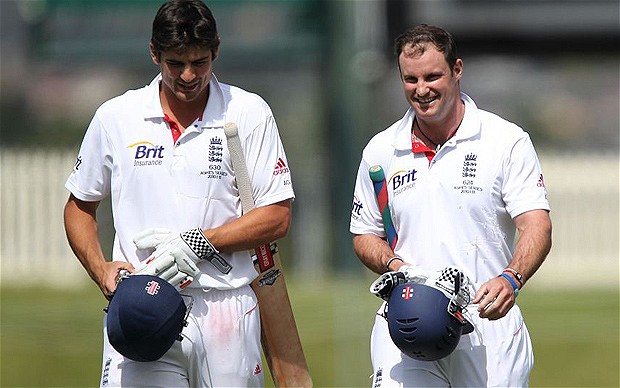
The batting forms of Cook & Strauss are still of major concern to England

The only worry for England would be the form of their openers, one that hasn’t changed since the last time I wrote a preview for a game this series. Cook has probably worked with Graham Gooch harder than he’s ever done before, even if it meant running with six bricks, and Strauss might have consulted Andy Flower for reasons other than visiting the dressing rooms of their opponents. But there is no hiding the fact that England’s concerns largely linger around the starts required from their southpaws at the top of the order.

The absence of Jonathon Trott, due to an injury he picked up during the test at Nottingham, witnesses the return of Ravi Bopara who has been in wilderness since his debacle of an Ashes back in 2009. His decision to snub an offer from the IPL, one for which he received lavish media attention and praise, seemed decisively incomplete when Morgan got the nod of him ahead of the Sri Lanka series.

Bopara’s return appeared to be unthinkable when one gauged the forms of Trott and Bell in the middle order, but with Morgan being the long standing target of test match temperament, there was always going to be an opportunity for Bopara to pounce at.

Bopara returns after a two year wilderness following a poor 2009 Ashes

That he replaces Trott now, due to injury, is not how the script would have seemed. Bell’s form will mean that he will slot in at three, and Bopara will likely play at 5, ahead of Morgan. Bopara’s medium paced seamers, additionally, are bound to come in handy on a green wicket.

England’s dominance in this series owes largely to their pace bowlers and the lower order batting. The wicket-keeping/batting department is one that expands the bridge between England and India, a reflection of the Indian skipper’s poor run of form both from behind, and in front of the wickets. And Matt Prior’s brilliance.

Additionally, the performance of Tim Bresnan, who slotted in for the injured Chris Tremlett, made many wonder why he wasn’t in England’s scheme of a playing XI selection at Lord’s. England’s tryst with replacement players shining instantaneously is one that they have carried since their Ashes victory down under.

On what beckons to be a decisive test match, one that would topple the charts at the top of the rankings, England will enter Birmingham with intent to kill, while India will look to strike back to protect their position at the top. India’s share of injury problems might give England the upper hand, but to assume that this test would be a walkover might be crudely misleading.

The prevailing view is that England will not withdraw and recline on a 2-0 lead. A 3-0 lead might tempt England to try their next generation of wannabe superstars – the pack being lead by Leicestershire’s young batsman James Taylor, and Durham’s all-rounder Ben Stokes. Unlike a lot of the other teams, the world hasn’t seen young English talent in the international arena. This presents as an opportunity to sort that out, and could well be playing in Andy Flower’s mind of late.

If that is a prospect appealing enough, their pacers should continue to hold the key that can unlock the trove to hand them the Number One status.  Their batting should continue to post enough runs to ensure that the bowlers have a sufficient margin of safety.

But hopefully, what shouldn’t continue are talks over what happened at Trent Bridge.
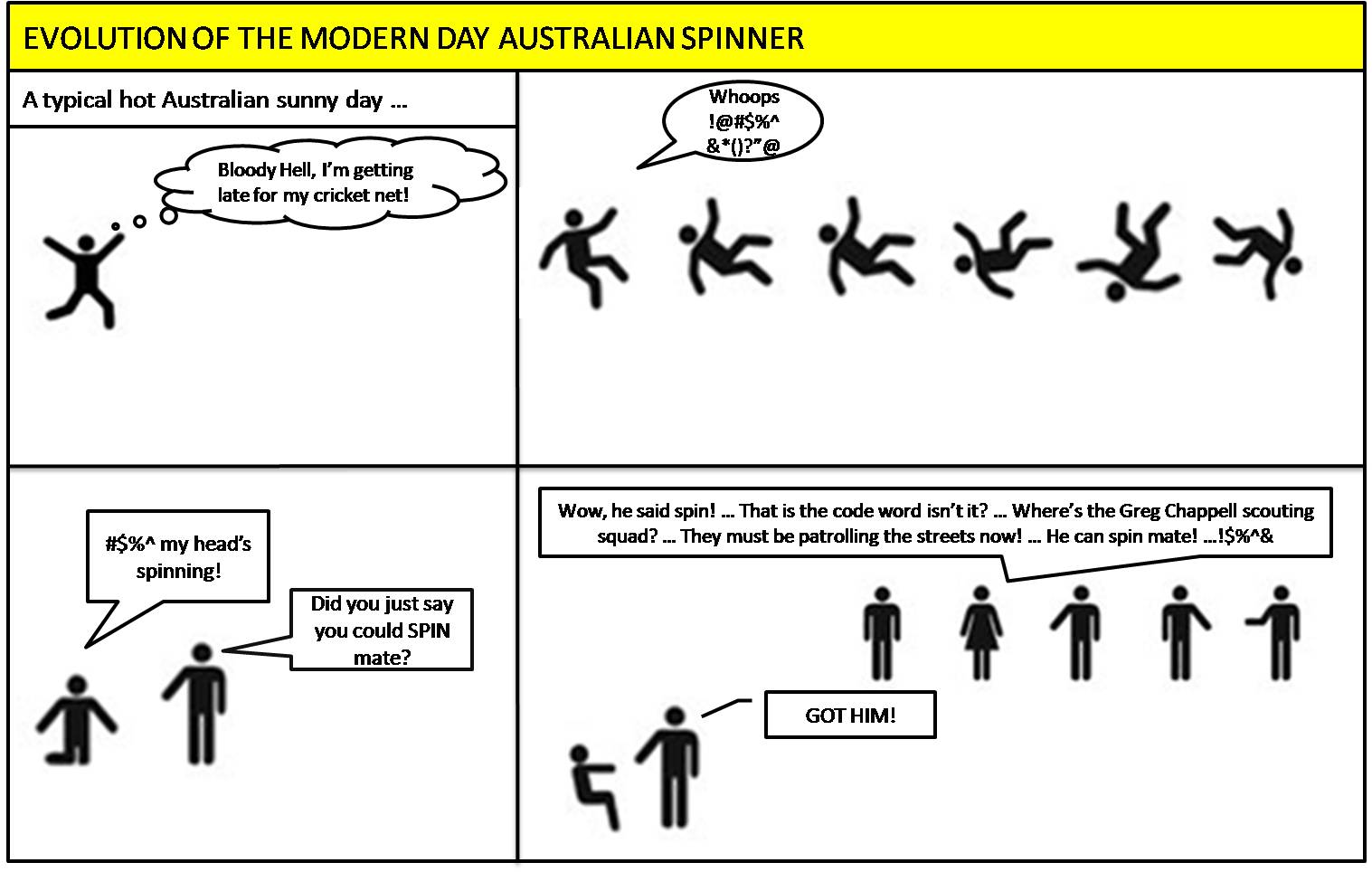
Got a flair for Sketching? Think no more …

Posted: August 4, 2011 by thecognitivenomad in Cartoons
Tags: ,

Chandrasekhar Jayarama Krishnan

Head of Cricket, CouchExpert

4 August 2011

CouchExpert welcomes contributions from those who’ve got a flair for sketching. Even an image from your scribbling pad would do – as long as the idea is conveyed!

Also, if you have played a game of book cricket, don’t hesitate to publish your scores. The XI you’ve chosen becomes your opinion, and the scores they’ve made … well … their fate.

Project Shane: Hunt for the New Kid with the Golden Arm

Don’t forget The CouchExpert’s Golden Rule: You don’t have to be good, you just have to possess an opinion of your own!

NOTE:  The sample caricature is to exhibit the current abysmal standards of the existing caricaturist within (your’s truly). Hope this propels someone to oust me from this section for good!


Chandrasekhar Jayarama Krishnan

Head of Cricket, CouchExpert

1 August 2011


During times when an Indian fan walks along that thin line which separates faith from hope, most often observed when the team isn’t doing well as it is capable of, the common fan’s sword and the journalist’s pen come together to diminish that metonymic adage of the pen being mightier than the sword.

Much of it emanates from the status of virtual invincibility India had attained after topping the ICC Rankings in Test Cricket, only to be followed by the euphoria of being crowned World Champions. In a continent where today’s superstars run the risk of being relegated to the status of forgotten heroes if they fail, sometimes even if just once, immortality would appear an easier wish to attain than consistency. The packed schedules do not favour either.

And along this thin line, the Indian fans started their walk on Day 4 of the Trent Bridge test when they were left to rue with harsh memories of momentum and advantage escaping their grips, at various instances during this test, to hand England a clear sight of victory within the horizon.

In a test where Dhoni’s tradition of shrewd leadership seemed subdued, the scars left by Bell, Prior and Bresnan, by the time England’s second innings came to an end were painful, and India’s morale, gaunt. The Indian skipper’s faith enabled him to appreciate the bowlers who attempted to make the most of the conditions, but it didn’t force him to lay a trap to dismantle the English batting cheaply, even when he’d possessed the upper hand at times.

Bresnan's outstanding all round contribution has given the English selectors a pleasant headache ahead of the 3rd test at Birmingham

This clearly is at the heart of what is disturbing about an Indian fan’s faith at this moment of predicament: it doesn’t worry him enough; neither does it drive him to have second thoughts before lamenting over the captain’s lack of ideas when the England tail wagged once again, as he watched Bresnan and Broad scoring at a rate of more than 6 an over. Third man, once again, bore the greater share of the Wagon Wheel.

Talks of India having to restrict England to a score not in excess of 300, prior to the start of their second innings, seemed imminently laughable as the lead stretched to 477 – leaving India five sessions to battle through. A more than decent outfit was made to look hapless by England’s lower order batting.

Tim Bresnan was unlucky to miss out on a deserved hundred, but he did enough to place the English selectors in a spot of bother as they were left pondering over the moves to be made once Tremlett returns for the third test.

When the Indians came out to bat, it looked as though they were batting in a different wicket to the one in which the third innings of the match had come to a conclusion. Batting through five sessions was never going to be an option and the result clearly seemed to have only one way about it.

Excepting Tendulkar, none of the Indian top seven crossed single digits. At no point of time during this test did the Indians look like a champion outfit – barring the session on Day One where Dravid and Laxman negotiated through tricky spells of seam bowling.

Bresnan’s breezing spell that fetched him four wickets (and the selectors, additional aspirins – for the good) in his total of a five-for was complemented by Anderson removing his man, Tendulkar, yet again, for 56. Like MS Dhoni earlier, Tendulkar shouldered arms to one that nicked back in and was ruled out leg before.

Local hero Broad picked up the Man of the Match after amassing 108 runs and 8 wickets

The ruthlessness of the Englishmen resembled that of Nottingham’s popular folk figure, Robin Hood, while the Indian unit was made to resemble the deceitful sheriff, almost as though the visitors had stolen the sport’s supremacy from the land of its founders. Man-of-the-Match Stuart Broad, whose looks bear more resemblance to Maid Marian than the legendary outlaw, contributed both with bat and ball to lead the yeomen’s charge in conquering Trent Bridge. Bounce and seam, instead of bows and arrows, helped England take an unassailable 2-0 lead.

India’s reconstruction will be as symbolically important as Duncan Fletcher’s role in reshaping a side that probably hasn’t been on morale as low as what it is experiencing now. But the margin of victory – both an exact and significant barometer of English dominance – will linger in their minds for a long time to come.

As for England, the opportunity to top the ICC Test Rankings is a mere win away. Who’d have thought a couple of years ago that this would be a likely proposition? Even among the most optimistic of optimists, this would have seemed a far-fetched ambition, having witnessed what English cricket had been through.

Well done England, you deserve to be 2-0 ahead.


Chandrasekhar Jayarama Krishnan

Head of Cricket, CouchExpert

1 August 2011


The DRS debate has puffed up beyond any imaginable extent, as has the credibility of Umpire Marias Erasmus’ decision making.

It wouldn’t have been a very big deal without the deepening impact of controversies that have arisen during this wonderful Nottingham Test. But it also has ballast as this test clearly has exposed many a flaw associated to the DRS – not least helped by the twitter rant, thanks to Michael Vaughan, whose statement, cheeky as the intent might have been, only added ammunition to a Test that has virtually witnessed anything and everything that a game of cricket possibly can.

I am not saying Vaughan was stupid. His statement was so staggeringly incurious that it appeared as though he rarely made an effort to find the truth of the matter. But more often, that is not how the public, and more specifically the Media, takes it.  Goutham Chakravarthi’s recent article will clearly explain how such an incident can be blown out of proportion.

Vaughan should have known well before hand that his comments would obviously be blown out of proportion

Vaughan’s statement misleads not only the cricket public, but him included. He could well believe that by portraying an image of himself as a considerate conservative, he could exercise the right of every opinion he publicizes, if found controversial, to be disemboweled by those who adore him – a reflection that has been characterized by his heroics back in 2005.

But England can no longer afford their ex-captain’s self-delusions, not least when their quest to top the ICC tables is at its most intense. But what Vaughan has done, knowingly or unknowingly, is to add more fuel to the debate involving the consistency and correctness of technology.  The situation is a mess, in large part because the common man now knows that a cricketer can hoodwink technology to make the tide turn his way.

As much damage Vaseline had done to cricket balls in the past, Vaughan’s theory of the same substance being used in bats to dodge hot-spot has ignited the sparks in those criminal minds of today’s bad world. So for every decision that looks contentious, different sections of the media and public will end up accusing players from the home and/or the away team for ‘cheating’.

Fingers will be pointed at many, endless debates over what is right and wrong will persist, only for the poor old game of cricket to react to all these soulless exercises with disdainful apathy. After all, how much chaos can a sport consume?

What if only one individual was responsible for a contentious decision? What if he was paid to decide what is right and what is wrong? What if was his role to decide whether a batsman is in or out? I am, of course, talking about the Umpire. This is how the sport has been played for over a century.

If his decision was incorrect, fingers will be pointed towards him. The debates will revolve around whether this individual needs time off from the stressful activities and schedules one tends to associate with umpires these days. What Dravid negotiated on a spiteful pitch, with his immense powers of concentration, is what Umpires are expected to do through five whole days – one that translates to a mammoth 30 hours.

They are there because they are the best in the business. You hit some, you miss a few, or you nick one to the keeper or the slips – even if your concentration is unflappable. Likewise, you make mistakes – you may think someone nicked it, or you might have missed an inside edge that could unfortunately rule a batsman out LBW. You do it because you are human, and unlike technology, people cannot outwit you – for a human being is not programmed.

But you are there among the elite because in a sample set of 100 decisions you make, in over 90 instances, you are right. If you are not good, you are demoted and someone with a better consistency rises. But like a cricketer who has been dropped from the squad, you can go back to your roots, work on areas where you feel you require improvement, and come back as a mentally tough umpire targeting better statistics. Asad Rauf is having an unbelievably outstanding series!

Marais Erasmus raised a lot of eyebrows with a few of his decisions during the on-going Trentbridge Test

Indeed, there is a strange karmic genius to this argument – one can rather trust a human over a machine, for one doesn’t know who has programmed that machine. But machines, or rather technology, can be used for verification – instances that require quantifying the degree of an Umpire’s decision-making correctness, one that is done behind the scenes.

I’m okay for the use of technology in the sport, as long as people do not question the motives of those who can overcome it. For every Antivirus, there exists an Anti-Antivirus-Virus. Nothing is perfect, and as long as we learn to accept that, the sport will move ahead with more conviction. Else, the perpetuity of the endless debates will continue until that inevitable day when mankind would end up regretting excess reliance on technology for even the most basic of tasks in life.

Marais Erasmus – yes, you have made blunders. Yes, you have had a very ordinary test. Yes, you are dubiously referred to as the ‘Not-Out’ umpire, but we respect you because of what you’ve achieved to get to where you are today. Technology will make you look silly at times, but doesn’t it do that to all of us?


Chandrasekhar Jayarama Krishnan

Head of Cricket, CouchExpert

30 July 2011


Dravid’s love affair with the Battle of Survival ascends when the original rationale for the contest between bat and ball – with the additional threat of a Trent Bridge turf war – intensifies. On a wicket that contained enough juice to make even a top batsman’s plight ignominious, Dravid’s approach towards every ball was reminiscent of a gallant soldier’s focus while guarding the borders of an endangered nation.

On a day of engaging Test cricket – involving a world class ton from Dravid, a spell of devastating consequence from Stuart Broad, dropped catches and an Umpiring blunder – it almost made the common fan wonder why five day cricket is still a topic of morose sentiment.

The script couldn’t have been written better: the world’s most technically equipped batsman fighting under the most testing of English conditions, a local hero picking up six that included a scintillating hat trick, and Kevin Pietersen dropping Yuvraj Singh at gully when the latter was on 4. And the third session of play demonstrating cricket’s own version of a Domino Effect.

The Wall’s 34th test ton, equalling the record of the greats Brian Lara and Sunil Gavaskar, adds to his tally of an inert century as an opener, a position that he doesn’t enjoy batting in, yet one which he takes up for the team’s cause. Memories of his purple patch during the tour back in 2002 flooded through the gates of Trent Bridge like a tsunami, commemorating the achievement of this batsman who has faced the maximum number of balls in Test cricket.

Intelligent cricket is often about respecting the conditions, especially for a batsman on conditions like these. Dravid’s willingness to leave and defend under cloud cover on Day One was equally matched by the intent to put the loose deliveries away on a relatively sunny second day – both being offsets of an outstanding technique and immense concentration.

Not to forget VVS Laxman’s contribution in ensuring that his veritable partner was in the right frame of mind to build this valuable innings. If the last fifteen overs of Day One was a lesson on survival, the good news from the middle on first session of Day Two was what the Indians had been touting for, almost entirely due to the excellent complementing efforts of Dravid and Laxman.

Dravid's 117 at Trentbridge will rank alongside his feats at Headingley, Adelaide and Rawalpindi

If Hogwarts School of Wichcraft & Wizardry taught cricketing magic, Laxman’s batting is one which would be invoked by a verbal spell that would read Gracio.  Such was the fluency of this master batsman that it allowed Rahul Dravid, at the other end, to play the game that naturally comes to him.

This new force seemed to transcend traditional Nottingham culture of seam and swing. Both these batsmen emphasized strong responses in difficult situations, using experience and role playing. Even the cruelest of Dementors would have found it impossible to suck these happy memories from an ardent cricket fan – such was their exhibition of batsmanship!

This display is something the current young crop of Indian cricketers must think about if they want to leave a distinctive mark on the sport, inspire a new generation of cricketers and succeed in the largest arena of Test cricket.

It was a shame to see Laxman getting out the way he did – a delivery that he certainly wouldn’t have poked at in the previous evening. While statistics would say that Laxman’s average record in English conditions persisted, the criticality of the knock – one that cannot be quantified – was as immense as any innings one would associate with the stylish Hyderabadi.

England’s bowling included sporadic spells of brilliance from Anderson and Bresnan, who supported a more consistent Broad in their quest to dig through the Indian middle order. Graeme Swann, predictably, with a bandaged left hand and unsuitable conditions for spin, had a day to forget with Yuvraj, back into the Indian test team after a long duration, targeting him in particular. The Indian southpaw’s valuable contribution, ably supporting the solid Dravid, certainly puts him contention for another berth in the starting XI for the subsequent tests.

The Indian lower order batting, once again, failed with the display appearing to be almost criminal, when compared to the value that Dravid put on his wicket. The Indian captain’s dismissal, especially, will evoke a lot of wrath from the fans.

Broad’s hat trick, which included the Indian captain, Harbhajan Singh and Praveen Kumar as victims, did not materialize without its own share of controversy. The Indian team’s reluctance to move with a fully fledged DRS back-fired as a Harbhajan Singh inside edge on to his pads went unnoticed by the umpire Marias Erasmus, who adjudged the batsman incorrectly, not for the first time this game, out LBW.

The local boy's hat trick was the first of its kind at Trentbrige

Nevertheless, Broad’s final tally of six wickets painted an image of a man who shared no resemblance with the one who was being victimized by the media prior to the start of this series. His contribution with the bat, as demonstrated at the Lords and the first innings at Trentbridge, did plenty to add to his credentials of portraying himself as a genuine all rounder.

Dravid would have had every right to be disgusted with the batting display of the lower order when he Bresnan had him caught at third-man in an attempt to search for runs, having been left with the tail. In hindsight, a lead of 59, after Dravid’s marathon display, should leave scars of remorse amongst those who didn’t apply their minds as they rightly should have.

With England commencing their second innings, the sport proved that it has a funny way of biting you as a player – as Broad’s presence ascended, the form of the Ashes hero Cook exponentially descended. After surviving a close LBW shout to Ishant Sharma, Cook was the first English batsman to be dismissed when a leading edge flew to Yuvraj at backward point. The law of averages, much to Cook’s dismay, applied itself on the England opener.

The course of this Test could well be decided on Day 3, especially with the injury of England’s talisman batsman Trott, and the fact that he’ll no longer play a part in this test.

But Day Two’s contribution to Test Match cricket will be those vivid images and memories of Rahul Sharath Dravid, battling through a hit on his wrist and later, cramps, to conjure one of the greatest innings of all time. What a champion!