Posts Tagged ‘Virender Sehwag’


Prasad Moyarath

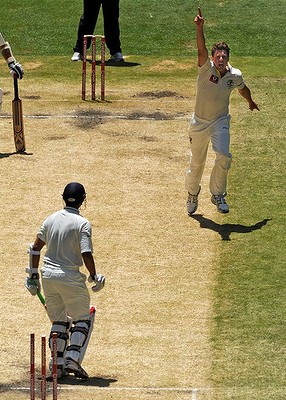
The MCG pitch was the best thing about this Test. Photo: Sebastian Costanzo

Yet another Boxing Day Test debacle for India or another usual Indian start for an overseas tour. The Boxing Day Test match result can be interpreted by an Indian fan in either way but irrespective of the result, this Test match between India and Australia provided a great advertisement for Test cricket. Though this match lacked the usual intensity of an India – Australia duel and finished in four days, the entertainment it provided was worth for any Indian who woke up early morning in this chilling winter to watch it on television. The Test match which started on a cloudy day with a few rain interruptions on the first day proceeded in bright sunshine leaving a doubt whether the rain Gods were sitting and watching with awe.

Not a single century scored, only a single five wicket haul, what was that made this Test match so special? For those who did not follow this match, its scorecard won’t provide the right answer either.

Going into the Boxing Day Test match, concerns were many for both the teams. The career of Ponting and Hussey hung in balance and they were contemplating playing Christian in place of one of the two. Hilfenhaus was making a come back and Cowan making his debut. For India, the fitness of Zaheer and Ishant was the major concern and so was the ability of their batsmen to adapt to the Australian conditions.

Michael Clarke’s decision to bat first on a cloudy day though raised the eye brows of many, considering the poor batting record of India in Melbourne, was a daring one which was vindicated in the coming days. Warner gave an explosive start to the Australian innings but an incisive spell of fast bowling by Umesh Yadav helped India fight back. Ponting despite been hit on the helmet by Yadav at the start, made his critics eat their words with a fluent innings which was cut short by a Yadav’s beauty. Two dubious umpiring decisions against Cowan and Hussey ignited the debate on UDRS and BCCI once again. Ponting and Hussey proved that they are still good enough to play for Australia with some fine batting in the second innings. Australian tail wagged in both innings, thanks to some unimaginative captaincy from Dhoni. Hilfenhaus made a remarkable comeback was well supported by Pattinson and Siddle.

Sehwag played in his own style in both the innings and luck favoured him only in the first. Australian bowlers never looked like bowling in the right areas on the second day and Sehwag, Dravid and Sachin capitalised on it. Sachin was the only batsman who looked comfortable in both the innings. Dravid getting bowled in both the innings has put a question mark on the technique of this great player. Gambhir and Dhoni continued their poor run outside the subcontinent and Ashwin made Harbhajan’s absence inconspicuous. Indian pace attack put relentless pressure on the Australian batsmen and Ishant and Umesh clocking 140+kmph consistently was a delight to watch.

Three of the four days ended like a television serial leaving the viewers to ponder what next. Scores of both teams in each innings drew a slanting graph line putting a question mark on the quality of the pitch. But for those who watched this Test match on a drop in pitch, the curator was the Man of the Match ahead of the official choice.

  Bini Sathyan

If Australia had declared yesterday at end of play and put India to bat in the first session today, the match would have ended in 30 overs. It is a shame we could not bat out 50 overs. Except Sachin, no batsman in the Indian camp looked good. Sachin did not seem to have any major problems and looked very solid in both the innings. It really looks like his century could happen in Australia.

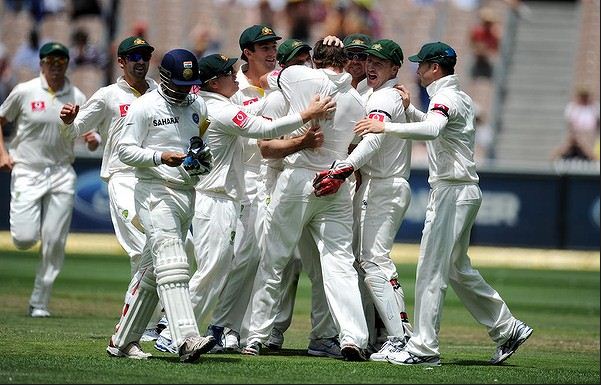
It was all too familiar when the Indian batting surrendered meekly to register their 5th straight away loss. Photo: Pat Scala.

Sehwag was his usual self – he lived and died by the sword. But the other opener, Gambhir seems to be a misfit in the Australian pitches. Either he is not learning from his mistakes or the Indian team coach is not interested in him. He got out in similar fashion to different bowlers in both the innings. Unless he can resist the temptation of sticking out the blade at an angle in the last moment to an away swinging ball, he might not get to play a long innings in this tour. Rahul Dravid did frustrate the bowlers to an extent but did not look comfortable during his stay in both innings. Kohli has got a taste of the Australian pitches, but he being a quick learner, we can expect more from him. Dhoni tried to attack but seemed out of sorts. He is yet to come good in such conditions.The sooner things improve in the batting department, the better for the Indian team.

The bowling that was considered India’s weakness looked promising with Zaheer leading the attack. Umesh and Ishant looked very good. They were just unlucky that they did not get more wickets. Ashwin promised a lot but was unable to deliver in the 2nd innings. He is turning out to be a an all rounder.

What experts considered as the inexperienced bowling attack of Australia easily got the better of the the most experienced batting line up in the world. They seemed to have done their homework very well and had a plan for every batsman. Though it did not work for Sachin, they easily got the better of him by using plan B which was to stop his flow by denying him the strike.

Siddle, Pattinson, Hilfenhaus all looked menacing. If India does not learn from the mistakes and improve, this bowling attack will push them further down the ranking ladder. Pontings determined comeback will only augur well for Australia in this series. Mr. Cricket, Hussey, as usual played his role to perfection. He led the fight back along with ponting. They have found a good anchor in Cowan who before the series was planning to watch the matches from the stands and instead got to watch it from the inside circle.

Warner is a destructive batsman like Sehwag and he almost got going in the 1st innings. But India was lucky that he tried to do too much. With Marsh and Clarke subdued by the Indian bowling, Australia was held back from a big score. But this was not enough to hold them back from winning the Boxing day test and take a 1-0 lead in the series. India’s hope lies in the fact that they have bounced back many times in the past from the initial shocks.


Goutham Chakravarthi

Teams were beaten even before they set their foot on these shores over the last two decades. Bowlers targeted batsmen and former players and media targetted the captain. Crowds were one sided, and invariably, so were the contests on the field. Insofar, this tour has been anything but that.

Two days into the series, the talk has largely revolved around DRS in the Aussie press. No talk to players and ex-players targetting opposition. Even newbies like Kohli and Yadav are left alone. If anything, a scathing attack was made on the pace of Ed Cowan’s batting in the first innings. Mental disintegration on and off the field that was the norm is now missing. It is a fair reflection of the times. It is still a marquee series, but it is still a battle between a side arresting its downward slide and another that is trying to rebuild to reclaim the top spot. It will be fought to the end, but the winner will not be crowned the champion as it was the case for much of the last decade.

Sehwag and Tendulkar scored aggressive half centuries in India's strong reply to Australia's 333.

Sehwag and Tendulkar scored aggressive half centuries in India's strong reply to Australia's 333.

Like Australia’s faded aura, cricket vocabulary seems anything but right with regards to its bowling. Words like attack, guile and spell sat well with the writers and bowlers of the past, but it chokes your throat to say that when you see Hussey and Warner as part of a bowling unit.  It was touted as much a battle of the young Australian quicks high on velocity and potential against an ageing yet formidable batting side. By lunch on day two, a determined lower order had taken the Australian tally to 333. The wicket had considerably quicked, and notably there was less happening off the wicket. But, good carry and enough movement off the wicket promised a lot in store for the remainder of the day.

Ivan Lendl was among the first to play mind games. He didn’t do it by targeting his opponent through the media space, but used his well-toned physique and the locker room to carry out the task. He would walking around the locker room doing skips stark naked. With Sehwag, there is no fear of such physical intimidation. But with bat in hand, he is designed to destroy bowlers. He is the barometer of courage for bowlers. He plays his game, and often with a smile. May be, Pattinson will not second that after his altercation with Sehwag. But India got what it wanted out of Sehwag – a quick and positive start for Dravid and Tendulkar to build on. Sehwag’s was a chancy innings, but promised more good in the remainder of the series.

The innings of the Test so far came from Tendulkar. With immense brouhaha surrounding his hundreth 100, he played with freedom and decorated the MCG with spectacular strokeplay. He was rarely in any trouble and put on a show. A repeat of his 2007-08 showing with the bat might well pull the series in India’s favour this time, but that is a discussion for later. The MCG crowd gave him a rousing reception and he didn’t let them down. With the day drawing to a close and a partner suffering with cramps, he closed shop early only to be bowled by the fiery Siddle who was the sole hope in a largely flat performance by the Australian bowlers. India will sleep comfortably in the knowledge that Dravid is still unbeaten, even if luckily so.

Both batting units have put up a good show thus far and the wicket has flattened out. It promises to be good for batting for another two days. But given the recent history of both batting units that is skewed towards more than the occasional batting collapse, there is still plenty to look forward to in the Test.


Goutham Chakravarthi

Numbers

India have more than held their own against Australia since 1995 when Australia became the numero uno side in the world. Since then, India is the only team with a positive Win/Loss ratio of 1.2 (12 wins, 10 losses in 28 matches) against Australia among all Test nations with England a distant second with a Win/Loss ratio of 0.56 (13 wins, 23 losses in 44 matches). India has not only played on equal terms over these years, but are the only team to have consistently competed with Australia through the last 17 years, both home and away.

Team Matches Won Lost Tied Draw W/L Ratio
England 44 13 23 0 8 0.56
India 28 12 10 0 6 1.2
South Africa 26 6 17 0 3 0.35
West Indies 31 6 22 0 3 0.27
Pakistan 20 2 16 0 2 0.12
New Zealand 20 1 14 0 5 0.07
Sri Lanka 16 1 10 0 5 0.1
Bangladesh 4 0 4 0 0 0
Zimbabwe 3 0 3 0 0 0

Table: All teams vs Australia (home and away) since 1 January 1995

Stats can only tell you so much. In this case, it quite clearly tells you that India have done well over Australia in this time. But only 2 of those 12 victories have come in Australia (2 wins, 6 losses in 11 matches) giving India a W/L ratio of 0.33 behind England whose W/L ratio stands at 0.42 (6 wins, 14 losses in 23 matches with 3 of those victories coming in the last series).  Restricting the performance in Australia to the last 11 years, you see that India have competed almost on an even keel with a W/L ratio of 0.66 (2 wins, 3 losses in 8 matches), with England second best with 0.4 (4 wins, 10 losses in 15 matches)

Team

Matches

Won

Lost

Tied

Draw

W/L Ratio

England

15

4

10

0

1

0.4

India

8

2

3

0

3

0.66

South Africa

9

2

6

0

1

0.33

New Zealand

9

1

5

0

3

0.2

Bangladesh

2

0

2

0

0

0

Pakistan

6

0

6

0

0

0

Sri Lanka

4

0

3

0

1

0

West Indies

7

0

6

0

1

0

Zimbabwe

2

0

2

0

0

0

Table: Teams in Australia since 1 January 2001

Indians have also racked up the highest score (705/7 dec) in this period and their team scores more runs per wicket (37.07), almost 5.25 runs more than the next best team, England (31.85).

Battle of the weakness

Even taking into consideration India’s no show in England earlier in the year, its batting continues to be its strong suit. Stats above show that they have done well in Australia in the last 10 years, and, largely, its top performers over these years are still part of the team – Sehwag, Tendulkar, Laxman and Dravid. This series proves to be the battle of the weakness that’ll largely determine the outcome of the series: India’s bowling vs. Australian batting.

Spicy wickets might give India its best chance of a series victory. ©AFP

India’s ability to take 20 wickets will determine how the series might pan out. So, green wickets might prove to India’s best chance of winning. Durban, Leeds, Perth and Cape Town victories were built on favourable bowling conditions. Indians will back their experienced batsmen to put one over the sporadic Australian batting should it boil down to that.

Favourites

Not since 1978 have India come into a series in Australia as favourites. This time they are favourites only slightly, but not overwhelmingly so. Australia’s depth in pace reserves gives it renewed optimism to put one across the very experienced Indian batting side. The freshness in the attack will also be the factor Indians will look to exploit. Sehwag’s first knock of the tour might be crucial for the outcome of the series. And should India keep the Australians on the field for a day and half, it might break the Australian backs pretty quickly.

Injuries

Injuries to bowlers might well decide the fate of the series. Zaheer Khan and Ishant Sharma are crucial to India’s chances and both come in to the series with dodgy ankles. Zaheer has some cricket under his belt, but it remains to be seen if he will last the course. Ishant’s fitness and form will be crucial given the impact he has playing Australia, especially Ponting and Clarke.

It is difficult to see Ishant and Zaheer playing all four tests. Spicy wickets and a fit Zaheer and Ishant are India’s best chance of winning this series.

Prediction

2-1 India


Prasad Moyarath

“Cricket is a game of glorious uncertainties” is a mantra repeated umpteen times by cricket commentators. These uncertainties of the game have grown manifold and have invaded the minds of the followers of the game and a cricket connoisseur’s tussle to solve these intricacies has dragged the game into excel spreadsheets and statistical calculations. The statistics involving cricket has grown into such a huge volume which can now be glorified to be among the biggest statistical data pertaining to a sport in the world. These statistics can not only be used to glorify some average cricketers but also be used to cast doubts on the credentials of some established ones. This article raises question marks on the two established stars of Indian cricket not only based on statistics but also on the commonly applied yardsticks in international cricket.

India's success in England in 2006 was built on the opening partnership of Jaffer and Karthik. Both are out of favour with the selectors today. ©The Hindu

International cricket is all about matches in various parts of the world and the stalwarts of the game are those who prove their worth irrespective of the playing conditions in various parts of the world. Test cricket is always considered as the ultimate test of character and ability for any cricketer and a match winning performance away from home conditions always draws the biggest accolades from cricket aficionados. Rating the real worth of a cricketer’s performance has become a task nowadays and adulated coverage by the media complicates it further.

Inconsistent selection policies plagued by nepotism and incompetence have made the career of Indian cricketers vulnerable to public opinion which are most often devoid of sound statistics and influenced mainly by the first impression created. Indian selection has plummeted to such a level that for a player to bloom, he should be selected at the right time and this right time is always his luck factor.

What is this luck factor in Indian cricket? It is undoubtedly a series of matches in the subcontinent for a batsman or a spinner and a series of matches outside the subcontinent for a fast bowler. A new player is always under scanner, more in Test matches than in ODIs and a few good performances in ODIs seem to protect this player from the scanner and there lies the folly. Vijay and Abhinav Mukund lost their places in Test team due to them not playing ODIs and Suresh Raina and Yuvraj got an extended run in Tests due to their ODI performances. This luck factor is something which is prevalent in any career and it has been globally accepted that the luck always favors the brave. But this luck factor is proving to be a bane in Indian cricket and the careers of two stars of the current team will reveal how this luck factor enabled them escape the initial expert scrutiny.

A Test opener’s technique is an important point of debate and scrutiny for former openers turned commentators like Gavaskar, Boycott and Arun lal during any overseas tour. S. S. Das, Vikram Rathore, S. Ramesh, Aakash Chopra and W. Jaffer were some of the players who failed to live up to the standards set for a test opener by these gentlemen. Despite all these standards, the search for a Test opening pair for India ended in two unconventional batsmen viz. Sehwag and Gambhir. How did Gambhir cement his place as an opener when some conventional openers like Chopra and Jaffer failed? Here is where statistics come handy. The answer is simple, the timing of their entry into international cricket.

Jaffer played 31 Test matches between 2000 and 2008 and 18 of them were outside the subcontinent and 5 of his first 10 tests were in West Indies and England. Don’t forget that West Indies had a better attack in 2002. Aakash Chopra played only 10 Test matches but 4 out of them were in Australia and 2 in Pakistan. He did well in Australia but went out of favor due to his slow batting. Gambhir has played 44 Test matches so far but has played only 10 matches outside the subcontinent. Out of his first 10 Test matches only 2 were outside the subcontinent and that too in Zimbabwe. And to add to these statistics, he was the only player who played ODIs continuously for India. His attacking batting combined with better understanding with his Delhi team mate Sehwag was an added advantage. Though Gambhir has played a lot of Test matches, he is yet to prove his credentials in trying conditions outside the subcontinent. He still continues to be in the team despite not scoring a century in 29 innings in 16 Tests since January 2010. Abhinav Mukund who was tried in West Indies and England has now been discarded despite his decent show and now with Ajinkya Rahane in the team, he is set to become another opener who made his entry at the wrong time. Why different yardsticks for different players?

After Nayan Mongia became a dubious character in Indian cricket, the selectors search for a wicket keeper batsman ended with M. S. Dhoni. Vijay Dahiya, Sameer Dighe, M. S. K. Prasad, Deep Das Gupta, Ajay Ratra, Parthiv Patel and D. Karthik were dropped either due to their poor keeping or poor batting or some unknown reasons. It was Kumble’s bowling more than their poor keeping that led to the downfall of Parthiv and Karthik as keeping to Kumble in Indian conditions was a tough task for a new comer. Dhoni did better and was persisted more because of the frustration of the selectors in not finding a better solution than Dhoni’s ability. Dhoni’s attacking batting in ODIs helped him escape the scrutiny of the so called experts behind the microphone. Dhoni too has fumbled with gloves like the others and his batting outside the subcontinent in Test matches is still unproved. The partisan attitude towards Dhoni is evident even in commentary when the BCCI sponsored commentators say “He almost fumbled” when Parthiv clutches on to a catch by his fingers, but keep quiet when Dhoni does the same. None of the above keepers got a continued run in ODIs like Dhoni. Dhoni has played 23 of his 64 Tests outside the subcontinent and is yet to score a Test century. All his 5 Test centuries have come in the subcontinent. If the same yardsticks applied to the other keepers were applied to Dhoni, I doubt whether he would have continued in the Test team.

Statistics clearly prove that Indian selectors apply different yardsticks while persisting with players for key positions in the Test team. Test cricket needs specialist players and ODIs should not become the gateway for the players to Test cricket.