Posts Tagged ‘Rafael Nadal’


Rajat jain

Head of Tennis, The CouchExpert

20 August 2011


“Not a shot from the back of the court that he doesn’t have.” Patrick McEnroe said this about Novak Djokovic just-like-that today, but I suddenly realized how much truth it carried. The lack of any weakness from the back of court, in addition to his incredible defense and supreme movement, makes it virtually impossible for any player, including Federer and Nadal, to trade ground strokes with Novak.

Djokovic came from a set down to beat Monfils in a thrilling contest

Of course, it took a while for the world No. 1 to get into that mode where he becomes impossible to play. Partly because he was down mentally—he just seemed uninterested to compete for the first half of the match—and partly because Monfils knew only a vintage Pete Sampras can compete against Djokovic. Monfils tried to take out the baseline out of the equation as early in any rally as possible. He followed almost all his first serves to the net, tried chipping and charging even when he was a standing duck to Djokovic’s passes, and hit flat, clean, winners from the baseline.

Vintage Monfils. The Monfils we know can come out some times. The Monfils we wish will come out every time.

His quality of the volleys would have even made Sampras, if not Edberg, proud and combined with Djokovic’s lack of mental focus, it seemed it would be the first time since Montreal Masters, 2009, when Federer, Nadal and Djokovic would lose on the same day.

However, this was another one of those matches in which Djokovic reaped the advantages of being …. Novak Djokovic. The world No. 1. Out of nowhere, and I don’t know why, Monfils started trading groundies with the Djoker—the very thing he had avoided till then. He waited for Djokovic’s errors—which didn’t come—and traded two brutal rallies, both exceeding thirty shots. After the second one, he lost his breath, just like it happened to Tsonga and Fish in Montreal, and looked completely out of the match after that. It also gave the necessary impetus to Djokovic to get back his mental focus.

After winning the second of those brutal rallies, he faced the crowd, open chested, with both arms flexed forward and roared loudly. The lion had woken up again, and just came out of his den. And the wolf was panting heavily, waiting to be preyed by the king of the jungle. Djokovic played it easy after that, slowly killing and enjoying the prey, rather than finishing it off in a hurry.

This match further proved his credentials as the top player and why I feel he is going to stay here for some time. Throughout this tournament, I felt Djokovic lacked the physical and mental energy to play at his inhuman level. And it is understandable given how hard he has played, and won, so far. However, it just took him two points to get back his focus. Once the match ended, he let out another roar towards his camp, and sprinted towards the net to complete the formalities. And this is what champions do. This is what they are known for. Djokovic is back in this tournament, and means business. For him, that means going all the way and winning the tournament.

Rajat jain

Head of Tennis, The CouchExpert

15 August 2011


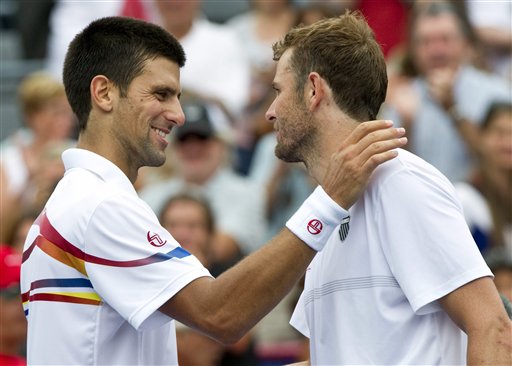
Is this how predictable the Men’s field has become these days? Yes. Was there any real contender for Montreal Masters apart from Novak Djokovic? No. Nine titles, two majors, five masters and a solitary loss against 51 wins, only 18 sets lost against 122 won; these are numbers that even Roger Federer was not able to conjure up in his glory days of ’05 and ’06.

Novak Djokovic defeated Mardy Fish to win his fifth straight Masters title of the year

Novak Djokovic defeated Mardy Fish to win his fifth straight Masters title of the year

Djokovic is playing like a much improved version of Andre Agassi. The same punisher’s attitude, moving his opponents from side to side and wearing them out. Of course, with a much better first serve, and supremely better movement. In his semis and final against Tsonga and Fish respectively, at a point when the matches were even (4-4 in the first set in the semis, and the opening game of the third set), Djokovic launched his famous assault. He played, and won, a brutal 27 shot rally against Tsonga, and a 33 shot rally Fish. Both players couldn’t continue at the same high level thereafter. The only weakness—if it is indeed a weakness—in Djokovic’s game currently, is that he has managed to lose at least one set in each of his nine titles this year.

Djokovic’s victory was the only predictable event that happened in Montreal. Rafael Nadal bowed out in his opening round, so did Andy Murray. Federer himself could only win a single match before bowing out spectacularly to Tsonga in a match that provided a lot of moments for the highlights. These losses further strengthened the fact that the outrageous consistency at the top is good for the game. If some opponent is to beat these top guys, they have to play out of their skin for three hours—and that means great tennis on offer.

Jo Wilfried Tsonga—the underachiever—has been on a different level after the grass court season started, and he looked in ominous touch in this tournament too. Perhaps breaking up with his coach has given him the license to play tennis in the way he wants to play: good, first strike, aggressive tennis with lots of athleticism and flair. Federer may be the artist, Nadal may be relentless, and Djokovic may be the punisher, but it’s hard to find anybody who pleases and works up the crowd more than Tsonga.

If the Frenchman is slowly starting to live up to his enormous potential—he will be back in the top ten from Monday, Mardy Fish is continuing to surprise us with his success, and making further claims that he deserves to be American’s top baller and a top ten player. If his consistency and fitness shot him into the top-ten last year, it is his intelligent mix of aggression and patience that was paramount to his run here at Montreal. It is not merely that he is serving and volleying every now and then, or approaching the net at the first opportunity that has been enjoyable to watch. It is the fact that he is starting to think like a pure serve and volleyer.

Throughout the tournament, he has shown great variety on serves. An ace down the T is followed by a kick serve off wide, or by a medium paced serve on the body. His opponent is constantly kept honest, which invariable has led to weak replies. Even his volleys are reminiscent of the serve-volley players of the 90s as he constantly throws down punch volleys deep into the mid court to rob his opponent any chance of angles—even for Djokovic. At one point, he had to throw three straight punch volleys at Djokovic, but lack of an angle resulted in a weak reply from Djokovic eventually, as Fish punched it for a winner. Fish has made three straight finals now, and is definitely one of the contenders for the semifinal spot at Arthur Ashe three weeks from now.

Amidst all these success stories, it will be easy to forget the failures of Rafa and Andy. Is this the start of the decline of Nadal, or is this is psychological effect of losing five straight finals to Djokovic? I remember the Rafa of 2008 or 2010 always had the edge once the match went the distance. Yet, Rafa has already lost two matches this year in a third-set tie-breaker. More worrying for him, though, is he is easily relinquishing a lead. Against Dodig, he was up a break twice in the third set and lost 7-6. Against Federer in the final of the French, he was up 4-2 in the third set only to lose five games in a row. Same against Djokovic in the second set of Madrid finals. Whether these patterns continue to affect him in future is something that I will watch with interest.

On to Cincy now.


Rajat jain

Head of Tennis, CouchExpert

26 January 2011


When a player as great as Rafael Nadal or Roger Federer loses a Grand Slam match, the event goes beyond being just the matter of a player winning and a player losing. It delves deeper than anyone can imagine. After all, there must be a reason why Rafa lost today in Melbourne, or why Roger lost in Wimbledon last year. These two have a winning percentage of more than 80% and probably much more in a Grand Slam, hence the occurrence of a loss is rare.


With this, the winner is almost overshadowed in the process (unless it is the other one of them, of course). As a Rafa fan, it was painful to see Australian Open’s update on facebook with all the depressed looking pictures of Rafa. Just like it would have been for Roger fans at the end of Wimbledon, when this picture was flashed ad infinitum on the several pages of media.

Right since he won the U.S. Open, it was rare that any conversation involving Nadal would not include the term “Rafa Slam.” It is another matter, that this feat has not been achieved in Men’s tennis for over 40 years now. The hype is not without substance—Rafa was clearly the best player in the world till now, and has tasted success before. But then, I see things going too far in trying to compare “Rafa Slam” with Rod Laver’s Career Grand Slam. I saw tonnes of articles on the same, and an entire fan base was busy arguing which one is a greater accomplishment.

And then, the small matter of people considering a possibility of Rafa winning six consecutive slams—French Open is his’ for the taking, and probably Wimbledon too.

Everything, today, makes no sense. What we only know is the winner of this tournament alone will have a possibility to run for a calendar Slam, and that would be too remote.

When Rafa publicly told that winning all four Slams consecutively is next to impossible, and that he is not the favorite going in to the tournament, he had a point. He knows his body is fragile, he was battling with a flu before the tournament began, and he is more prone to being upset on a hard court than Federer. Yet, we pondered all over the news as to who will have the upper hand should they meet in the final—Federer or Nadal. The same happened in the U.S. Open during the semis, and the same happened this time (although, to be frank, Ferrer d. Nadal sounds a lot like Federer d. Nadal).

I believe the reason we saw Rafa sobbing during a changeover was not because he unable to finish the ‘Rafa Slam.’ It was probably because for the second time in a row, his journey at Melbourne was being cut short due to factors outside his control. And a part of it, obviously, was because of the hype surrounding this remote possibility. As much as Rafa downplays these records, greatness, and any kind of statistics, all this talk would have gotten into his head, surely.

And yet, the media has nothing to lose. The title “Rafa Slam?” has been conveniently replaced by “Rafa Slammed!” An already big story turned into an ever bigger one. Media is a necessary evil in everything regarding any profession. And it is a small price to pay for such professionals who earn big bucks, anyway. Or is it?

Enhanced by Zemanta

Rajat jain

Head of Tennis, CouchExpert

25 January 2011


The Swiss War between Roger Federer and Stanislas Wawrinka has never attracted anybody’s attention until today. And for good reason. Wawrinka is considered Federer’s whipping baby just like the herd of Spaniards are for Rafael Nadal. The scoreline, 6-1 in favor of Federer, is ample proof, considering that even the solitary victory for Wawrinka came on clay, and at a time when Federer was most vulnerable.

Today was different, however. Perhaps this was the only time—past or future—that Stan-the-man was considered to challenge Federer; many were touting him to finally topple Federer given Federer’s inconsistent form in the first week, and Stan’s hair raising performance against Andy Roddick. Stan has never been more motivated, more energized and more deadly on court, and he had the added advantage of Peter Lungdren—Federer’s former coach—on his side to help him with the specifics. An upset would have been a perfect story for the little Swiss who has played his entire career under the shadow of the Great Swiss.

There were a couple of caveats, though.

First, Federer usually ups his performance in the second week of the major, especially after the quarters.  Second, Wawrinka was coming after an emotional high after his match against Roddick. Even though Roddick is never in the elite group, he is always one of the biggest scalps for a lesser player. After all, he is a Grand Slam champion, and a former world No. 1—his career is much greater than five of the players (even Novak Djokovic has never attained the world No. 1 ranking) above his ranking. Wawrinka was in the zone against him, he was riding a high wave of confidence, which ended with an emotional high after the match.

A letdown was on the cards. The adrenaline rush was missing today, the yells of “Allez” were absent, and as Steve Tignor wrote, his greatest show of emotion was a broken racquet. And of course, Federer is not the same player as Roddick.

Wawrinka cashed in hugely by nullifying Roddick’s serve with a chipped forehand. While that neutralized the rally against Roddick, it quickly gave the more aggressive Federer and upper hand. While Stan dominated the rallies against Roddick, Federer was always in position to give it back. And when Stan’s down the line backhands were going for clean winners on Sunday, they were meekly dispatched by Federer waiting at the net. Wawrinka simply ran out of answers against the in-form Federer and the high flying Swiss back on the ground.

Of course, Federer has too much respect and concern for his countrymen, and partner-in-crime en  route to his Olympic doubles medal, hence there was no visible sign of emotion or celebration once the match completed. Wawrinka was stunned, but Federer gave comfort in the exit.

As for the others, there is no room for comfort. Federer is back in full form, starting the match with a blitz, cooling down in the middle—without any brain wobbles, though—and ending with a flourish. He is back to the top of the favorite’s list for the Australian Open—again.

Enhanced by Zemanta

Rajat Jain

Head of Tennis, CouchExpert

23 January 2011

Watching Australian Open in the United States is difficult, equally difficult as watching U.S. Open in India. It is nice to have Grand Slams across the world, but it is a given that you will have a nightmare following at least one of them due to difference in time zones. I missed watching the thriller between Hewitt and Nalbandian due of some morning commitments the next day, and many other night matches at Laver (or RLA, as it is called in Australia). I had a firm willpower to watch the teenage sensation Bernard Tomic battle his funky ground strokes with the heavy top spin of Rafael Nadal, but I accidentally dozed off at around 1AM, and when I woke up, Nadal was one point away from victory. Sigh.

From what I have heard, Tomic gave quite a few punches of his own to the world No. 1 outlasting him in winners and the ace count by a healthy margin (and of course, in unforced errors as well, which ultimately made the difference). Even though Tomic claims that he loves to play the funky cat and mouse tennis reminiscent of Miloslav-the-cat Mecir and Andy Murray, he has the ability to turn the heat when situation demands—unlike the two players he reminds us of. Murray is often criticized for the lack of offense in his game, but Tomic showed the willingness to hit a heavy ball after the 6-2 blowout in the first set. And he made Nadal sweat for most part, especially in the beginning when he raced to a 4-0 lead before pressure started to creep in. Will this talent help him to achieve what his predecessors Mecir and Murray (till now) have not achieved?

Of course, as Nadal himself confessed in his interview, it is a different ball game when you are 17 or 18, as you have nothing to lose, even if you lose. He stressed on his own match against Hewitt at the same venue seven years earlier when he impressed everybody at the stadium and declared himself as the future of tennis. I promptly searched for these clips, and it was a very different Nadal than what I have seen in the past five years.

—The YouTube ID of the poster is “federermagic,” and there is a “bonus” at the end of the title. Nice to see some Federer fans being equally appreciative of Nadal. Read the summary of this clip by the poster to get a better picture.

—Even way back in 2004, one of his knees was taped. As he started playing, and winning, more, the pressure on his body increased, and so did the tapes on his knees, which finally crumbled in 2009 after Madrid. Since then, though, it is a completely different Rafael Nadal. He plays more efficiently, is not afraid of losing a few points, and games, towards his path to victory, and hence does not play every point as if it is a match point. Many say that his level of play is not as spectacular as it was in 2008 and early 2009, but he is winning more too. And of course, the knees are no longer taped.

—That forehand! It was not like the one we see today. Very hard, as today, but as flat as have seen much like Del Potro. And he was not only hitting winners when he was on top of the ball, but even when the bounce was low. He was able to generate enough spin to keep the ball above the net, and yet, enough pace to not allow one of the best retrievers in the game (and at his peak), to have a sneak at that laser.

—Back then, Nadal’s technique on his forehand was adept at hitting flat. The massive follow through that goes above his head in a circular motion today, was not there. It was tailor made for hitting fast, flat forehands. And it was this same forehand, which helped him towards his first major breakthrough in the ATP—a win against the no. 1, Roger Federer, at Miami, just a couple of months later. Some time late during the year, he made a decision to add more spin to that laser and that resulted in the development of one of the greatest clay court players we have ever seen.

—This also explains why his transition from a clay court specialist to a supreme all court player was smooth. He always had that flat forehand—that aggressive game—ingrained in him. As he matured, he learned to find the right moment to pull the trigger from defense to offense. It made him a less attractive player to watch, but a much better one.

—I have not watched pre-2009 clips of Nadal for a while now. It was a welcome change to hear the expressive fist pumps and loud yells of “Vamos” once again.  It was never a secret that Nadal is always booming with energy on the tennis court. The utilization of that energy has changed with time. He is still as expressive as 2004, but in a different, mature way.

—Nike had not yet spotted this teenage sensation. The fiery bandana was still there, but the sleeveless was missing. The ‘pirate’ was still an infant, but with the same luxilon strings of Babolat.