Posts Tagged ‘India’


Chandrasekhar Jayaramakrishnan

16 September 2011

Had it not been for image, power and charisma, Indian cricket’s state of affairs would be contracting even more than it has over this English summer. By not turning up for the ICC awards ceremony in London, deliberate or not, the force of the critics’ arguments have carried on in to the abyss.

The indications, thus far, are that Team India is unwilling to acknowledge mistakes on its part. The focus on their absence might have temporarily found some of the underperformers’ relief from being a part of obscure passages in tabloids, but the road away from London towards Wales will finally put an end to what has been nothing short of a disastrous series for India.

The Indians will certainly be hoping that crossing the English border would hopefully see a turn in their fortunes as batting stalwart Rahul Dravid, under strange circumstances, gets ready to wear the Indian blue outfit for the last time in his limited-overs career. That Graeme Swann had to openly admit that seeing Dravid for the last time would make the bowlers around the world heave a sigh of relief is a testament to his wonderful, illustrious career.

Rahul Dravid will bow out of the ODI arena at Sophia Gardens on Friday

Dravid has been the most perfect iteration of the textbook approach candidate. At various instances, during an era ruled by the hard hitters and shorter formats, a serene eye would squint as it witnessed Dravid attempt an odd slog, so unnatural of him, in the middle: open-chested, sweat-laded shirt, high elbowed, and ramrod straight – he could have so easily been the strict disciplinarian amidst pampered souls, lost in a world ruled by chaos.

The next-gen fan seems to have a primal need for watching the ball travel high and afar; cricket has become the modern day equivalent of The Epic of Gilgamesh. It is common wisdom among great cricketers that there are preconditions for attaining success at the very highest level – they key factor being mastering the basics. It is a trait that even fetched two of England’s top three batsmen, batting-order wise, highest honours during the ICC Awards ceremony in London a few days ago. The icing on the cake for both Cook and Trott would be to send the visitors back home without a win all summer.

History-making is rarely free, and the Englishmen are on a roll with the momentum backing them as they approach Cardiff. Broad’s injury would definitely deprive them of their star performer this summer, but the manner in which the replacements have slotted in and performed would give Andy Flower little headache.

India’s addiction to picking youngsters on tours outside the subcontinent and not giving them a run is very much like American addiction to Oil. Why Varun Aaron hasn’t been given a look in yet is a question that beats most of us. If they thought he was ready before he boarded the flight to London, one can’t seem to concretize on a reason why he wouldn’t be ready now. Even if Cardiff were to script a remitting horror story so reflective of this summer, it wouldn’t be a bad idea to witness what this youngster has in store.

Plenty of words have been written, both supportive and critical of the visiting team on and off the field. A victory in Cardiff wouldn’t alter the writing on the wall to an extent that the scars will heal effortlessly. But certainly, a win over the current World Number One would offer some credibility to a unit that has appeared as dry as dates with a loyal fan base slowly swallowing the bitter seed that they never would have imagined to have germinated after a memorable world cup win earlier this year.

As the curtains are about to close on a series that has been haplessly one-sided, a war hero from the victimized camp will slowly, and humbly, walk away from the arena in which he has amassed over 10000 runs at an average close to 40. As he bows out, so will an integral part of the art of classical batsmanship, from the shorter format of the game!
Chandrasekhar Jayaramakrishnan
12 September, 2011

It is hard to decide whether to laugh or frown after witnessing the scenes at The Lord’s on Sunday. While the result was clearly unexpected, the belligerence within was revealing through the body language of players from both camps, during different instances.

Dhoni’s frustration is understandable – the battle has gone bonkers with every route to success having brick walls with loaded artillery. Once again, the D/L method proved as hard to comprehend as The Grand Unified Theory, and as ruthless as terrorists as both camps underwent nervy moments when the rain gods intervened towards the end. A neutral, whole heartedly would state that a tie was a fair result. Not before both camps showed their reluctance to enter the field when the numbers were inclined to their side.

Quantitatively, India got off to a good start by weathering the new ball in order to prevent a repeat of what happened at The Oval. Qualitatively though, Rahane’s rather slow start to his innings witnessed moments of lunatic madness as he tried to whack the leather out of the white ball as frustration seeped in. Rahane would have completed an entire team’s innings had he been playing baseball instead of cricket.

Parthiv, at the other end, dismissed anything that was short of length by quickly shifting his weight on to the back foot and pulling the ball with confidence. Both the openers had luck on their side and trudged along at close to five-an-over. While the numbers seemed convincing, the approach, especially from Rahane, wasn’t. He’d have done well to learn from this innings on how to approach the game when shots keep finding the fielders.

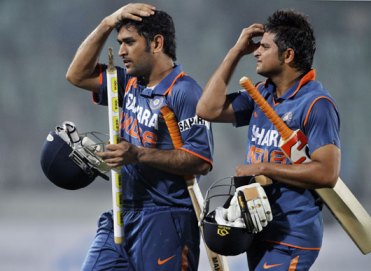
Raina and Dhoni unleashed the pyrotechnics to get India up to 280

Another miniature collapse, following the dismissal of Dravid and Kohli almost immediately after one and other, saw the Indian skipper work on rebuilding the innings once again. With Raina, heart in sleeve, hoping to become a part of the reconstruction, a solid partnership was built to suitably daunt the English attack.

The run rate during the last ten overs headed towards the stratosphere, as over a hundred runs were gathered in a passage of play that helped India reach a more-than-respectable total of 280. It seemed as though the world had absorbed a lesson on Indian resolve, a characteristic that had made them world champions a few months ago.

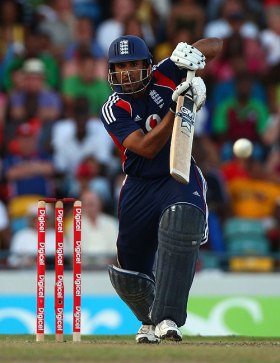
The English reply was an unpredictable scatter of method and madness. Only Ian Bell’s fifty stood out amongst the top four batsmen, after the openers had departed in search of quick runs. Ravi Bopara, one of the heroes from The Oval, played an innings of undoubted steadfastness by building valuable partnerships with Bell, Bresnan and Swann. Signs of sloppiness on the field from the Indians were vivid once again with RP Singh being the culprit for a chance that he left begging at long on. Another instance of a frustrated Jadeja’s overthrow, way off radar, would surely have brought a smile on to the face of Steve Harmison, who definitely needed chaffing after publicly expressing his disgust over Durham CC when they had released his brother Ben.

At 173-5, bearing in mind Broad’s injury, the game seemed India’s to lose, with less than fifteen overs remaining. However, Bopara played intelligent cricket – strokes that demonstrated the work put in by a man who is clearly trying to cement a place in the current English setup. He targeted gaps, and slow fielders, to convert ones into twos and keep the rate ticking. The consequences of the Indian bowlers’ inability to walk through the lower order batsmen may become more apparent once the series is over, but England, no doubt, have enjoyed their role in the melodrama of lower order batting.

Ravi Bopara played a crucial innings for the second time in two games this series.

When rain intervened, the story had two parts to it: one, when the Indians were on the driving seat, and another, after another over, when the Englishmen took charge. With the score at 242, when the second spell of heavier rain hit the city, it seemed as though that England had clinched the game with the demanded D/L score at that juncture reading 240. Earlier, the Indians had a brief advantage but the spell of rain vanished by the time the teams could leave the ground.

But play resumed, much to the delight of the sport, to witness a spell of wickets falling in quick succession. Bopara departed by holing out to deep mid-wicket for a well constructed 96, but rain played spoil-sport again and used the D/L tenets do declare that the game was tied with England, at that time, further requiring 11 runs from 7 balls with a couple of wickets in hand. D/L doesn’t take into account the case of injured players who can’t bat.

Just like how an organization’s balance sheet doesn’t capture the true costs and risks of business activities, The Lord’s scorecard did likewise. The verdict would simply pose that England clinched the series with India yet to record a victory this summer. As the focus shifts to Cardiff, there is still no ballast to raise any hopes within the Indian camp.


Chandrasekhar Jayarama Krishnan

Head of Cricket – The CouchExpert

11 September, 2011

With just a day’s gap between the two ODIs in London, the drive from Kennington to St. John’s Wood have had the players reflecting over a result that is yet to witness a tilt in scales. In an awful collision between hope and reality, the Indians finally came through a game that witnessed their best chance to finally rope in a result to their favour.

The Indian top order crumbled by the time ten overs were bowled in the day, with vice-captain Suresh Raina falling to a heinous shot which, given the situation, was way out of bounds. In an act that reacted to insistence on largely relevant public opinions, featuring MSD’s determination and Ravindra Jadeja’s place, the innings was laudably rebuilt on a weak foundation by the two.

Jadeja's Man-of-the-Match performance wasn't enough to hand India its first victory this series

There are many who’ve voiced their mistrust over Jadeja’s place in the squad. For the youngster to respond the way he did speaks a lot on his temperament, a trait that is worth its weight in gold. Sure, there are a few glitches already in his relatively short career so far, but even the best sportsmen have had their share of mistakes committed when young.

India, yet again, finds itself in a conspicuously difficult situation; even if it seems apparent that the previous ODI showcased their ability down the order. Ashwin, with his intelligent innings late in the game, surprised many with his cheeky approach.

The Englishmen, on the other hand, just do not seem to run out of fuel. Bopara, a player who has been under the scanner since his return, steered England to victory. Munaf’s bowling, with an economy rate that would have sent a shiver down one’s spine had it been recorded on a Ritcher Scale, did no favours to an already depleted Indian morale. RP Singh, thankfully, looked a much quicker (and fitter) bowler than the one witnessed at The Oval a few weeks ago.

But nothing seemed enough to stop the Kieswetter cannon ball from firing explosives to give England the start that they needed. A charge down the track against Praveen to heave the ball into the midwicket boundary was a shot that would have had the heads of NY Mets coaches turn towards the youngster. Bopara and Bresnan, towards the end, acted as able catalysts to help England add another win to their tally this series.

As the game moves in to the Lord’s, it is only memories from the past that would shed any light into India’s hopes. England will look to play an unchanged squad, whereas the Indians, hopefully, might consider handing Varun Aaron his debut. That he might be raw and inexperienced doesn’t matter, his very inclusion could see an increase in the number of viewers who would turn on their TV sets on Sunday.

This may tell us something about the state of Indian fans around the world: the romantics are a tiny minority, the ones with oil of vitriol up their opinion glasses are high in number, but there may not be enough to lend energy to effect a turnaround at Lord’s. Righteous contempt seems called for, but it is never within the Indian nature to do so. You just have to ask the cold-blooded criminals who’re yet to be tried by the government – they could narrate tales longer than Navjot Sidhu on how fortunate they are.

If the Indians have to do something, they’ll have to do it without an iota of sympathy from the enraged fan.


Chandrasekhar Jayarama Krishnan

Head of Cricket – The CouchExpert

September, 2011


India’s battle with England this summer, thus far, has hardly possessed any dramatic interest. In the past, when Indian cricket had been through plenty of such phases, there would always be an instance of one player whose image would bring to mind a personal battle of absolute resolve. The truth, however in this series, is more prosaic; while there were a few performances that had glimpses of excellence, the overall picture, though, was seemingly fogged.

With absolutely nothing to lose henceforth, it would make sense for India to adopt Admiral Farragut’s ‘damn the torpedoes’ approach during the Battle of Mobile Bay. The influx of youth has helped the unit remove scarred egos, with Rahane’s good run of form being a huge positive. He has looked comfortable for someone who’s just arrived in to International Cricket. Coupled with Parthiv’s blitzkriegs at the top of the order, there have been plenty of positives to derive from the approach.

While some of the players handled the English attack with grace, the overall result has been the same – odd emotional moments in a failing quest that few people are taking seriously. The seriousness debate could have half a point – there were always going to be questions about the crowd that otherwise would have been generated had injuries not affected the celebrity stars.

The success of Rahane would surely give young Aaron a boost in confidence. He must be handed his debut soon.

Despite various signs that indicate a depleted level of interest, thanks more to the weather than the lack of stars, the battle might not be joined until the reverse fixtures commence in India later this year. But what can currently generate interest is to expose some of the young stars and offer a glimpse of what the future has in store for Indian cricket. The failure, to say hand a debut to young Varun Aaron would end up demonstrating the chronic weakness of Indian selection.

It is easy to forget that change in fortunes can still fetch silverware for the Indians this series. The Indian cricket fan’s substantive liability is to forget the opportunities that still lie ahead when times are bad – he becomes besotted with pessimism. The response so far from the team has been forceful, but grossly inadequate.

England, on the other hand has lost its One Day talisman with Irish roots to injury. Morgan’s injury could prove a blessing in disguise for ex outcast Ravi Bopara, who is trying is hardest to cement a place in a side which once struggled to pick a squad on credit alone. It is strange to observe how a chunk of past memories are formatted when times change for the good.

England must ride on this wave while it still lasts, and their current opponents are prime examples of what dark times can do. With a bunch of youngsters being given a fair run this series, Dernbach and Stokes have opportunities to pose additional headaches to the English selectors.

Bopara will slot in to fill the injured Morgan's place in the England XI

Alastair Cook’s doubted limited over skills were put to rest with the innings at Southampton, additionally backed by a few good performances in the same format against the Sri Lankans prior to the Indian series. His success has set a predicate that Cook, as a batsman, can now be relied on in the shorter formats of the game and practically, on incommodious leadership issues, if they may exist, along the way to definitive deal.

The trouble is, success will not always walk into the hands of the Englishmen. If England’s new found aggression is about ruthlessly wiping out enemies, as they’ve demonstrated in the recent past, it probably wouldn’t be a bad idea for even Captain Cook to take a leaf out of Admiral Farragut’s book: Damn the Torpedoes, full speed ahead! Weather permitting, of course.


Chandrasekhar Jayarama Krishnan

Head of Cricket, The CouchExpert

22 August 2011


There is a growing sense that our best days as a Test Cricket Superpower are behind us, and that England, currently is in the driver’s seat to ride on this throne for the foreseeable future. A sense of anguish seems to dominate any conversation that runs around India’s future in Test Cricket – the consequence of a whitewash whose coffin was nailed at The Oval.

There is, of course, some truth to this concern. Even Real Madrid’s 5-0 loss to Barcelona last December wouldn’t have had enough quantity of remorse to outweigh that suffered by the Indians lately. If at all anything was common, it was that both the Los Galacticos and Indians succumbed to the presence of sheer class amongst their opponents, coupled with bad errors of judgment intrinsically.

England dominated the series with the aura of a historical superpower that has never been colonized. The script of the fourth test could’ve well been written before the first ball was bowled at the Kia Oval, but what was heartening to see from the Indians, for a change, was resistance of some sort. Dravid’s defiance had thrown seeds of hope in to the Indian dressing room, two of which managed to last through a session without having its wicket thrown away.

The media-frenzy of a Tendulkar milestone that dominated headlines preceding this series is likely to continue until it is reached

Tendulkar’s near-repeat of his World Cup Semi Final innings against Pakistan, one filled with numerous chances that the opposition failed to grasp hold of, and Mishra’s battling (and splendid) innings – one that had to have had the other ‘batsmen’ hang their heads in shame- saw India through their first session without losing a wicket. Mishra’s guts, and temperament, are now widely endorsed with a large section of the Indian public willing to forgive him for lack of ideas while bowling – only to tout him to contention for the number six slot as a batsman.

That it had to end this way for the Indians was a certainty. A curious selection towards the end of the series had depicted a thought, or even a belief, that the Indians were as adept in conference rooms, where selections were made, as their players had been on the green wickets of England. Indeed, the uncontrolled fall of morale, confidence and the exposure of weaknesses and inability overshadowed all imaginable pretenses – not least helped by the fall of seven wickets for a paltry twenty odd runs to bring this series to a close.

Some of India’s most exciting one-day players were victims of the English soil’s greenish vengeance. Less gullible but no less feeble were the bowlers who ran out of ideas at the rate at which gas-guzzling SUVs drink fuel. Predictable responses to events of such drastic inconvenience hovered around packed calendars and lack of preparation – but lack of application, barring Rahul Dravid, stood out among the key culprits. England played brilliantly well, no doubt, but was made to look even better by the hapless Indians at various instances during this series.

England’s progressive rise in performance of their players, with Swann completing the cycle with his dominant performance in the second innings of the final test, picking up six, pretty much summarizes their state of confidence. A few of the statistics from the recent past – backed by innings victories and large integers – plant a scary proposition to the rest of the world: they’re right on top, and there seems to be no roads that descend anywhere near the British Isles.

It may now appear ironic that Man of the Series Stuart Broad was a doubtful starter at Lords, owing to his unimpressive form leading up to the series

Broad’s consistent lengths throughout the series, ones that would have made even the best of the long-jumpers proud, and high scoring cameos with the bat earned him the Man of the Series award, one for which there existed many a contestant from the English dressing room. Dravid, from the other dressing room, was parsecs ahead of any other Indian in terms of achievements this series. That, in itself, is a reflection of how the series eventually panned out.

Most of the Indian players, subsequently, will have to bite the bullets once the post-mortem verdicts are out; not that most of these facts aren’t known anyway. Some of their ‘shorter-format’ skill sets have probed in and out like Somalian pirates in the Gulf of Aden. Apart from the self-inflicting damage that it has caused to most of them, more than anything else, it has left a billion sullen faces staring at this plight back home.

On the contrary, the Englishmen have found themselves a bed of roses to recline on – their tale to reach the top of the rankings, followed by a whitewash of the previously reigning champions, couldn’t have had a better script in the making. The quality of their quests henceforth will decide whether they build their fortresses across the globe in sand or stone. They have had a remarkable time stamping their intentions, but the real game of governing unconquered territories is about to begin this winter.