Posts Tagged ‘Australia’


Chandrasekhar Jayaramakrishnan

Anyone who experienced the events leading up to Tendulkar’s half century on Day Two of the Melbourne Test would have been forgiven for thinking that the Boxing Day test was hovering towards a Tendulkar biopic fleetingly waiting to acknowledge a long awaited milestone. The next couple of days, however, seemed to outline the fact that the periphery of this achievement has rather harsh boundary conditions. As did the hopes of a victory on foreign soil, given that India’s next tour outside the subcontinent is a far two years away.

Thus, yet another favorable Test result has vanished into oblivion, leaving many of us wondering over the secret behind the magical formula that Gary Kirsten possessed, that others didn’t. A logical thought would question the challenge posed by during those tours outside the subcontinent when Kirsten was in charge as compared a tour to England and Australia, the latter by no means pushovers albeit their recent results.

Cricketing plans, in general, anticipate years of austerity and stability with fitness of talent pools ranking high amongst others. While talent remains plentiful in supply, the longevity of most remains a function of form and/or fitness. A lot of the younger players who’ve paid brief visits to the international setup resemble the yesteryear Internal Combustion Engines that possessed low volumetric and thermal efficiencies – a direct correlation to unfavorable statistics and rapid breakdown. Temperament remains a spark plug that pre-ignites when exposed to high temperatures.

Virat must be persisted with, and the quick hopeful fix of bringing in Rohit instead will only send wrong signals © ThatsCricket

Having said that, it is important to remember that the inevitable day when the Indian batting would be forced to field a middle order that resembles the current Australian top order – sharing a grand total of five test matches between them – isn’t far away. Whether the best laid plans weave a middle order fabric that fills the gap between the large sized shoe and small feet will remain unanswered for some time to come, it will be worth persisting with a few who’ve shown that with time, maturity evolves.

Persisting with Virat Kohli for the rest of the series, irrespective of the statistics that come out, is one way to tap the right ore. Given that he has matured into an outstanding ODI cricketer, it is hard to imagine why he cannot replicate his achievements in the longer formats. This would, on the other hand, mean shutting the doors for Rohit Sharma this tour, who seems to have picked off from where he left off the last time he toured down under. He has certainly seen enough downslides to let this hit his game hard again.

The archetypal Indian sentiment would find it hard to drop a veteran to accommodate a couple of youngsters given the lack of proximity of the next tour abroad. One may find it even needless to house such a need given that a prolonged gap wouldn’t require youngsters to be armored with foreign soil experience as immediately as the present moment. Even if the contrary decision was made, there is every chance that a few selectors could be painted as villains by a section of the fans and media for robbing their ‘local legends’ of a last ditched attempt to gain glory. The fact is hard to argue against, given that the veterans have had very good track records down under during previous tours.

But again, only one out of the four scheduled tests have been completed – even if it was premature. A Test match that gets over with over a whole day’s play left reflects quite strongly on either the nature of the wicket, or a single sided dominance. The effect of losing a potential entire cricketing day dances to a different tune than the one set by Samoa changing time zones in order to remain in line with its trading partners who are nearly a full day ahead.

The key for India to succeed will remain focal around sticking to this combination. The inabilities exposed haven’t changed with time – the opposition tails have forever wagged at amplitudes that summate those of all hundred odd Dalmatians. A large part of the blame, as gathered through eavesdropping on discussions between common man and common man during train and bus journeys, among others, has been cannoned towards MS Dhoni and his ‘defensive’ methods. The picture painted resents a star who neither takes his himself nor the dream job too seriously.

Although in reality, the belief must be that the Indian tail fails to place a price on its wicket. As much as men want to hate (yet find it hard not to like) Harbhajan Singh, he proved the most infuriating of all lower order batsman to get out, even amidst bouts of unaffected public depreciation down under. Ashwin, a craftsman plying the same trade, seems the nascent player showing signs of steadiness amongst a sample that includes the Indian skipper. Dhoni’s lack of inventiveness in wiping out an opposition tail would certainly have been neutralized, or even forgotten, had his willow yielded more runs.

The series is still young and alive, and whatever was learnt out of Melbourne must be applied in Sydney for sustenance. This would mandate sticking to the same combination, unless injuries hamper the thought, if India hopes to gain anything out of Sydney.

Prasad Moyarath

The MCG pitch was the best thing about this Test. Photo: Sebastian Costanzo

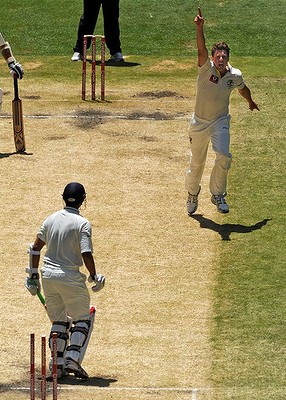
Yet another Boxing Day Test debacle for India or another usual Indian start for an overseas tour. The Boxing Day Test match result can be interpreted by an Indian fan in either way but irrespective of the result, this Test match between India and Australia provided a great advertisement for Test cricket. Though this match lacked the usual intensity of an India – Australia duel and finished in four days, the entertainment it provided was worth for any Indian who woke up early morning in this chilling winter to watch it on television. The Test match which started on a cloudy day with a few rain interruptions on the first day proceeded in bright sunshine leaving a doubt whether the rain Gods were sitting and watching with awe.

Not a single century scored, only a single five wicket haul, what was that made this Test match so special? For those who did not follow this match, its scorecard won’t provide the right answer either.

Going into the Boxing Day Test match, concerns were many for both the teams. The career of Ponting and Hussey hung in balance and they were contemplating playing Christian in place of one of the two. Hilfenhaus was making a come back and Cowan making his debut. For India, the fitness of Zaheer and Ishant was the major concern and so was the ability of their batsmen to adapt to the Australian conditions.

Michael Clarke’s decision to bat first on a cloudy day though raised the eye brows of many, considering the poor batting record of India in Melbourne, was a daring one which was vindicated in the coming days. Warner gave an explosive start to the Australian innings but an incisive spell of fast bowling by Umesh Yadav helped India fight back. Ponting despite been hit on the helmet by Yadav at the start, made his critics eat their words with a fluent innings which was cut short by a Yadav’s beauty. Two dubious umpiring decisions against Cowan and Hussey ignited the debate on UDRS and BCCI once again. Ponting and Hussey proved that they are still good enough to play for Australia with some fine batting in the second innings. Australian tail wagged in both innings, thanks to some unimaginative captaincy from Dhoni. Hilfenhaus made a remarkable comeback was well supported by Pattinson and Siddle.

Sehwag played in his own style in both the innings and luck favoured him only in the first. Australian bowlers never looked like bowling in the right areas on the second day and Sehwag, Dravid and Sachin capitalised on it. Sachin was the only batsman who looked comfortable in both the innings. Dravid getting bowled in both the innings has put a question mark on the technique of this great player. Gambhir and Dhoni continued their poor run outside the subcontinent and Ashwin made Harbhajan’s absence inconspicuous. Indian pace attack put relentless pressure on the Australian batsmen and Ishant and Umesh clocking 140+kmph consistently was a delight to watch.

Three of the four days ended like a television serial leaving the viewers to ponder what next. Scores of both teams in each innings drew a slanting graph line putting a question mark on the quality of the pitch. But for those who watched this Test match on a drop in pitch, the curator was the Man of the Match ahead of the official choice.


Goutham Chakravarthi

Numbers

India have more than held their own against Australia since 1995 when Australia became the numero uno side in the world. Since then, India is the only team with a positive Win/Loss ratio of 1.2 (12 wins, 10 losses in 28 matches) against Australia among all Test nations with England a distant second with a Win/Loss ratio of 0.56 (13 wins, 23 losses in 44 matches). India has not only played on equal terms over these years, but are the only team to have consistently competed with Australia through the last 17 years, both home and away.

Team Matches Won Lost Tied Draw W/L Ratio
England 44 13 23 0 8 0.56
India 28 12 10 0 6 1.2
South Africa 26 6 17 0 3 0.35
West Indies 31 6 22 0 3 0.27
Pakistan 20 2 16 0 2 0.12
New Zealand 20 1 14 0 5 0.07
Sri Lanka 16 1 10 0 5 0.1
Bangladesh 4 0 4 0 0 0
Zimbabwe 3 0 3 0 0 0

Table: All teams vs Australia (home and away) since 1 January 1995

Stats can only tell you so much. In this case, it quite clearly tells you that India have done well over Australia in this time. But only 2 of those 12 victories have come in Australia (2 wins, 6 losses in 11 matches) giving India a W/L ratio of 0.33 behind England whose W/L ratio stands at 0.42 (6 wins, 14 losses in 23 matches with 3 of those victories coming in the last series).  Restricting the performance in Australia to the last 11 years, you see that India have competed almost on an even keel with a W/L ratio of 0.66 (2 wins, 3 losses in 8 matches), with England second best with 0.4 (4 wins, 10 losses in 15 matches)

Team

Matches

Won

Lost

Tied

Draw

W/L Ratio

England

15

4

10

0

1

0.4

India

8

2

3

0

3

0.66

South Africa

9

2

6

0

1

0.33

New Zealand

9

1

5

0

3

0.2

Bangladesh

2

0

2

0

0

0

Pakistan

6

0

6

0

0

0

Sri Lanka

4

0

3

0

1

0

West Indies

7

0

6

0

1

0

Zimbabwe

2

0

2

0

0

0

Table: Teams in Australia since 1 January 2001

Indians have also racked up the highest score (705/7 dec) in this period and their team scores more runs per wicket (37.07), almost 5.25 runs more than the next best team, England (31.85).

Battle of the weakness

Even taking into consideration India’s no show in England earlier in the year, its batting continues to be its strong suit. Stats above show that they have done well in Australia in the last 10 years, and, largely, its top performers over these years are still part of the team – Sehwag, Tendulkar, Laxman and Dravid. This series proves to be the battle of the weakness that’ll largely determine the outcome of the series: India’s bowling vs. Australian batting.

Spicy wickets might give India its best chance of a series victory. ©AFP

India’s ability to take 20 wickets will determine how the series might pan out. So, green wickets might prove to India’s best chance of winning. Durban, Leeds, Perth and Cape Town victories were built on favourable bowling conditions. Indians will back their experienced batsmen to put one over the sporadic Australian batting should it boil down to that.

Favourites

Not since 1978 have India come into a series in Australia as favourites. This time they are favourites only slightly, but not overwhelmingly so. Australia’s depth in pace reserves gives it renewed optimism to put one across the very experienced Indian batting side. The freshness in the attack will also be the factor Indians will look to exploit. Sehwag’s first knock of the tour might be crucial for the outcome of the series. And should India keep the Australians on the field for a day and half, it might break the Australian backs pretty quickly.

Injuries

Injuries to bowlers might well decide the fate of the series. Zaheer Khan and Ishant Sharma are crucial to India’s chances and both come in to the series with dodgy ankles. Zaheer has some cricket under his belt, but it remains to be seen if he will last the course. Ishant’s fitness and form will be crucial given the impact he has playing Australia, especially Ponting and Clarke.

It is difficult to see Ishant and Zaheer playing all four tests. Spicy wickets and a fit Zaheer and Ishant are India’s best chance of winning this series.

Prediction

2-1 India


Chandrasekhar Jayaramakrishnan

December 25, 2011

There is a new whiff of anxiety that engulfs the Australian air amidst the shimmering heat of expectations leading up to the Boxing Day test at Melbourne. Triggered over the last 18 months by a sudden upsurge in the number of individuals presented a baggy green, it marks a stark contrast to the mood in a nation that boasts having fielded the least number of captains in Test Cricket over the best part of the last 3 decades – an accolade that that sits atop a list that boasts solidity and surety in selection and leadership.

A defeat to their Trans-Tasman neighbors isn’t the most ideal way to approach a Boxing Day fixture. Australia’s amorphous top order has welcomed its newest occupant in the form of Ed Cowan, an individual perhaps known more for his prowess with the pen than the bat (given that a lot of viewers do not follow Australian Domestic Cricket) – one who has just come off a century in Canberra against the touring Indians. Avid book readers will relate his autobiography to the isomeric title that is shares with that written by a Pakistani General.

The opening partnership of Cowan and Warner will have to lay a solid foundation for the rest to capitalize on

The partnership of Cowan and Warner, representing solidity and attacking batsmanship respectively, will look to take advantage of a brittle Indian bowling line up whose injuries and form are governed by Heisenberg’s Uncertainty Principle. The Australian weakness against the moving ball has been as well documented and exploited as political instability in the Middle East – a problem that has been diagnosed with no credible solutions on the card. Whether the Indian attack is all steam and no engine, depending on the fitness of Zaheer amongst others, to take notice of this is a question that will be answered over the next few days.

The lone positive that Australian cricket has witnessed is the rebirth of Michael Clarke, the batsman, after taking over the captaincy mantle. Clarke was touted as successor to Ponting well before he turned 25, and had his sinusoidal fluctuations in form – one that saw more troughs than crests over the last three or four years, including an alleged assault by current outcast Simon Katich.

But Clarke seems to have learnt, and learnt for the good. Much will depend on the number of runs he contributes at number five, given that he is the meat of the sandwich formed by old war veterans Ponting and Hussey, whose batting averages over the last few series’ have dipped to numbers possibly lesser than their ages.

But history has shown that these men have answered questions with the axes right over their heads. And they’ll look to capitalize against what appears a fragile attack on paper, given that the lower order’s batting form – especially Haddin and his unsure methods – has been indifferent of late.

A good total is one that would allow a young Australian bowling attack – boasting pace and aggression, but lacking experience – to have a go at an experienced Indian batting lineup that could well see off its stars from Australian soil for possibly the last time in some of their careers. The impressive forms of Pattinson and Siddle along with a wily Nathan Lyon will be up against a batting line up possessing a barrage of runs in their career banks – something that they are unlikely to encounter anytime later in their careers.

But the bigger concern that would require addressing from Mickey Arthur and the rest of the coaching camp is the Australian catching of late. Never before have so many issues tainted the Australian lineup and their first foreign coach would look to bury the issues, rather than sweeping them under a carpet.

Weather permitting, as I glance through the weather forecasts in Melbourne predicting showers, the cricketing world will look forward to a series that will erase the bruises of the last series down under to tip the cricketing scales towards the sporting direction.


Chandrasekhar Jayaramakrishnan

November 13, 2011

The real story of test cricket has little to do with what was exposed in the newspapers on the morning of day three of the Newlands Test, and has everything to do with us fans – some who’ve challenged the entertainment plausibility of having to watch 450 overs of cricket spanning five days. The articles and reactions to the second day of the Newlands Test were only the meekest ghosts of a summary that the numbers depicted.

The build up to the clash between the Southern Hemisphere’s cricketing giants now seems inadvertent, given the fact that this battle would have given the Anglo-Zanzibar war of 1896 a run for its money. It had taken the British only 45 minutes to overthrow Khalid Bin Bargash, when five warships of the Royal Navy opened fire to commence and complete what would become one of the shortest wars fought in the history of the world.

Just as one began to wonder the chronic consequences of not having played test cricket in over ten months time, the residual effects of which were blatantly vivid during South Africa’s first innings, the landslide that followed painted a bizarre picture on how the art of temperament has gone for a toss, without doubting South Africa’s resilient response and character. It is, in one way, ironic to imagine that the teams that had once been involved in the highest ever run chase in ODI history had to enact a drama that would dubiously place itself at the other end of the spectrum.

The emergence of shorter formats seemed to have stamped its presence when a few Aussie batsmen – the main culprit being Brad Haddin – appeared to have played shots that they’d never want to see replays of. The entertaining form of attacking batsmanship was decisively rejected by the challenge posed by Test Cricket. It would now seem ironic to quote Michael Clarke in the past tense – a common ploy used by many who know that the words of the captain will appear on print post the result – just after the toss when he’d said he would have batted on this wicket.

Australia now finds itself in the middle of a two match series, with many believing that by stating the complexities of an ‘insidious’ wicket, the visitors can hope to bounce back after a break. A large part of Australia’s problems lie within their own camp – from the ineffective, unguided missiles of Mitchell Johnson to the questionable form, but not the class, of Ricky Ponting. To add to this heavy bag of questions exist a very fragile opening pair, whose lack of efflorescence against the moving ball would have undercut the post mortem’s storyline.

The Aussies certainly did well to ensure that their Trans-Tasman rivals held on to their dubious Test Record of the lowest score in an innings

Historically, the Australians are believed to be constitutionally averse to strategies adopted by other cricketing nations. If form-based remedies are displaced by class-based remedies, the number of young Australian cricketers staking a claim to play test cricket will fall incredibly. However, the recent trend scripts a contrary story, and rightly so – David Warner’s call up to replace the injured Shaun Marsh adds fuel to this theory.

Mental toughness has always been embedded into the DNA of Australian sport, but for once, ability seems to be posing a colossal question. But knowing the Australians well, they cherish pride and victory way too much to let it slip away – and no one would know that better than the set of men who’ve thrown their hats hoping to fill the vacancy left by Tim Nielsen.

In this process, the other side of the contest has been overlooked. If it probably weren’t for Amla and Smith’s centuries, it is for anyone to guess whether the other South African batsmen would have been found wanting, as they were during the first innings. But debutant Philander’s baptism of fire certainly prevented what otherwise would have been a very unpleasant courtroom featuring the batsmen responsible for a collapse during South Africa’s first innings on home soil during the month of November since 1921.

The Law of Large Numbers states that the result of performing the same experiment a large number of times would yield the expected result. The method adopted by Steyn, Philander and Morkel was to constantly hit the channels on and around off-stump – and the expected results were obtained.

The result has Australia in free fall now. Unlike gravity, a bad result can often push a team to the extremes of possible reactive decision making. There will be a temptation to replace the misfiring Johnson with the young and quick Pat Cummins – but as the late Peter Roebuck wrote in his very recent article: “Ambitious selectors and captains understandably seek players of high potential to replace time-servers, but cricket is also a game of skill, stamina and experience, and it takes time to learn its lessons.”

Sun Tzu’s Art of War states that what the ancients called a clever fighter is one who not only wins, but excels in winning with ease. Certainly, the South Africans wrapped up the game so. And they’ll look to repeat the same, excluding the first innings debacle, in Johannesburg.