Rajat Jain
Head of Tennis, The CouchExpert
24 August 2011


The U.S. Open series is over, and there is a lot to look forward to in a week from now as the final grand slam of the year begins in New York. The two masters before the Open are usually supposed to give us a fair idea of who are the players to look up to during the Open. Unfortunately, Canada masters is usually the first tournament after a month long layoff (for the top players) and hence are looking to shake off the rust. In Cincinnati, the conditions are extremely hot and humid, and hence the players are cautious to not over exert themselves ahead of the Open. The quality of tennis does take a hit, as was evident by the lackluster performance of all the top-4 this year. So who are the top contenders for the trophy two weeks from now?

Djokovic and Murray are among the top contenders for the Open

Novak Djokovic(1): The sub-optimal form of the Serb was still sufficient to make him end up as the best player of the two masters. Even though he sustained a shoulder injury in the final, it is the mental fatigue that would worry him. He looked disinterested during both tournaments, and this was after he had a month long break post-Wimbledon. How much would that be a factor going into the Open? And what about the shoulder injury? It would have been serious enough to make him pull off a match for the first time since Jan 2009. More importantly, will it effect the confidence on his serve which has become such a potent weapon this year?

Rafael Nadal (2): The five losses to Djokovic has made a huge dent in Nadal’s confidence this year. It is not that he lost early in both tournaments, because he has not done well here historically. It is the way he played in these tournaments–a third set tie-breaker against Dodig after having a break lead twice during the third set, and the error-prone three hour slog against Verdasco. In addition, he faced problems with his foot during Wimbledon, burned fingers here, and some more blisters in the feet. The physical issues, while genuine, will definitely impact him even more. Despite all this, he still managed to reach the semis in 2009, his worst year. I would expect at least a repeat of that if not more.

Roger Federer (3): Federer loves playing in New York … period. And if anything, his form in these masters is not indicative of his performance at the Open. He won Cincinnati in the last two years and failed to make the finish line at Open, while he lost in the first round in 2008 and yet saved his year by beating Murray in the finals. The difference being, during 2008 his losses were brushed off as one-off, while now they are becoming a pattern, like with Berdych and Tsonga. This definitley eases the pressure on the rest of the tour and makes them more confident.

Andy Murray (4): Murray last reached the final here in 2008. He has improved a lot in these three years. The problem for him is that his peers have improved even more. These are his peak years as a player, and with each passing major, the pressure on him to win that elusive one increases exponentially. Historically, he has not played well here in the last two seasons going down to big hitters not afraid to compromise on their shots, but one has to agree this is his best chance to win a major given the possible mental burnout of Djokovic, phsyical problems of Nadal and the natural decline of Federer.

Mardy Fish (6): There is no doubt that Fish is the best American player at present, and he deserves it. His new found all court game is exciting to watch and so is his eagerness to improve. Even with all this, he is miles away from the top-4 as the best game of Fish was still unable to beat a 50 percent Djokovic at Montreal, while he lost yet again to Murray at Cincinnati. Even though the win against Nadal was progressive, even he knows the Nadal he might face at New York will be vastly improved from Cincinnati. More than winning the title, his first step should be to make his maiden semifinal appearance, and given the recent form, he is definitely in contention for the same.

Juan Martin del Potro (19): Given his giant leap in the rankings in the first five months, the summer hard court series was supposed to be a bonanza for this gentle giant from Tandil. However, uncharacteristic losses to Cilic and Gulbis, and the retirement at Cincinnati does not bode well for him going to the Open. If not, it would be a huge disappointment given how the tour desperately needs somebody to step it up and challenge the top-4.

Other players to watch out: Bernard Tomic who showed some real promise during Wimbledon, Jo Wilfried Tsonga who is showing renewed enthusiasm on court, Grigor Dimitrov and the local boy Ryan Harrison.

Rajat Jain
Head of Tennis, The CouchExpert
23 August 2011

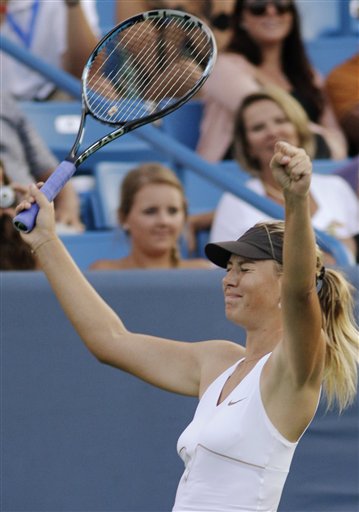
After winning the title at Cincinnati, Maria Sharapova is one of the top contenders for the U.S. Open

After winning the title at Cincinnati, Maria Sharapova is one of the top contenders for the U.S. Open

Now that all the mandatory tune ups for the U.S. Open are over and it is only less than a week before the Open commences, lets have a look at how the top men and women contenders for the last Grand Slam of the year.

Serena Williams (29): Few would argue against Serena as the favorite going into the Open. Her wins at Stanford and Toronto, and her utter demolition of top women, including Maria Sharapova, does not give a single hint that she was out of courts for almost a year before Wimbledon. In fact, her being seeded at the Open would be a blessing in disguise for the top women as they’ll avoid her at least till the third round. The absence of the defending champion, Kim Clijsters, will only make her contention even stronger.

Still, as the 29th seed at the Open, Serena will be the most dangerous floater in the women’s draw.

Maria Sharapova (4): Can you imagine what this Russian blonde can achieve in her second stint if she solves out her issues around her ridiculously unreliable serve? She committed 11 double faults in the final at Cincinnati, and still managed to beat Jankovic 6-4 in the third. In fact, her past few results—Rome winner, French Open semifinalist, Wimbledon finalist, Toronto R16 and Cincinnati winner—have been the most consistent of all the women save Serena. Despite all the uncertainty in the women’s tour, Sharapova is someone who can be relied to make a deep run at the Open. Of course, if she does not commit 15 double faults in a match.

If she ends up winning the Open, women’s tennis will have found their marquee face again.

Petra Kvitova (6): Was her slump at the North American tournaments just a one off or will she suffer the post-first-slam-victory-slump that engulfed players like Ana Ivanovic? It would probably be too much to ask her to repeat her Wimbledon feat at the Open. However, it would not be too far fetched to expect her to go deep into the draw, possibly a semifinal apperance.

Li Na (7): Ever since her historic victory at Roland Garros, she has not done anything special. However, she had not done anything special between her run to the final at Melbourne and victory at Roland Garros, either. In fact, she lost five straight matches during this period. This suggests that her form in the smaller tournaments is no indication of how she will perform at the grandest of stages.

Caroline Wozniacki (1): It is a bit baffling that the world’s top lady baller (at least on the computer) is fifth on the list of contenders for the Open. But lack of a major coupled with dismal performances in recent smaller events—something which she was great at!—do not give good indications ahead of the Open. To her credit, she has taken criticism sportingly and always has a smile on her face. But lack of a coach would hurt her chances at the Open, given how deeply she relied on her father for on-court coaching during the premier tournaments. Failing to win a single match during the North American hard court series will definitely rob her of confidence and a second week showing here would be a good start to her new career without the coaching services of her father.

Victoria Azarenka (5): Always considered a threat in every tournament, she is also at the stage where the question “when will she win a major” will turn into “can she win a major”. She has no apparent weakness at the back of the court, but she doesn’t have a strength either. And lack of a solid weapon is usually her downfall to an opponent who either has more firepower, or is more consistent than her. She finally reached her first major semis at Wimbledon this year, but to expect anything more than that will likely result in a disappointment.

This more or less wraps us the preview on the top contenders for U.S. Open. The other faces to look out for will be the fast rising Andrea Petkovic, with Svetlana Kuznetsova, Ana Ivanovic, Dominica Cibulkova and Sabine Lisicki being the dark horses.

Next, we’ll look at the top contenders on the men’s side.


Chandrasekhar Jayarama Krishnan

Head of Cricket, The CouchExpert

22 August 2011


There is a growing sense that our best days as a Test Cricket Superpower are behind us, and that England, currently is in the driver’s seat to ride on this throne for the foreseeable future. A sense of anguish seems to dominate any conversation that runs around India’s future in Test Cricket – the consequence of a whitewash whose coffin was nailed at The Oval.

There is, of course, some truth to this concern. Even Real Madrid’s 5-0 loss to Barcelona last December wouldn’t have had enough quantity of remorse to outweigh that suffered by the Indians lately. If at all anything was common, it was that both the Los Galacticos and Indians succumbed to the presence of sheer class amongst their opponents, coupled with bad errors of judgment intrinsically.

England dominated the series with the aura of a historical superpower that has never been colonized. The script of the fourth test could’ve well been written before the first ball was bowled at the Kia Oval, but what was heartening to see from the Indians, for a change, was resistance of some sort. Dravid’s defiance had thrown seeds of hope in to the Indian dressing room, two of which managed to last through a session without having its wicket thrown away.

The media-frenzy of a Tendulkar milestone that dominated headlines preceding this series is likely to continue until it is reached

Tendulkar’s near-repeat of his World Cup Semi Final innings against Pakistan, one filled with numerous chances that the opposition failed to grasp hold of, and Mishra’s battling (and splendid) innings – one that had to have had the other ‘batsmen’ hang their heads in shame- saw India through their first session without losing a wicket. Mishra’s guts, and temperament, are now widely endorsed with a large section of the Indian public willing to forgive him for lack of ideas while bowling – only to tout him to contention for the number six slot as a batsman.

That it had to end this way for the Indians was a certainty. A curious selection towards the end of the series had depicted a thought, or even a belief, that the Indians were as adept in conference rooms, where selections were made, as their players had been on the green wickets of England. Indeed, the uncontrolled fall of morale, confidence and the exposure of weaknesses and inability overshadowed all imaginable pretenses – not least helped by the fall of seven wickets for a paltry twenty odd runs to bring this series to a close.

Some of India’s most exciting one-day players were victims of the English soil’s greenish vengeance. Less gullible but no less feeble were the bowlers who ran out of ideas at the rate at which gas-guzzling SUVs drink fuel. Predictable responses to events of such drastic inconvenience hovered around packed calendars and lack of preparation – but lack of application, barring Rahul Dravid, stood out among the key culprits. England played brilliantly well, no doubt, but was made to look even better by the hapless Indians at various instances during this series.

England’s progressive rise in performance of their players, with Swann completing the cycle with his dominant performance in the second innings of the final test, picking up six, pretty much summarizes their state of confidence. A few of the statistics from the recent past – backed by innings victories and large integers – plant a scary proposition to the rest of the world: they’re right on top, and there seems to be no roads that descend anywhere near the British Isles.

It may now appear ironic that Man of the Series Stuart Broad was a doubtful starter at Lords, owing to his unimpressive form leading up to the series

Broad’s consistent lengths throughout the series, ones that would have made even the best of the long-jumpers proud, and high scoring cameos with the bat earned him the Man of the Series award, one for which there existed many a contestant from the English dressing room. Dravid, from the other dressing room, was parsecs ahead of any other Indian in terms of achievements this series. That, in itself, is a reflection of how the series eventually panned out.

Most of the Indian players, subsequently, will have to bite the bullets once the post-mortem verdicts are out; not that most of these facts aren’t known anyway. Some of their ‘shorter-format’ skill sets have probed in and out like Somalian pirates in the Gulf of Aden. Apart from the self-inflicting damage that it has caused to most of them, more than anything else, it has left a billion sullen faces staring at this plight back home.

On the contrary, the Englishmen have found themselves a bed of roses to recline on – their tale to reach the top of the rankings, followed by a whitewash of the previously reigning champions, couldn’t have had a better script in the making. The quality of their quests henceforth will decide whether they build their fortresses across the globe in sand or stone. They have had a remarkable time stamping their intentions, but the real game of governing unconquered territories is about to begin this winter.


 Goutham Chakravarthi

 22 August 2011


The entire series has been about Rahul Dravid standing up for his team’s cause almost like another man back home fighting for the cause of anti-corruption. On a beautiful sunny Sunday, Rahul Dravid battled for his country with everything he’d got – with the skill of a sculptor, concentration of a chess Grand Master and the determination of a soldier. It was a throwback to the best days of Dravid between 2000 and 2006 when he scored runs with regularity and consistency of Indian government’s frequency in increasing fuel prices.

Rahul Dravid went past Gavaskar's 34 Test hundreds on Sunday.

A lower-order that has paled in comparison to the grit and skill shown by their English counterparts, showed admirable fight in supporting Dravid. Amit Mishra, showed twice today that he is made of good stuff. He handled the threat of Swann with great confidence and good skill. Alas, he was undone by a brilliant Bell catch. As a night watchman, batting overnight following on, he will be expected to carry the fight for his team for as long as he can. One the evidence so far, he is likely to.

Amid all the turmoil of wickets falling around him, Dravid looked at ease facing the turning deliveries of Swann, who has been highly impressive in this Test. Dravid looked unperturbed against some honest fast-bowling. If only the top-order didn’t acquiesce to the pressures of the English bowling, he may have helped hold the forte much longer. As it turned out, a determined lower-order helped India add another 197 runs in their first innings before the innings closed and Dravid became only the third Indian to carry his bat through.

The Indian fans would be relieved at the fight on display by the team battling a far superior team in all aspects this summer. Not often has the batting shown fight this summer, but today was different. The bowlers were made to work harder for their wickets and nothing was made easy. Even a skillful, determined unit that has had so much the better of its opposition was at times made to look tired and blunt by a determined lower-order. The message finally seemed to rub-off on the top order which looked more determined than before when made to follow-on. Finally, it looked a contest and it was a good battle.

Much of the series has been a disappointment for the poor standards exhibited by the visitors. Only Rahul Dravid has come out with his reputation intact. Enhanced as some would argue. Only cynics would argue of his stature or his greatness. Men of his ability rely not on reputation or pedigree but on deeds. Never the one to complain or seek excuse, he seeks pleasure earning his stripes and respect with deed on the field.

He is a clever man who studies administration and leagues of various sports across the globe and it is not difficult to see him get into cricket administration when he is finished with playing cricket. He was involved in the administration of world cup games in Bangalore for the KSCA (Karnataka State Cricket Administration). He makes case-studies on batting and presents them to young batsmen for his state Karnataka and for Rajastan Royals in the IPL. A selfless, but a clever man who is soaked deep in the games traditions and its values, it is but inevitable that his best runs should have come in a country that respects and values them as he does.

Alas, a controversial decision derailed his spectacular fight. India is proud to have such fighters represent it on the cricket field.


Chandrasekhar Jayarama Krishnan

Head of Cricket, The CouchExpert

21 August 2011


India’s performance this series seems like a hangover from the past with no present meaning. The standards displayed on the field continue to slip the limits of cricketing propriety, and it has become clear that something fundamental is amiss.

It is understandably human tendency to stretch the truth when times are good, and hide behind it when riding through the doldrums. This Indian campaign has left public opinions on Indian cricket with a disdainful taste, none as disparagingly passive as the display on the 3rd day of the Oval test. There exists no strategy that can camouflage the current levels of incompetence on English soil, and as Australian cricket witnessed very recently, certain facets of Indian cricket could well be in for a major overhaul. At the same time, there is every fear that the administrators would respond to all this criticism with diplomatically phrased brush-offs.

Part of the problem lies with the board and the selection. The recall of RP Singh, a topic of heated debate amongst many already, tagged the selection committee with the dubious hint of a “George W Bush” about it. RP Singh, in hindsight, would have preferred to have continued his vacation along the sunny beaches of Miami, than enter the contrastingly cold grounds of England after 8 months of first-class inaction to face the current World Number One.

But that doesn’t pain the entire picture. The Indians, undoubtedly, on their day, can be incomparably strong opponents. Adding to that the monetary background of the players and the board, they may quite not appear to be a benign superpower. What was lost, amidst all this power and glory, was responsibility – a residue of which became the status that demoted us from champions to mortals.

Whereas, on the other side of the river that separates the Champions from the Mortals, England continued their dominance and aggression with Ian Bell’s maiden double hundred. To borrow the words of Norman Maclean “… all good things-trout as well as eternal salvation comes by grace, and grace comes by art, and art does not come easy …”: Bell epitomizes the art of batsmanship, with grace and fluidity being apt by products of his wonderful technique.

Bell recorded his maiden double ton in Test Cricket with an innings of the highest quality

Rahul Dravid, the other proprietor of this gift continues to be the only Indian player who can walk with his head above the surface of the water in the Ocean of Misery. He continued to battle at The Oval, the same way that he has done throughout this series. If Dravid’s success can emphasize on the work ethic, technique and commitment that any youngster should possess to reach the top, and sustain at the top, Indian cricket should frame a completely different approach to nurture young talent henceforth.

A follow-on is starkly consequential, with bad weather the only factor that can have an influence on the game’s scales titling towards a draw. With Swann back amongst the wickets, England will look to close the game out before weather can spoil their chances of a whitewash.

The Indian fan should learn to tolerate a unit that isn’t quite as world-class as he’s always imagined it to be. The signs presently look as blank as Sreesanth’s expression on getting Anderson’s wicket yesterday. It will be very interesting to see if the BCCI, an organization that has pretty much gotten its way at every turn, will be able to accept and react accordingly to this.