Rajat Jain
Head of Tennis, The CouchExpert
13 September 2011
Feeling of Invincibility

Feeling of Invincibility


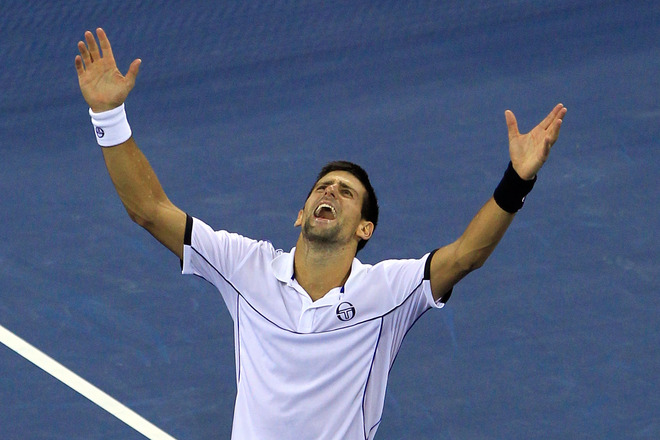
It is no secret that Roger Federer and Rafael Nadal are the two greatest players of this era and rank at or near the top in the list of all time. It is not difficult to see how Andy Roddick would have won multiple Wimbledon titles, or Andy Murray would have ended the British drought if it were not for these two men. Novak Djokovic himself struggled to compete against the two for a while and has gradually improved himself to the point where he is almost unbeatable against the two — well, everybody. Look at how he monumentally increased his performance at majors this year. First, he beat the defending champion, Federer, in Melbourne. Then he beat Nadal, again the defending champion, at Wimbledon. To top it off he beat both, Federer and Nadal, at New York.

I have mentioned many times that the Miami finals this year was the turning point in the rivalry. Actually, the trivalry. He beat Nadal at his own game — by outgassing him in the final set tie-breaker. Even after beating Nadal four times in the Masters, we still thought that is a different task to take three sets off Nadal in a major final (Nadal had lost just two major finals before this year). He did that at Wimbledon. Today, he completed his dominance over Nadal.

A scoreline of 6-2 6-4 6-7 6-1 loos like a routine four set win, completed somewhere around 3 hours. It was anything but. The actual time of this match was north of four hours spanned over 268 points. Most of those 268 points were contested in brutal, physical rallies of the highest magnitude, ones which we have rarely seen. Each point had to be won two, three or four times. One of these games lasted 17 minutes and rarely was there a game not going to deuce. They battled from the baseline, came to the net to hit volleys, were lobbed and had to scramble back to start the point over …. I can go on. The physicality of this four set match was even more than most of the five set epics that Rafa has played in his career.

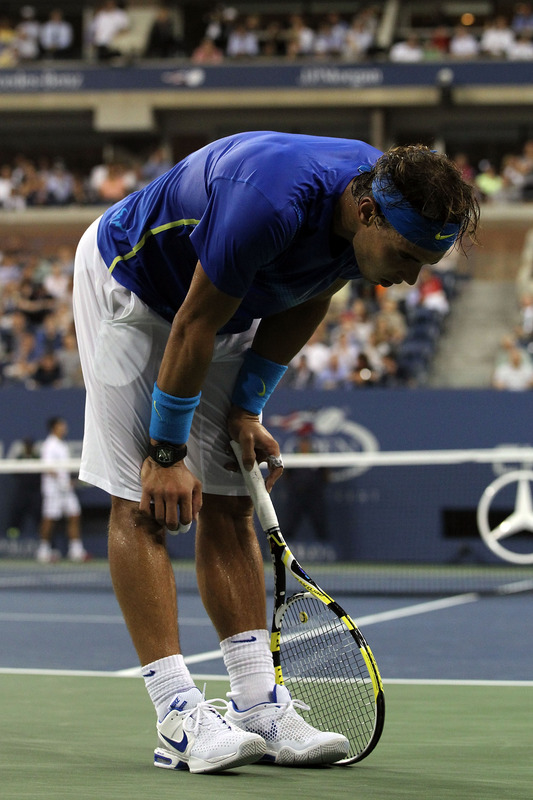
In the past, Rafa had made a career on outlasting his opponents. After magically winning the tie-breaker with his extreme fighting ability, he had finally turned this match into a physical battle. Djokovic called for the trainer and did not hit a first serve above 100mph thereafter. Everybody thought Rafa would take the match in five. Except Rafa, that is. Because he used his entire fuel tank to bring cramps on his gulten-free opponent. When Djokovic hit the final forehand winner, Nadal did not make an attempt to reach for it. The tireless opponent was also robbed off every ounce of mental energy by then to fight any longer.

What a difference a year makes. What changed? Nadal said, “less mistakes.” Federer said the same. Djokovic called the change in his “attitude.” But one feels it is more than that. Nadal was broken just five times last year but Djokovic broke him 11 times today. The latter has taken the return of the serve to an entirely new level. Everybody, including Djokovic, felt that he was lucky on the return winner down 15-40 to Federer, but he showed today that it was not
Solutions? Still Looking ...

Solutions? Still Looking ...

mere luck. When Nadal’s signature serves wide from the ad court are blasted for return winners, you know you are witnessing something special. It might not be an overstatement to say that Djokovic did a great job “holding” his return of serve. The most scary statistic: Nadal lost every second point on his first serve. And this was when Nadal was not playing bad himself. He broke Djokovic six times in the first three sets and saved 15 break points. Even though his backhand was no match against Djokovic, he kept himself alive in rallies using great combination of slices, forehands and change of pace. He fought from the deepest hole when Djokovic was serving for the match in the third to extend it for another set.

In the end he kept everything in perspective during the press interview by saying he is closer to finding the solution than he was at Wimbledon. Which he is, considering he kept the scoreline same on his worst surface (hard courts) compared to Djokovic’s worst (grass). Djokovic, on the other hand, is still trying to come back to earth. When asked about his accomplishments this year he rightly said it will take time to realize what he has done. For him, as well as for us. 66-2 and counting …

Chandrasekhar Jayaramakrishnan
12 September, 2011

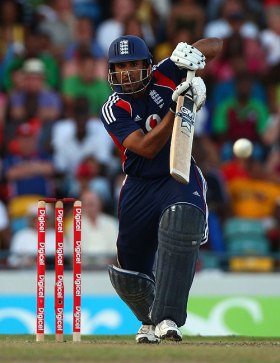
It is hard to decide whether to laugh or frown after witnessing the scenes at The Lord’s on Sunday. While the result was clearly unexpected, the belligerence within was revealing through the body language of players from both camps, during different instances.

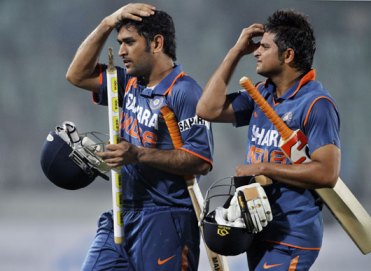
Dhoni’s frustration is understandable – the battle has gone bonkers with every route to success having brick walls with loaded artillery. Once again, the D/L method proved as hard to comprehend as The Grand Unified Theory, and as ruthless as terrorists as both camps underwent nervy moments when the rain gods intervened towards the end. A neutral, whole heartedly would state that a tie was a fair result. Not before both camps showed their reluctance to enter the field when the numbers were inclined to their side.

Quantitatively, India got off to a good start by weathering the new ball in order to prevent a repeat of what happened at The Oval. Qualitatively though, Rahane’s rather slow start to his innings witnessed moments of lunatic madness as he tried to whack the leather out of the white ball as frustration seeped in. Rahane would have completed an entire team’s innings had he been playing baseball instead of cricket.

Parthiv, at the other end, dismissed anything that was short of length by quickly shifting his weight on to the back foot and pulling the ball with confidence. Both the openers had luck on their side and trudged along at close to five-an-over. While the numbers seemed convincing, the approach, especially from Rahane, wasn’t. He’d have done well to learn from this innings on how to approach the game when shots keep finding the fielders.

Raina and Dhoni unleashed the pyrotechnics to get India up to 280

Another miniature collapse, following the dismissal of Dravid and Kohli almost immediately after one and other, saw the Indian skipper work on rebuilding the innings once again. With Raina, heart in sleeve, hoping to become a part of the reconstruction, a solid partnership was built to suitably daunt the English attack.

The run rate during the last ten overs headed towards the stratosphere, as over a hundred runs were gathered in a passage of play that helped India reach a more-than-respectable total of 280. It seemed as though the world had absorbed a lesson on Indian resolve, a characteristic that had made them world champions a few months ago.

The English reply was an unpredictable scatter of method and madness. Only Ian Bell’s fifty stood out amongst the top four batsmen, after the openers had departed in search of quick runs. Ravi Bopara, one of the heroes from The Oval, played an innings of undoubted steadfastness by building valuable partnerships with Bell, Bresnan and Swann. Signs of sloppiness on the field from the Indians were vivid once again with RP Singh being the culprit for a chance that he left begging at long on. Another instance of a frustrated Jadeja’s overthrow, way off radar, would surely have brought a smile on to the face of Steve Harmison, who definitely needed chaffing after publicly expressing his disgust over Durham CC when they had released his brother Ben.

At 173-5, bearing in mind Broad’s injury, the game seemed India’s to lose, with less than fifteen overs remaining. However, Bopara played intelligent cricket – strokes that demonstrated the work put in by a man who is clearly trying to cement a place in the current English setup. He targeted gaps, and slow fielders, to convert ones into twos and keep the rate ticking. The consequences of the Indian bowlers’ inability to walk through the lower order batsmen may become more apparent once the series is over, but England, no doubt, have enjoyed their role in the melodrama of lower order batting.

Ravi Bopara played a crucial innings for the second time in two games this series.

When rain intervened, the story had two parts to it: one, when the Indians were on the driving seat, and another, after another over, when the Englishmen took charge. With the score at 242, when the second spell of heavier rain hit the city, it seemed as though that England had clinched the game with the demanded D/L score at that juncture reading 240. Earlier, the Indians had a brief advantage but the spell of rain vanished by the time the teams could leave the ground.

But play resumed, much to the delight of the sport, to witness a spell of wickets falling in quick succession. Bopara departed by holing out to deep mid-wicket for a well constructed 96, but rain played spoil-sport again and used the D/L tenets do declare that the game was tied with England, at that time, further requiring 11 runs from 7 balls with a couple of wickets in hand. D/L doesn’t take into account the case of injured players who can’t bat.

Just like how an organization’s balance sheet doesn’t capture the true costs and risks of business activities, The Lord’s scorecard did likewise. The verdict would simply pose that England clinched the series with India yet to record a victory this summer. As the focus shifts to Cardiff, there is still no ballast to raise any hopes within the Indian camp.


In second of the two part series, Island Cricket‘s Hilal Suhaib discusses various things ranging from the mismanagement funds in the world cup, and the need for minimal government intervention in selection policies. Also in discussion are the controversial selection of Sanath Jayasiriya for one last game in England, Dilshan’s captaincy and batting and the need for vision in SLC to take its cricket forward.

Sri Lanka’s domestic league T20 league being postponed is also discussed along with the impact the IPL and BBL will have on world cricket and on the cricketers.

You can listen to Part II of the conversation here: Silly Point – Episode 3-part2. You can listen to Part I here.

The Usual Red Thorn

Posted: September 11, 2011 by stoic trader in Barclays Premier League, Football

 Mayank Gupta

Football Analyst, The Couch Expert

11 September 2011

Cometh the hour, cometh the man!

Britannia stadium

2009. Stoke City drew with Liverpool depriving us of the 2 crucial points necessary to maintain pressure for the league title.

2010. Stoke City hammer Liverpool after an abject display of football from Liverpool ending their streak of 3 wins on the trot.

2011. Stoke City win against Liverpool due to refereeing decisions and extravagance of Liverpool at the goal.

There seems to be a thorn at ‘The Britannia Stadium’ for Liverpool. No matter how god you play or how bad, something will happen to deprive you of what you deserved.

In  a long time, it seemed appropriate for Liverpool to finish the trip with 3 points. After the first 20 minutes, none could have expected anything else as an outcome. Against the run of play, Stoke City scored from a penalty which should have been a free kick in the first place for the barging of Walters into Carragher.

How many times do we see the whistle blown away when Carroll so much as breathes into a defenders ears at the other end?.However, as Carragher goes down, he wraps his hand around Walters resulting in a penalty kick which the latter eventually converts with the greatest of ease.

After that, it was the 61st minute drama where Henderson and Adam failed to play in a team and went for glory after glory failing to achieve it in 5 cumulative attempts. The injection of pace with the introduction of Bellamy and the physicality of Carroll proved cumbersome for the Stoke defence but it was never to be.2 penalty claims were not approved from which the second one was as clear handling in the penalty area as daylight.

To gift wrap the performance, Suarez missed a sitter in the injury time.

As dismal as it may sound, the performance was good and to have 24 attempts on goal against Stoke City in ‘The Britannia’ is an achievement in itself. It shows the leaps and bounds LFC have come from an abject season last year.  Many would counter this with a statement for the ability of the Mancs to grind out a win when necessary however, I would rather watch LFC lose with The Liverpool Way than with the antics, theatrics and negativeness of other teams who are desperate to win.

The highlight of the match was the different attitude of ‘The King’ who with his wit has asked the media and the referees to buckle up for their mistakes have cost us 5 points in 4 games already. Nice, to watch him not slating the referee as his compatriots and colleagues do but pleasantly warn them that he could jump the fence if that’s the only manner for them to respect LFC.

Conclusively, it is the lack of mentality in the players to play at places like ‘Britannia’ which cost us the game. As I mentioned in the beginning this was these games which will cost us the top 3 slots. I hope they learn from this how important it is to play and have the fightback mentality that makes a Gerrard tick and Suarez bite.


In a two part discussion, The CouchExpert’s Goutham Chakravarthi talks to Island Cricket‘s founder and owner, Hilal Suhaib, to discuss about islandcricket, cricket in Sri Lanka, cricket literature in Sri Lanka, issues of corruption with the board and the impact of T20 cricket

In part 1 of the discussion, Hilal discusses the origins of islandcricket, the need for fan generated content, need for satire in cricket writing, Sri Lanka’s ability to produce uniquely original cricketers and the need to groom these original cricketers to deal with success and mental approach at the top level and the cricket literature available in Sri Lanka.

In Part II of the episode, Hilal discusses corruption in Sri Lanka cricket – the mismanagement funds in the world cup, the need for proper administration and the government interference in selections. Also, he discusses the future of Sri Lankan bowling and batting and the impact of T20 cricket on the world game and the need for Sri Lanka Cricket to look beyond India in staging its own T20 league.

You can listen to Part I of the conversation here: Silly Point – Episode 3-part1. Please check here for part II.