Goutham Chakravarthi

India hadn’t won the Boxing Day Test in its three recent attempts before this tour. They didn’t this time either. They come to Sydney with a similar track record: no wins in their last three attempts. And the last of those Tests will be remembered as the bloodiest among all India-Australia tests. It wasn’t cricket. Reputations were scarred. Careers suffered – both cricketers and umpires. Cricket burned.

Thankfully, the relationship between the two sides are more amicable these days and some credit for it should be given to the IPL. Four years have passed, and Symonds and Harbhajan are now teammates and reigning champs of Champions League T20. But Symonds might still feel let down by his Aussie teammates and the board with the incident four years ago. It affected him and eventually ended his Test career. He never made peace with the incident and felt more let down by his board and his teammates.

Neither India or Australia are the top Test team any longer, but cricket between the two sides, for most part of the Boxing Day Test, was exhilarating. It is a great moment for SCG as it is all set to host its hundredth Test. And Tendulkar’s quest for his hundredth ton has now reached Sydney (On the occasion of Sydney’s hundredth Test, Sydney Morning Herald listed the top 10 innings played there and Tendulkar features twice in it).

India have won only one Test in 1978-79 in Sydney in all their tours (in 9 attempts) of Australia so far. That it is supposed to be the ground that suits them the most in Australia is not translated in to more Test wins at least. When India walks in to the SCG on Tuesday, they will know that it is still their best chance of putting it across Australia in a generation.
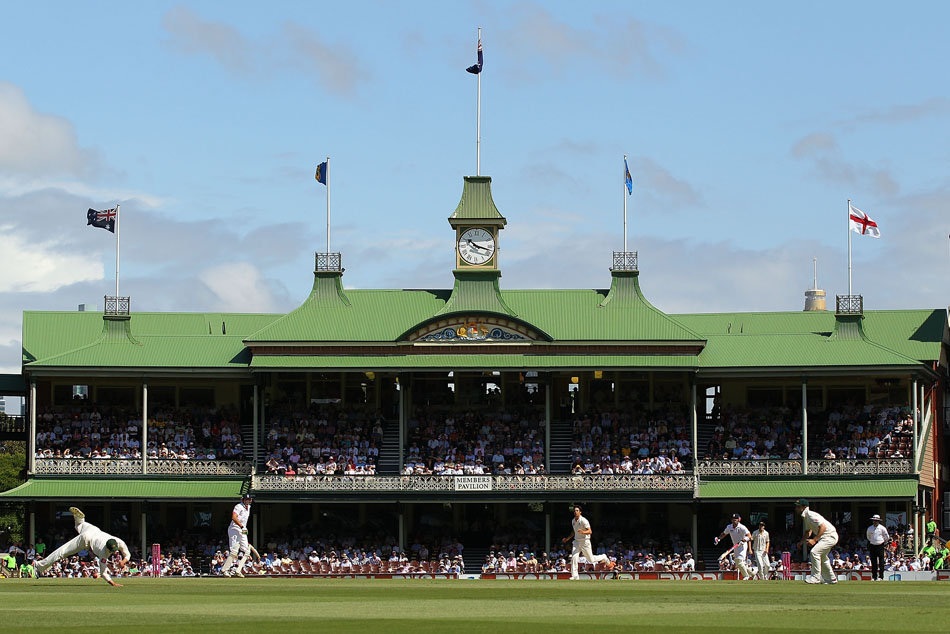
SCG is all set to host its 100th Test. Photo by Cameron Spencer/Getty Images

India’s batting has shown up to be brittle over the last year. A famed batting order has been tamed. And as much can be inferred from their recent performances, it must not be forgotten what they are capable of. Each of them have defined some great batting moments of the decade gone by, and some, like Laxman’s 281, have redefined the fortunes of their country.

Sometimes, it takes an enormouns effort to change the tide. Viv Richards’ decline in his last three years of his career were offset by Richie Richardson’s backfoot strokeplay and the emergence of Walsh, Ambrose and Patrick Patterson. The swagger never really disappeared and Australia seemed to be more worried about hosting the first three Tests on bouncy wickets before going to Sydney and promptly lost the series before the Sydney Test came along in 1988-89. Yes, it was an Australian side still re-building and West Indies was still the overwhelming champion concealing its cracks rather well.

But this is more the opposite for Indians. They are not fighting Steve Waugh’s Australia of 2000. Their batsmen made their names with performances against the great Australian sides and then some others. This is more a case of a heavyweight boxer returning to the ring after being felled by a young challenger. Often, adversity was tackled and overcome. But apparently, not so over the last year. The mind knows what it takes to be the champion again, but it also wonders if the punch is as strong as before, if the reflexes are still good enough to sway out of strong punches and if the legs can survive twelve rounds of boxing.

Sometimes, you need to take a blow and stand the ground to know that you can still do it. It was the same for a young Virender Sehwag playing the Boxing Day Test in 2003. He was peppered with bumpers, and after an hour of ducking and weaving, he was hit on the head by a Lee missile. He stood his ground and scored one of the most celebrated near double hundreds in Australia. He would later say that getting hit made him realize that there was nothing more for him to be afraid of. He was hit and he was still there. He realized he could take it. And he realized he could scare the opposition as much as the quick bowlers scared him and his teammates. Perhaps that one ball was all it took to shape his career in the remarkable way it did.

There are more worries and question marks over India than Australia going into this Test. Once the game starts, it only takes one inspired moment of cricket to change things around. A top draw batting order will fight its battles individually and collectively and a celebrated captain has confessed to having been conservative when he had the chance to finish off the battle with the right call.

Remarkably, bowlers have come through well in the first Test, and the captain and the supporters will hope the fitness and form will continue through the remaining Tests. Australia still remains a fragile batting side and it will keep the Indian bowlers interested even when a strong partnership is flourishing.

It is still a battle of two teams capable of lot more than what they have achieved of themselves over the last one year. Series are won over jelly beans, and careers made in a single Test. India should believe Sydney’s hundredth has one inspiring moment in it that will change the fortunes for them.

More than that, let’s hope the cricket helps erase the pains of 2008.

You can read the match preview from the Australian perspective here


Chandrasekhar Jayaramakrishnan

So we enter another chapter of the Gregorian calendar with the Australian team poised to enter the Sydney Test with as much optimism as confidence, given that their young bowling attack is not only steering the visitors’ batting out of Aussie shores, but loving the challenge of it. It is the quality that distinguishes great teams from other mortals – teams that possess enough ammo to grab twenty wickets consistently.

Even during tough times, especially after defeats to South Africa and New Zealand, there seemed a resilience and determination that promised perseverance. And the Boxing Day Test wrapped up those beliefs, although cynics would argue that the result of the first test had more to do with India’s self-aggrandizing interests, and some dreadful decision making. No wonder ‘Pigeon’ McGrath’s crystal balls predict a 4-0 whitewash this Australian summer, albeit his share of grossly incorrect predictions in the recent past.

It only seemed logical that Michael Clarke decided to stick with the same eleven he fielded in Melbourne, given that a four man pace attack on a Sydney wicket would not only break tradition, but deprive Nathan Lyon to execute his reworked methods based on the learning imparted during the first test. Given that he, by far, looks the most likely of spinners from Australian soil to pick up wickets consistently in the big stage, the petulance of an average outing against the Indians can be excused knowing that even the great Shane Warne didn’t have his share of success.

Australia’s batting, on the other hand, still has a few significant question marks that require addressing. Cowan’s grit in the first innings, Ponting’s flashes of brilliance, and Hussey’s determined second innings knocks, coupled with strong performances with the bat from the tail, aren’t strong enough to support the batting foundation that has enough to claim bragging rights. You would have been forgiven for thinking that Marsh probably didn’t play the Test. To rely on to old veterans to steer the ship isn’t a great sign for the future – an issue that even the visitors are facing in parallel.

Clarke will need to score runs to ease the burden on the ageing Ponting and Hussey © TopNews

Skipper Clarke’s magic with the ball at the SCG Test towards the end of Day Five last tour brought one of the more controversial Tests to have ever been played to a nail-biting finish. Given that his contribution with the bat would hold more value in a lineup that clearly lacks experience and numbers, excepting the two veterans, his quasi-purple patch of late will demand more runs from his willow. As would Brad Haddin’s contribution with the bat – although Tim Paine, touted to be the next in line for the job behind the wickets, is out injured.

The Aussie public, without doubt, will be relishing the prospect of witnessing an eleven with the currently injured Cummins and all rounder Shane Watson, whose potential slot in the batting order is a matter of endless debate. But that is a discussion for another day. Meanwhile, the likes of the ‘stop-gap’ members would well bring out performances to ensure that they don’t find themselves in the shoes of the promising Hughes and Khawaja.

One can only hope that this year’s Sydney test is a lot more exciting, and a lot less controversial than its own course of events last tour.

You can read the match preview from the Indian perspective here


Chandrasekhar Jayaramakrishnan

Anyone who experienced the events leading up to Tendulkar’s half century on Day Two of the Melbourne Test would have been forgiven for thinking that the Boxing Day test was hovering towards a Tendulkar biopic fleetingly waiting to acknowledge a long awaited milestone. The next couple of days, however, seemed to outline the fact that the periphery of this achievement has rather harsh boundary conditions. As did the hopes of a victory on foreign soil, given that India’s next tour outside the subcontinent is a far two years away.

Thus, yet another favorable Test result has vanished into oblivion, leaving many of us wondering over the secret behind the magical formula that Gary Kirsten possessed, that others didn’t. A logical thought would question the challenge posed by during those tours outside the subcontinent when Kirsten was in charge as compared a tour to England and Australia, the latter by no means pushovers albeit their recent results.

Cricketing plans, in general, anticipate years of austerity and stability with fitness of talent pools ranking high amongst others. While talent remains plentiful in supply, the longevity of most remains a function of form and/or fitness. A lot of the younger players who’ve paid brief visits to the international setup resemble the yesteryear Internal Combustion Engines that possessed low volumetric and thermal efficiencies – a direct correlation to unfavorable statistics and rapid breakdown. Temperament remains a spark plug that pre-ignites when exposed to high temperatures.

Virat must be persisted with, and the quick hopeful fix of bringing in Rohit instead will only send wrong signals © ThatsCricket

Having said that, it is important to remember that the inevitable day when the Indian batting would be forced to field a middle order that resembles the current Australian top order – sharing a grand total of five test matches between them – isn’t far away. Whether the best laid plans weave a middle order fabric that fills the gap between the large sized shoe and small feet will remain unanswered for some time to come, it will be worth persisting with a few who’ve shown that with time, maturity evolves.

Persisting with Virat Kohli for the rest of the series, irrespective of the statistics that come out, is one way to tap the right ore. Given that he has matured into an outstanding ODI cricketer, it is hard to imagine why he cannot replicate his achievements in the longer formats. This would, on the other hand, mean shutting the doors for Rohit Sharma this tour, who seems to have picked off from where he left off the last time he toured down under. He has certainly seen enough downslides to let this hit his game hard again.

The archetypal Indian sentiment would find it hard to drop a veteran to accommodate a couple of youngsters given the lack of proximity of the next tour abroad. One may find it even needless to house such a need given that a prolonged gap wouldn’t require youngsters to be armored with foreign soil experience as immediately as the present moment. Even if the contrary decision was made, there is every chance that a few selectors could be painted as villains by a section of the fans and media for robbing their ‘local legends’ of a last ditched attempt to gain glory. The fact is hard to argue against, given that the veterans have had very good track records down under during previous tours.

But again, only one out of the four scheduled tests have been completed – even if it was premature. A Test match that gets over with over a whole day’s play left reflects quite strongly on either the nature of the wicket, or a single sided dominance. The effect of losing a potential entire cricketing day dances to a different tune than the one set by Samoa changing time zones in order to remain in line with its trading partners who are nearly a full day ahead.

The key for India to succeed will remain focal around sticking to this combination. The inabilities exposed haven’t changed with time – the opposition tails have forever wagged at amplitudes that summate those of all hundred odd Dalmatians. A large part of the blame, as gathered through eavesdropping on discussions between common man and common man during train and bus journeys, among others, has been cannoned towards MS Dhoni and his ‘defensive’ methods. The picture painted resents a star who neither takes his himself nor the dream job too seriously.

Although in reality, the belief must be that the Indian tail fails to place a price on its wicket. As much as men want to hate (yet find it hard not to like) Harbhajan Singh, he proved the most infuriating of all lower order batsman to get out, even amidst bouts of unaffected public depreciation down under. Ashwin, a craftsman plying the same trade, seems the nascent player showing signs of steadiness amongst a sample that includes the Indian skipper. Dhoni’s lack of inventiveness in wiping out an opposition tail would certainly have been neutralized, or even forgotten, had his willow yielded more runs.

The series is still young and alive, and whatever was learnt out of Melbourne must be applied in Sydney for sustenance. This would mandate sticking to the same combination, unless injuries hamper the thought, if India hopes to gain anything out of Sydney.


Prasad Moyarath

The MCG pitch was the best thing about this Test. Photo: Sebastian Costanzo

Yet another Boxing Day Test debacle for India or another usual Indian start for an overseas tour. The Boxing Day Test match result can be interpreted by an Indian fan in either way but irrespective of the result, this Test match between India and Australia provided a great advertisement for Test cricket. Though this match lacked the usual intensity of an India – Australia duel and finished in four days, the entertainment it provided was worth for any Indian who woke up early morning in this chilling winter to watch it on television. The Test match which started on a cloudy day with a few rain interruptions on the first day proceeded in bright sunshine leaving a doubt whether the rain Gods were sitting and watching with awe.

Not a single century scored, only a single five wicket haul, what was that made this Test match so special? For those who did not follow this match, its scorecard won’t provide the right answer either.

Going into the Boxing Day Test match, concerns were many for both the teams. The career of Ponting and Hussey hung in balance and they were contemplating playing Christian in place of one of the two. Hilfenhaus was making a come back and Cowan making his debut. For India, the fitness of Zaheer and Ishant was the major concern and so was the ability of their batsmen to adapt to the Australian conditions.

Michael Clarke’s decision to bat first on a cloudy day though raised the eye brows of many, considering the poor batting record of India in Melbourne, was a daring one which was vindicated in the coming days. Warner gave an explosive start to the Australian innings but an incisive spell of fast bowling by Umesh Yadav helped India fight back. Ponting despite been hit on the helmet by Yadav at the start, made his critics eat their words with a fluent innings which was cut short by a Yadav’s beauty. Two dubious umpiring decisions against Cowan and Hussey ignited the debate on UDRS and BCCI once again. Ponting and Hussey proved that they are still good enough to play for Australia with some fine batting in the second innings. Australian tail wagged in both innings, thanks to some unimaginative captaincy from Dhoni. Hilfenhaus made a remarkable comeback was well supported by Pattinson and Siddle.

Sehwag played in his own style in both the innings and luck favoured him only in the first. Australian bowlers never looked like bowling in the right areas on the second day and Sehwag, Dravid and Sachin capitalised on it. Sachin was the only batsman who looked comfortable in both the innings. Dravid getting bowled in both the innings has put a question mark on the technique of this great player. Gambhir and Dhoni continued their poor run outside the subcontinent and Ashwin made Harbhajan’s absence inconspicuous. Indian pace attack put relentless pressure on the Australian batsmen and Ishant and Umesh clocking 140+kmph consistently was a delight to watch.

Three of the four days ended like a television serial leaving the viewers to ponder what next. Scores of both teams in each innings drew a slanting graph line putting a question mark on the quality of the pitch. But for those who watched this Test match on a drop in pitch, the curator was the Man of the Match ahead of the official choice.


  Bini Sathyan

If Australia had declared yesterday at end of play and put India to bat in the first session today, the match would have ended in 30 overs. It is a shame we could not bat out 50 overs. Except Sachin, no batsman in the Indian camp looked good. Sachin did not seem to have any major problems and looked very solid in both the innings. It really looks like his century could happen in Australia.

It was all too familiar when the Indian batting surrendered meekly to register their 5th straight away loss. Photo: Pat Scala.

Sehwag was his usual self – he lived and died by the sword. But the other opener, Gambhir seems to be a misfit in the Australian pitches. Either he is not learning from his mistakes or the Indian team coach is not interested in him. He got out in similar fashion to different bowlers in both the innings. Unless he can resist the temptation of sticking out the blade at an angle in the last moment to an away swinging ball, he might not get to play a long innings in this tour. Rahul Dravid did frustrate the bowlers to an extent but did not look comfortable during his stay in both innings. Kohli has got a taste of the Australian pitches, but he being a quick learner, we can expect more from him. Dhoni tried to attack but seemed out of sorts. He is yet to come good in such conditions.The sooner things improve in the batting department, the better for the Indian team.

The bowling that was considered India’s weakness looked promising with Zaheer leading the attack. Umesh and Ishant looked very good. They were just unlucky that they did not get more wickets. Ashwin promised a lot but was unable to deliver in the 2nd innings. He is turning out to be a an all rounder.

What experts considered as the inexperienced bowling attack of Australia easily got the better of the the most experienced batting line up in the world. They seemed to have done their homework very well and had a plan for every batsman. Though it did not work for Sachin, they easily got the better of him by using plan B which was to stop his flow by denying him the strike.

Siddle, Pattinson, Hilfenhaus all looked menacing. If India does not learn from the mistakes and improve, this bowling attack will push them further down the ranking ladder. Pontings determined comeback will only augur well for Australia in this series. Mr. Cricket, Hussey, as usual played his role to perfection. He led the fight back along with ponting. They have found a good anchor in Cowan who before the series was planning to watch the matches from the stands and instead got to watch it from the inside circle.

Warner is a destructive batsman like Sehwag and he almost got going in the 1st innings. But India was lucky that he tried to do too much. With Marsh and Clarke subdued by the Indian bowling, Australia was held back from a big score. But this was not enough to hold them back from winning the Boxing day test and take a 1-0 lead in the series. India’s hope lies in the fact that they have bounced back many times in the past from the initial shocks.