Taking Guard In Style

Posted: May 11, 2012 by binisajan in Cricket, IPL, Opinion
Tags: , , ,

Bini Sathyan

Some of the big hitters of the game whom I admire very much have peculiar styles when they come out to bat. A few of them I felt really peculiar are Chris Gayle who I think comes in like the Predator, Morne Morkel who always looks lost, Virender Sehwag who gives the impressions of a lazy goose and Dhoni who is emotionless. Read on.

Chris Gayle: When he comes out to bat with the helmet on, the locks hanging from behind his ears and the black bandana shielding his neck, he looks like the alien from Predator in full body armour. Moves around sluggishly as if unbothered about the territory he is in and has a cold stare. The bat looks like a small club like weapon attached to his left hand whenever he is in armour. He looks menacing. Before taking guard, he will look around sluggishly once again as if to find a target. Then just like his cold looks and slow movement, he will start tapping his bat in slow motion which means he is ready. Now he fixes his stare on the bowler running in. Once the ball is delivered, his hands move so swiftly and the ball is hit so hard with the bat that it more often than not lands in the stands and sometimes attains escape velocity. He launches his attacks with such ferocity that bowlers start erring in line and length. It is immaterial where the ball lands on the pitch as Gayle ensures that it lands in the stands after that.

Gayle: The predator

Albie Morkel: A 6 foot plus giant, he strides into the middle unassumingly and in no hurry and looks like a child lost in the forest. Looks around in surprise, as if he was suddenly awakened in the middle of his sleep and finds himself in hostile territory. Looks around once again and realizes that he is in the middle of a cricket ground. Takes guard but still looks surprised. Prods at the first couple of balls and then suddenly understanding dawns. The next ball probably lands in the stands. He is probably the most powerful hitter around. Some of his sixes have hit the roof and threatens to go overboard.

Virender Sehwag: The laziest goose around. The man with the most laidback attitude. His body shape and movements will never reveal that he is a sportsperson. Comes out to the middle in a very casual way. And in the middle, he simply refuses to leave the crease for a run. And when he does, his running looks funny. You realize that he simply does not love moving around too much. Left to face the bowler, he takes his stance in an easy manner and waits and waits like a cat for the ball to be released. Then all of a sudden there is transformation. His eyes widen. The bat swings in his hand. It’s all over in a flash. The ball vanishes in thin air and reappears outside the field. Fetch is the call to the fielder. All this while his feet doesn’t move. To know what happened, the television crew invented slow motion replay. He is a magician. A man gifted with such perfect timing. He relies only on his eyesight. Once his eyes spot the ball, his brain knows where to despatch it. The hand just executes the order. No coaches will prescribe to their scribes to learn from him because he does not follow the copy book. But has written one for himself.

The TV crew inveted slow motion to study Sehwag’s stroke-play

M S Dhoni: He seems to be a man in a hurry. Comes out to bat in a hurry. Before taking guard, looks around, keeps moving and exhibits plenty of gestures. He touches his pads, hits his gloves, touches his face and the motions continue for a while before he settles down to face the bowler. This peculiar action sequence is repeated before every ball. He is a slow starter to bat. But once he gets going there is no stopping him. The speed at which he moves the bat and the power which he garners when he hits is matched by none. He remains unfazed when he comes out to bat whatever the situation. Out in the middle he expresses no emotions. If he hits the winning runs, still the emotions are hidden. And when he is out, he still seems to be a man in a hurry. He walks quickly back to the pavilion again without revealing any emotion.
IPL Addiction

Posted: May 6, 2012 by binisajan in Cricket, IPL
Tags:

Bini Sathyan

Contrary to popular perception of the media that the fifth edition of the IPLT20 will not draw enough eyeballs and the concern of the cricketing authorities about the dwindling numbers of fans at the venues, the 5th season of the IPLT20 is a runaway hit. Though it began with a few low scoring matches, it gained momentum with the century scored by Ajinkya Rahane. The thrills started coming with the chases led by Rohit Sharma and then Morkel. From there it just took off with a lot of big hitting high scoring and nail-biting finishes. Now the stadiums are full and the television ratings are picking up.

For me it was goodbye to boring TV shows. Great entertainment in the evenings. And sleeping past midnight. I am addicted to the IPL and have my own reasons for being so. My love for this two month entertainment carnival started in the first match of the first season when Brendom McCullum went berserk and hit anything hurled at him out of the park. He scored a staggering 158 runs which could be more than the average total of most of the teams. He was nuts and I got stuck.

It is not often that you get to watch Sehwag bat along with Kevin Pietersen. Now that is aggression from both ends. You get to watch this only in the IPL. The forthcoming showdowns are even better. For the Delhi Daredevils, it will be Sehwag opening the innings with his double: Warner! That combination will be a death warrant for the bowlers. Another destructive combination is the Gayle force that will blow away the best and the explosive batting of Dilshan in tandem to open the entertainment. And a de Villiers coming down the order to sow devastation all around for the Royal Challengers Bangalore.

For those who are missing the smashing opening style of the retired Gilchrist who ran away with a world cup final in the blink of an eye, the IPL has brought him alive from retirement and he is captaining, keeping and opening for a Punjab side. The Wall is rebuilt by the IPL in a different avatar. He is the captain, the opener and a fast one at that for the Rajasthan Royals an exciting side which showcased India’s hidden gems more often. The world’s boldest and most result oriented captain, Michael Clarke playing under Saurav Ganguly for Pune Warriors owned by the Sahara Pariwar, the sponsors of the Indian Cricket team. The world,s best fast bowler Dayle Steyn bowling his heart out for a South Indian team of Hyderabad. A big hitting Pollard playing alongside Sachin for Mumbai Indians under Harbhajan Singh. Muthiah Muralidharan and Daniel Vettori bowling in tandem for Royal Challengers. Fancy a showdown between two of the greatest captains of Indian cricket – Ganguly and Dhoni, and you have it.

A combination of different nationalities joining forces brought together by the business power houses of India and the Kings and Queens of Bollywood entertaining a cricket crazy nation whose thirst for cricket is unsatiable. These scenes would have simply been in the realms of fantasy had it not been for IPL T20.

An Ajinkya Rahane who could be India’s future opener getting to facing Dale steyn or an Awane who is yet to debut on the international stage would not have got an opportunity like this to test their mettle against the best of the best.

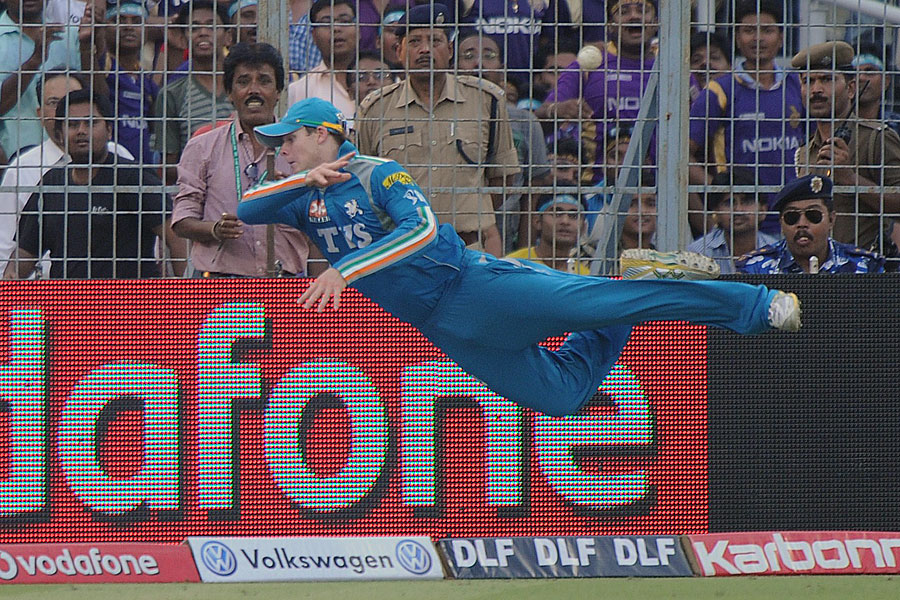
The IPL has thrown in many amazing moments like the immaculate power hitting of Dhoni where he sends the ball floating out of the stadium. The switch hits of Pietersen. The Dilscoops. The Upar cuts of Sehwag. Gayle scoring 31 runs in an over and also launching a few into orbit. Albie Morkel smashing 28 runs in an over for a famous victory when all seemed lost. Rahane’s deft touches bringing him 24 runs off an over. Awana fearlessly sending down bouncer after bouncer when Pollard was in his elements and tying him down to the crease. An amazing fiery spell of fast bowling by Steyn against MI. And then the most amazing of them all – Steve Smith flying like superman and pulling back a ball from the air which was sure to land out of the boundary. The way in which he was flying in the air in a blue dress with one arm outstretched looked like watching superman in action sans the cloak. These are a few of my favourite and amazing moments of IPL-V.

A Ganguly of the yesteryears running across the ground in excitement on getting a wicket was hair raising and took me back to the memories of the Natwest trophy final. A 41 year old Brad Hogg diving around and celebrating like a kid at the fall of each wicket. And most interesting of all was the paradox of Ganguly fans. The same crowd that was rooting for Dada with all those placards and banners across the stadium celebrated at his fall! Well that was because he was felled by the Kolkata team. Welcome to the great cricketainment carnival of India!

This year’s tournament has also seen the rise of new players specially a couple of good spinners and the fall of some mighty ones. Yousuf Pathan has been one of the most explosive batsmen in the first few editions. But has turned out to be the biggest flop till now. The greats like Jacque Kallis  who seemed to have cracked the T20 format look to have forgotten how to bat in the shortest version. But Sachin has shown his class against CSK after a few forgettable outings. Kohli is another star whose firepower is yet to be seen. The match winners like Husseys, Shaun Marsh, Ross Taylor too have not performed. Dada at times showed the glimpses of his old self when he was considered the God of the off side but seems to be too slow for the format.

The tournament is getting more and more exciting with 17 matches that went down to the wire. Lot more tight finishes and big hits are expected with the Australians too coming in full force and a few more big guns yet to boom.

The IPL is a power packed treat condensed into just 3.5 hrs where you need not wait for the explosion till the end of the innings if you have missed the opening treat. It is action packed throughout. In such a short span of time you can see many wicket taking deliveries and a lot of wickets tumble. The boring centuries are no more. If there is one, it will certainly be explosive. The thrills are guaranteed. A last over finish if not a last ball finish has become the norm. Now this is value for money. Keep chewing your finger nails and be glued to the entertainment.

The IPL5 2012 winner?

Posted: April 8, 2012 by muthumra in IPL
Tags: , ,

The battle for the IPL5 trophy has already begun!

With each team competing strongly, who is your favorite this time? Go ahead and vote for your team!!!


Goutham Chakravarthi

It is but natural that people pick the best players from their generations as the sport’s best ever no matter what sport. For many octogenarians, Sydney Barnes was the greatest bowler to play the game of cricket as would many middle-aged men swear by Malcom Marshall. The spread is similar in all sport. Here, I take a look at one of tennis’s all time greats, Jack Kramer, who, as a player and as an administrator.

Early Years

Kramer: Tennis's single most significant figure

Born to a railroad man in Las Vegas in 1921, Big Jake would go on to be a part of the golden generation of American tennis players who dominated world tennis: King, Marble, Riggs, Schroeder, Wills, Budge, Vines.

Young Kramer played an aggressive game with a huge serve, which he generally followed-up with a winning volley much like the way Pete Sampras played.

His aggressive serve-and-volley game earned him a doubles spot in the U.S. Davis Cup team in 1939. Almost immediately after that Kramer went away to serve as a Coast Guard officer during the Second World War. He lost some of his best years serving as the Coast Guard officer at the pacific.

After returning from the war he had a great run at Wimbledon in 1946 only to lose in the semifinals as he suffering from blisters in his feet. He went on to win the U.S. Nationals, forerunner of today’s U.S. Open, the same year.

He followed it-up with a victory at Wimbledon in 1947, where he swept past the challenge of Tom Brown 6-1, 6-3, 6-2 in a mere 45 minutes.

He went on to defend his U.S. Nationals title in a classic five-setter; coming from two sets down to beat Frankie Parker.

That finals holds significance, as it was just before the final that Kramer decided he would turn professional.

“It was simple,” he said. “I needed the money.”

Also, those were the times of “shamateurism,” when players remained amateurs in order to compete in major tournaments, but took money under the table.

It was a significant step for tennis and as Bud Collins, Hall of Fame tennis journalist observes of Kramer, “From a competitor to an administrator to a broadcaster, Jack Kramer was the most important figure in the history of the game.”

Between 1946 and 1953 he was considered to be the no.1 player in the world. At the peak of his powers as a player, he was asked to endorse a racquet from Wilson Sporting Goods. They named it Wilson Kramer.

At His Peak

Kramer chucked his beloved Don Budge racquet for Wilson’s new one, but sent it back after going down to Bobby Riggs. He asked Wilson to repaint it, and Wilson obliged, as they wanted to have a racquet named after Kramer.

Since 1947 Wilson has manufactured more than 30 million Jack Kramer Autographed Racquets, giving it the distinction of being the most popular racquet in the history of the game.

Kramer was to get two-and-a-half percent of the racquet sales. Wilson eventually had to renegotiate the deal as the racquet sold by the millions.

“We just did a flat rate,” Kramer said. “I understood. I was making more money than the president of Wilson Sporting Goods.”

He started playing on the pro-tour playing in cities across the world. He had a great time against his rivals Bobby Riggs, Frank Sedgman and Pancho Gonzales. With little left for him to achieve, and suffering from an arthritic back, he retired in 1954.

From Player to Advocate

He was, by then, running the pro-tour that he had dominated so much. He took on the tennis establishments of Australia, England and other nations and sought identity for professional tennis.

In those days, there were severe restrictions on the money that could be taken out of Australia, so Kramer took some of his earnings in racehorses.

As “The Kramer circus” grew in stature over the years the pressure began to tell on the tennis federations, which finally led to the establishment of “Open tennis” in 1968.

From Advocate to Executive

In 1972 he became the first executive director of the players union, Association of Tennis Professionals (ATP).

Kramer also served as an announcer at Wimbledon for the BBC. BBC banned him in 1973 following a player boycott headed by Kramer. Niki Pilic, the Yugoslavian, refused to play in the Davis Cup and a suspension by the International Tennis Federation extended through Wimbledon.

When Wimbledon honored Pilic’s suspension, Kramer led a player boycott that left Wimbledon bereft of top players. Kramer turned villain as a result. But, as it turned out, it led to players gaining more control of tennis.

Kramer was a shrewd businessman. He once hired “Gorgeous Gussy” Moran to serve as a part of his warm-up matches for one of his tours. As you’d expect he hired her more for her beauty than for her game.

His belief that women didn’t sell as well as the men eventually cost him in 1970, when Billie Jean-King led a walk-out after a tournament run by Kramer. That event, the Pacific Southwest Tennis Tournament, offered only 15 percent of the available prize money ($50,000) to the ladies.

The walk-out led directly to Virginia Slims Tour and then to the creation of Women’s Tennis Association (WTA).

Final Days

The Pacific Southwest Tennis Tournament became the Jack Kramer Open in 1979, and was known by that name until 1983. His son Bob Kramer now runs the event at the UCLA Tennis Center.

This year Jack Kramer saw his last tennis match from the sidelines of that UCLA Tennis Center, as he took in an exhibition match between Pete Sampras and Marat Safin.

“Dad loved the way Pete played,” Bob Kramer said, “because it was a lot like he played.”

“He was a class act and always willing to help. I was happy to see him and say hi at the L.A. Tennis Open. This is truly a great loss for tennis,” said Sampras the day after Kramer passed away.

Ramanathan Krishnan, the ace Indian player who was offered a three-year contract for $150,000 in 1959 says, “He was a great player, a critic, commentator, and above all, a wonderful human being who cared for fellow players. Open Tennis, as we see today, is the legacy of the great Jack.”

“We all needed money and he helped a lot of players get some,” says Rod Laver who came into the game when Kramer was a monumental figure in tennis.

Jack Kramer knew everyone in the game of tennis for over half a century. He was a great tennis player and an astute businessman, but it is for his contribution in the elimination of the line between professionals and amateurs that he will be best remembered.

A version of this article first appeared on Bleacher Report


Goutham Chakravarthi

With this being the Olympics year, and with Usain Bolt being its main attraction of the Olympics’ blue-ribbon event – men’s 100m – here is a re-look at the race that stunned the world, when he ran the 100m in an astonishing time of 9.58 seconds.

August 19, 2009

Every batsman around the world must be thanking his heavens that Usain Bolt gave up fast bowling for sprinting. At 6’5” and capable of doing the 100 meter dash swifter than I can in my car, if his bowling speeds was anywhere near his sprinting deeds he’d have been a handful!

Cricket’s loss is athletics’ gain. On Sunday in Berlin he decimated his Olympics time of 9.69 seconds by 0.11 seconds to stun the sports world. Sprint records are meant to be broken incrementally like in long jump, pole vault or high jump.

Here, within a span of 9 and half seconds, he went a generation ahead of everyone else like Jesse Owens did with his long jump leap at the 1936 Berlin Olympics. If anything, it is befitting that both should have happened at Berlin where Hitler wanted to demonstrate the superiority of Aryan race over ethnic African race.

Sample this: since Jim Hines became the first man to go under 10 seconds in the 1968 Mexico City Olympics to set the then world record, it has been broken 12 times since.

Bolt: Simply the best

The world record time has never been bettered by more than 0.05 seconds – when Maurice Green clocked 9.79 seconds in Athens (1999) he broke Donovon Bailey’s 1996 Atlanta gold medal winning performance of 9.84 seconds by 0.05 seconds.

Ben Johnson did thrash Calvin Smith’s world record of 9.93 seconds by 0.10 seconds in Rome in 1987 only for his time of 9.83 seconds to be disallowed along with all his other achievements between 1981 and 1988 after testing positive right after winning the Seoul Olympics gold with another world record time of 9.79 seconds.

That it took another 12 years for anyone to get to that mark of 9.79 seconds shows how difficult it is to nick a good 1/10th of a second off the world record. Bolt has now smashed his last world record of 9.69 seconds from Beijing Olympics by 0.11 seconds. It has never happened before that a sprint record is bettered by so much, at least since electronic timing came into the sport in 1977.

He is the only person to have breached the 9.7 and 9.6 seconds’ barrier. Now he says he can go under 9.5 seconds! The next fastest time ever is 9.71 seconds – Tyson Gay (0.13 seconds behind). Asafa Powell’s best is 9.72 seconds.

The 12 fastest men after Bolt are separated by a mere 0.15 seconds between them. It simply shows how much he is dominating his sport and how far ahead he is from anyone else.

It is not like Sergei Bubka and Yelena Isinbayeva bettering their pole vault world records by a centimeter or two each time, it is like bettering it by 15 centimeters at one go (Bubka took more than 10 years to better his world record by 20 cms and Isinbayeva has taken 4 years to increase her record to 5.05m after breaking the 5m barrier in London in July, 2005)!

Bolt is sprinting his way to becoming the greatest athlete of them all. 9.58 seconds! I still can’t believe it!

This article appeared on Bleacher Report on August 19, 2009.