Prasad Moyarath

If the crowd presence on the ground and the pre and post match analysis by the media are any indication of popularity, the first ODI between India and SriLanka has been indubitably cold shouldered by the cricket fans of both nations. Don’t forget, the revelation of Rahul Sharma’s drug usage during IPL had already triggered a controversy prior to the start of the series. A rustic start sans rain on a huge ground in SriLanka was not an unusual one for an Indian cricket connoisseur, but an Indian victory surprised many.
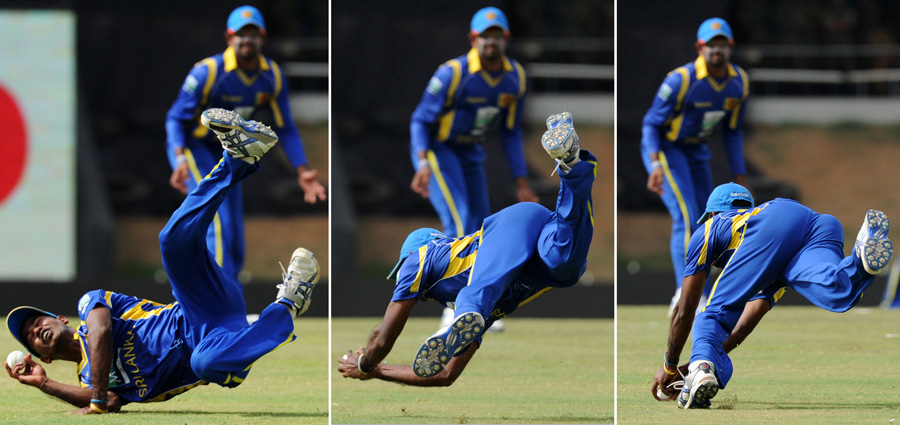
Another game that raised a debate about technology ©AFP

A huge ground with a shortened boundary and windy conditions excited many, but the dull rattling sound of the white cherry hitting the willow and the two paced wicket doused their excitement in no time. Sehwag struggling to get going and Dilshan dropping a straight forward chance offered by Sehwag, though unbelievable was accepted as symptoms of start of a fresh season.

Kohli and Sehwag made use of the fielding lapses of SriLankans and laid the foundation for a huge score. Kohli with his consistent performances in the recent past looks all set to be a new generation Ricky Ponting. Raina and Dhoni did well to maintain the momentum after the fall of Sehwag and Kohli. The SriLankan bowling attack looked toothless and Herath could not extract any turn. Kulasekara’s injury added to their woes.

The Sri Lankans had a start similar to the Indians. Irfan Pathan moved the ball in and out and looked like regaining his lost bowling form. Though his speed was in the late 120s, he seemed to bowl with his original bowling action unlike the high arm action with which he bowled, the last time he made a comeback. Umesh Yadav bowled a lot slower and raised a doubt whether he is becoming yet another Indian fast bowler who becomes a medium pacer after establishing in the squad. Ashwin extracted turn from the pitch which was missing when the SriLankans bowled. Yet another masterpiece from Sangakkara which proved that he is in top form. Perera proved his worth as an all-rounder. 16 wides from Indian bowlers led to their slow over rate, once again putting Dhoni in trouble.

While the cricketing nations debate over the introduction of new technologies into the game, this match exposed the limitation of the existing technology and the need to improve it. Sehwag was caught by Kulasekara with an acrobatic dive but the television cameras could not give a conclusive evidence of the catch and so allowed Sehwag to play a big innings. Another instance was the run out appeal against Sangakkara. Though his bat appeared to be on the line when the bails were dislodged, the cameras failed once again in giving a conclusive evidence which helped the batsman. It is time the ICC and the broadcasters sit together and find solutions for such problems. Using technology and giving the benefit of doubt to the batsman due to its limitations puts a question mark on the worth of it.

Had Dilshan caught Sehwag, had Kulasekara caught Sehwag cleanly, had Dhoni or Sehwag caught Sangakkara when he edged Umesh Yadav between the keeper and first slip in Umesh’s first over, this match provided a lot of possibilities to ponder. If what was seen in this match is any indication of what is going to happen in the coming matches, the batting of Kohli and Sangakkara and bowling of Irfan Pathan needs to be followed. Let us hope for an interesting ODI series in the coming days.

Goutham Chakravarthi

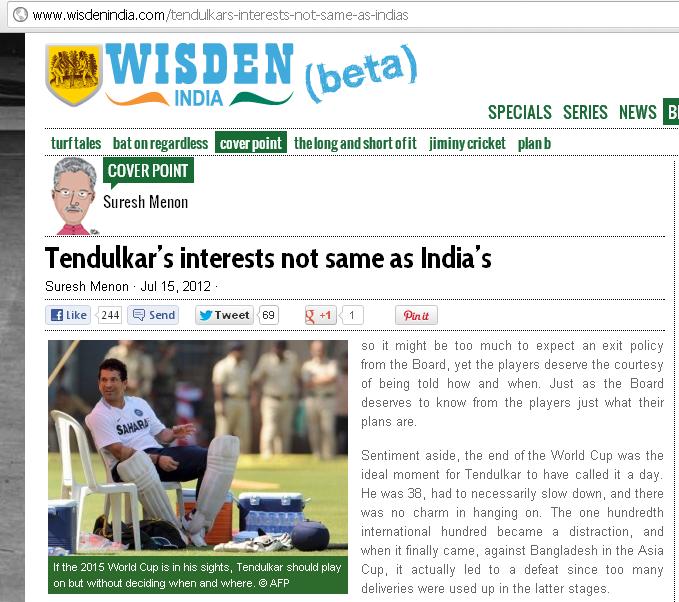
Earlier today, Suresh Menon’s  article appeared in Wisden India with the heading ‘Tendulkar’s interests not same as India’s‘. This is not about my view on Tendulkar’s retirement or any retirement for that matter (of which I have already shared my view). This is more about the very headline of the article. While what much of the article around Suresh Menon’s well documented opinion of how Tendulkar’s career is now controlled by his commercial interests, I felt this time, it went from being just his opinion to a verdict or judgment of sorts – that he claims Tendulkar put his interests ahead of the India’s seemed not a mere inference of sequence of events or a likelihood. Menon was certain. He wrote, “clearly Tendulkar’s interests are no longer the same as the country’s, certainly not in one-day internationals.”

The sequence of events leading up to this article is fishy.

A sequence of events surrounding this article and coming from Wisden India now has got me thinking if there might have been an ulterior motive to him writing what he did. Read me out.

First, let’s start with Wisden India itself. Bloomsbury announced late last year their foray into India through Wisden India. This year they have now become fully functional. With an ambition ‘to be a single consolidated voice of Cricket, and to be known as the ‘Home of Indian Cricket.”, they seemed serious (It is a competitive market with Wisden India facing stiff competition from ESPNCricinfo and Yahoo! Cricket) and they roped in big names including the likes of Dileep Premachandran as Editor-in-Chief and Suresh Menon as Editor Cricketers’ Almanack.

So when almost exactly a month ago, Wisden India awarded Tendulkar with the Wisden India Outstanding Achievement award it seemed a good way market itself in the process. It was also announced that Wisden India would hold five more such dinner events involving Sachin Tendulkar over a period of three years. It was apparent that Wisden India had invested themselves in brand Tendulkar.

So when Tendulkar pulled out of the one-day series against Sri Lanka citing he needed to spend more time with his family, predictably, media space was abuzz if he ought to be able to pick and choose the series he plays in. Following the pull out, Wisden India’s when Editor-in-Chief Dileep Premachandran decided to write that selectors ought to be the ones that decided who should be picked and who shouldn’t. Here’s where things got a little fishy. At least, to me.

Surprisingly, the article appeared in the UAE based The National and not in Wisden India. Of course Dileep Premachandran contributes to The National and also The Sunday Guardian. But an article on Tendulkar and selection didn’t warrant a feature on the site that aspires to be known as the ‘Home of Indian Cricket.’

Perhaps the investors on the Tendulkar brand for three years didn’t want to jeopardize by carrying a story that seemed to sort of accept that it may not have been a wise investment. Or that it might jeopardize relationship with the player himself. Whatever it was, it appeared as though the investors got their way.

But it didn’t escape the fact that the article did appear on UAE based The National. Did it mean Wisden India would refrain from carrying out any ant-Tendulkar stories for another three years?

No, apparently not. At least from this article earlier today. Whether it means Wisden India do not want to be seen to be favouring a certain player, or if it was a case of a decorated and high-profile writer wanting to show that he couldn’t care less for his employer or their investment and would get his own back  against the both of them are all possibilities.

In any case, opinions are points-of-view based on facts and inferences. Like Suresh Menon disagreeing with Sanjay Manjrekar’s opinion that Dravid was not talented for example. Or his example that Dravid and Boycott were examples of  constructive and destructive selfishness respectively. Infering from shrewd observation like how the investment industry is linked with Tendulkar is what alalysts like Suresh Menon or Mike Atherton are very good at.

But to be certain of Tendulkar’s interest not in line with his country’s seems beyond a mere opinion. More a judgement of character. And it cannot be pinned on a player just because it appears the whole cricketing commerce revolves around him. And it sits uneasily on me more to do with the sequence of events leading up to this article.

While we want our writers to be unbiased and critique for what is best for the game, we wouldn’t want them to influence us with views that may be intended just to prove a point. Cricket is struggling enough to fight corruption, maladministration, and player agents and con men influencing player selection.

We don’t want the small circle of our best and honest writers use their power to fight their personal battles.


 Niranjan K

Sport has a way with human emotions. It transcends geographical boundaries and let people enjoy and adore such great athletes with amazement. There are tournaments that are crown jewels in every sport and lift that particular sport by a few notches. Every football player who trades his wits in Europe wants to play in the Champions League. In Cricket, it’s about being part of a World Cup winning team. Wimbledon is one such event that catches the breath of the tennis world. You may be a winner of 3 other grand slams and World No 1 but you are not regarded as great until you walk out SW19 as Wimbledon Champion.

So what makes Wimbledon special? Is it the place, the royals, the whites or the strawberries? The same set of players who compete in Wimbledon battle week in week out for the rest of the year. But why do great Champions cry in the post match presentation only at Wimbledon? What makes such legends like Sampras and Federer even at 30 years of age and 6 titles already in the kitty, come back and win it like it was their first? Why this romance with the tournament which first started as a fundraiser?

When I first started watching Wimbledon, it was a time when Pate Sampras took over the baton from Boris Becker. When Pistol Pete, with his cool demeanor and a vibrant smile, broke down in the post match presentation, I wondered why a sports person would cry for winning a tournament. But it took me 9 years to know the answer when Goran Ivanisevic’s near impossible journey from a wild card ended as the new Wimbledon champion.

Roger Federer’s mastery of tennis is artistic and complete.Photo: Kirsty Wigglesworth

When you look at someone like Sampras and Federer Wimbledon, you know that they are destined to be great champions there. Everything about them is Wimbledon. Quality. Class. Elegance. It was almost like a long decided arranged marriage, always meant to happen. But Ivanisevic’s was a love story of theatrical content. Before the final I was not thinking too much of Ivanisevic but by the third set in the final I was fully behind him and when he won even I had moist eyes. I didn’t know why but I realized that it must have been something special. His relentless pursuit to be a Wimbledon Champion showed why this is such a prestigious tournament.

One of the reasons that I love Wimbledon was the fact that it encourages serve and volley – or it is supposed to, at least. In other grand slams, you don’t really notice the beauty of moving around the court like here in the lawns of SW19. And it broke my heart when such a wonderful expert of serve and volley like Pat Rafter never won at Wimbledon. It also explains why someone like Ivan Lendl, a wonderful player otherwise, also never won the championships.

Lendl was a force from the baseline but never good at the net and that cost him two finals. It takes a great player to master the uneven and sometimes nasty bounce of the grass and no wonder Wimbledon champions were regarded as greats. It’s what separates the men from the boys. Today tennis has changed to a more baseline play than approaching the net. The Australian Open produces slug fest every year with long matches but if you look closely, you will realize that fewer players approach the net to cut down the risk. But is that good tennis? I don’t think so. To me, it’s a horrible site to see men playing double-handed backhand.

I will go any day to watch Federer and Sampras play against each other and create masterful angles with their single-handed backhands than a Djokovic – Nadal slug fest. Women’s tennis is even worse in this which explains why I like players like Navaratilova, Graff and Justine Henin. It’s a pity that Henin never won at Wimbledon despite that beautiful backhand which prompted John McEnroe to comment that it was on par with the men’s.

Now, as Federer masterfully captured a record equaling 7th Wimbledon gentleman’s Singles Championship and Serena Williams her 5th, we take stock of what’s in store for the future of tennis. Sure the future of tennis looks good with the likes of Djokovic, Nadal and Murray. Women’s tennis, though has become a mostly two set contests, still manage to produce good players and beautiful players to keep it going.

But are these players capable of being the great if not the greatest? When Boris retired Sampras rose and Federer took over after that ‘passing the torch’ 4th round match in 2001. But invariably we knew that it was passed from one great player to another. Now who is there to claim it from Federer? Is men’s tennis going to become like the women’s where a new world no. 1 emerges every few weeks just because there are no great players left?

Are we going to be satisfied with baseline slug fest experts winning Wimbledon when there are no artistic masters left? Who is going to use the tennis racquet as a paint brush? Whoever does will make this great game even greater! Even Roger Federer would not want history to remember him as the last great player of the game. But until then, enjoy that awe inspiring tennis that the legend produces for you may see too few and too far once he retires.


In the fourth edition of Kick-Off!, we are joined by Chandrasekhar JayaramakrishnanNiranjan K, Akshay Balachandra and the twins Gautam Rajagpalan and Gaurav Rajagopalan  to discuss on where the current Spanish team stand in comparison to the Brazilian team of the ’70s. Also, the panel assess Team GB’s strength and throw their verdict on whether Stuart Pearce was right in ignoring Beckham for the Olympics. That, and more, on the fourth edition of Kick-Off!

Introduction Music: Composer and singer – Rakesh Salian

Guests: Niranjan KAkshay BalachandraGautam Rajagpalan and Gaurav Rajagopalan

Host: Chandrasekhar Jayaramakrishnan


In the third edition of Kick-Off!, we are joined by Chandrasekhar JayaramakrishnanNiranjan K, Sairam and Akshay Balachandra to discuss the build up to the Euro 2012 finals at Kiev. The panel discuss the road taken by Spain and Italy to the finals, and assess whether Spain’s possession based football is equipped well enough to out-wit Italy’s mid-field Maestro Andrea Pirlo and problem-child Mario Balotelli. Will Spain have enough in them to become the first team to win three consecutive major trophies?

Introduction Music: Composer and singer – Rakesh Salian

Guests: Niranjan KSairam and Akshay Balachandra

Host: Chandrasekhar Jayaramakrishnan