Chandrasekhar Jayaramakrishnan

There are few instances that beat the experience of waking up to the sight and sound of waves splashing against rocks along the coastline. What didn’t help was the showers that followed, adding fuel to our fears of rain playing spoilsport this tournament.

Nevertheless, the appeal to walk along the beach while it rained was tempting enough to get us ready within ten minutes, and park aside thoughts of rain persisting. The present was too valuable to let go of.

We checked back to the hotel café after witnessing sunshine (much to our relief) to order coffee and tea. Unfortunately, for Goutham and Suneeth, the coffee turned out to be an indigenous version of Ragi-Malt! So much for rounding of a fine morning!

Chamara’s Lasith Verdict

We stopped by Pizza Hut for brunch (thanks to a delay – yes another one – in the taxi arriving at our resort) and realized that we were supposed to head to Premadasa and not P Sara stadium, as we’d most certainly assumed, for the warm-up game between India and Pakistan.

The taxi driver, Chamara, told us that he was another Sangakkara fan who rated Nuwan Kulasekara better than Lasith Malinga, calling the latter an actor whose only concerns were centric around colouring his hair. It was an interesting comment given the cricket fan’s perception of Malinga in Sri Lanka – you could’ve got away if you’d thought he enjoyed a Warne-like image among the public.

Rohit Sharma’s Visa

We made it to the Premadasa by the second over of the Indian innings. Gambhir, who we’d assumed wouldn’t play after reading the reports that suggested he was injured, didn’t last for too long – Umar Gul the predator who disturbed his furniture. Sehwag, with his idiosyncratic ‘just-another-game-in-the-park’ approach was victim to a brilliant catch taken by Shahid Afridi off the bowling of Saeed Ajmal.

The entry of Rohit Sharma prompted Triyambak to scream “Who gave this fellow his visa to enter Sri Lanka?!”, something that got most of us in to chuckles. The scorecard at the end of the innings would suggest otherwise, but certainly Rohit’s tryst in the international circuit, highlighted through frequently packed zip-code resembling scores with the odd show of class, would’ve irked other cricketers who’ve been shown the door after a single failure.
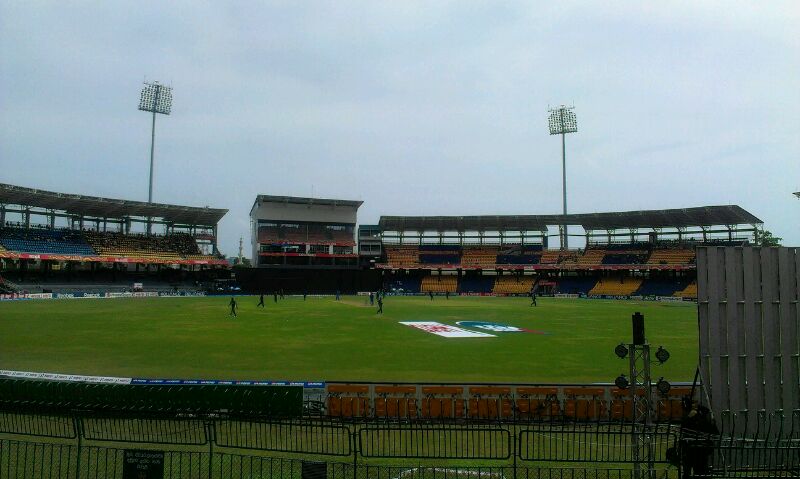
The picturesque R Premadasa stadium.

Kohli’s purple patch doesn’t seem to show signs of crashing in to a dead end, and along with Hashim Amla, he’s been having a remarkable set of two years in the International Circuit, notwithstanding the formats.

Unfortunately for us, the Indians lost their way during the second half of Pakistan’s innings and made heroes out of Kamran Akmal and Shoaib Malik – batsmen whom international bowlers, in general, would’ve fancied for breakfast, lunch and dinner.

The Cricket Shop

Goutham had got in touch with a few Gray Nicolls cricket gear dealers prior to the trip to check if he could procure gear in Sri Lanka. And a box of Kookaburra cricket balls to take back home so that the CECC boys could get accustomed to bowling/facing the Kookaburra in line with their preparations to tour Sri Lanka later this year.

We zeroed down on a pretty popular shop (through internet ratings) called The Cricket Shop, located at Urban Colombo. We chanced taking a couple of tuk-tuks – envisaging options of a cheaper ride, as compared to a taxi from the Premadasa.

The route to The Cricket Shop seemed a detour, given that the drivers had little idea of the location we were talking about. Suneeth’s concerns over the rate the driver would charge us fell to deaf ears – both parties being unable to understand what the other was saying. The only word the driver seemed to know was “No Problem.” To add to that, the other tuk-tuk had taken a different route, and Suneeth seemed certain that this was a game to rob a few foreigners off their cash.

Suneeth was in half a mind to get down and call a cab, but we figured any adventure (or mis-adventure) was an experience worth shouldering. Fortunately, we made it there eventually and ended up paying 600 Sri Lankan Rupees for the ride.
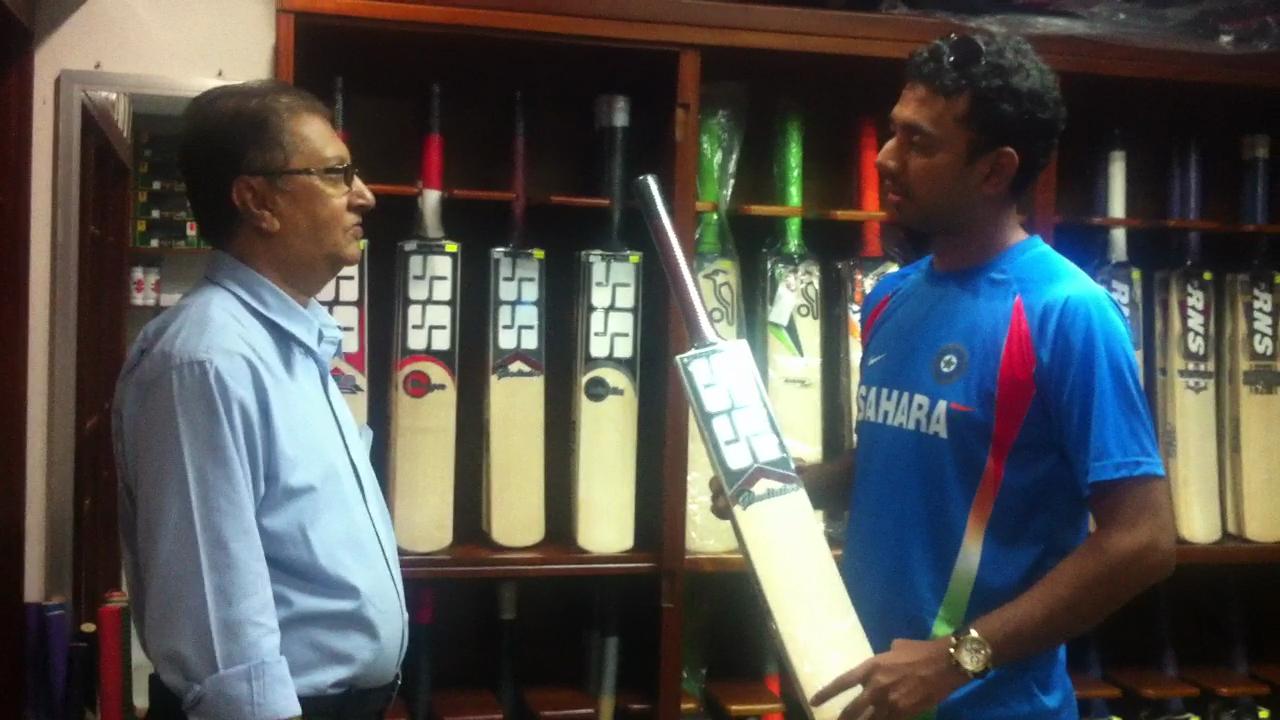
In discussion with Rila Mohamed, Director – Administration, The Cricket Shop, Colombo.

The Cricket Shop, at St Anthony’s Mawatha (Mawatha means ‘Road’ in Sinhalese) seemed the one-stop-solution for cricketers, ranging from amateur to pros, for procuring gears. The very purpose of our visit there, as mentioned earlier, was to check out Gray Nicolls gear. The cheapest Gray Nicolls willow was priced at around 45000 Sri Lankan Rupees, with a top end willow costing close to 70000 LKR.

The shop had an impressive range of display spanning Kookaburra, Stanford (SF), Puma, CA, Gunn & Moore, and SS – a fast moving brand since Sangakkara and a few other Sri Lankan crickets started endorsing it.  The shop Proprietor and Director, Rila Mohamed, was a very friendly man who took time off to explain in detail how he imports bats from India and why SS has become the brand being sought after by youngsters.

He boasts of photos and autographs from some of the best players from around the world, while mentioning that since most of the players are sponsored by manufacturers themselves, they stop by in case of an urgent need to procure a quality willow. Trust, he says is the factor that brings most cricketers back to The Cricket Shop.

Our hopes of buying a box of Kookaburra cricket balls went for a toss when we discovered that a single piece cost close to 14000 LKR. Maybe it’s time we believe in our players and understand that they, after all, can spontaneously adjust to the demands of the Kookaburra cherry when we get here.

Goutham Chakravarthi

17th September 2012

Colombo

Nearly four years have passed since I last visited this glittering island. The lack of multiple security checks at military checkpoints, a facet that seemed a norm back then, immediately stands out. One thing that hasn’t change is the warmth of the locals and the smiles on their faces.

Photo

A cyclist rides past a cut out of Sri Lankan players in the capital Colombo. © AFP

A cyclist rides past a cut out of Sri Lankan players in the capital Colombo. © AFPFrom the airport to the beachside restaurants in the south of Sri Lanka, it’s all about the ICC World Twenty20. Seaside resorts are abuzz with cricket fever, and even the cab drivers tell me they are keeping an eye on the weather forecast, praying for the rain gods to show mercy for a month.

“I want West Indies to win and I believe they have a good chance,” Abhishek Bharathkumar, an Indian national and a former age-group captain for Tamil Nadu, who is here in Sri Lanka on vacation with his family, said.

In addition to home favourites Sri Lanka, India and West Indies are also seen as favourites by the locals to win the trophy while Kumar Sangakkara, Chris Gayle, Virat Kohli, Shahid Afridi and Lasith Malinga appear to be the fans’ picks for the stars of the tournament.

Sangakkara is extremely popular amongst the locals here, understandably so.

“Kohli is my favourite player from outside of Sri Lanka. But Sangakkara is my favourite though and his three awards only prove that he is among the best in the world,” says Haroon, a shopkeeper at the airport.

Teams, stats, clubs, T20 leagues are all part of routine conversations with cab drivers and at family dinners.

The locals are also excited by the unearthing of unconventional talents Dilshan Munaweera and Akila Dananjaya, and the expectations for them to deliver are high. Sri Lankans are extremely confident the two players discovered at the SLPL have what it takes to succeed; many of them want both players to be included in the playing XI instead of warming the benches at this year’s T20 World Cup. With Sri Lanka known to offer unorthodox talent, the world will wait with equal interest to see if Dananjaya and Munaweera can use this platform to launch their careers similar to how Angelo Mathews did during the 2009 edition of the tournament in England.

The wickets here seem to be no longer inclined to help slow bowlers or batsmen who thrive on slow, low tracks. Well rounded attacks like Pakistan’s are expected to succeed and progress beyond the Super Eight stages.

“Wickets these days offer some nip to even medium pacers. I think Thisara Perera will be the player of the tournament if we go on to win the cup,” says Cathy, who is a waitress at the wonderful beachside restaurant Loon Tao in Mount Lavinia. She believes teams with allrounders who can bowl medium pace are at an advantage.

A large contingent of tourists meanwhile are keen on catching the action at the India-Pakistan warm-up game on Monday. However, the overselling of World Cup tickets still lingers as a prime concern amongst many of them.A large contingent of tourists meanwhile are keen on catching the action at the India-Pakistan warm-up game on Monday. However, the overselling of World Cup tickets still lingers as a prime concern amongst many of them.

“Ticketmaster, who are handling the ticket sales for the ICC, found that in the first few days of sales certain ticket outlets had access to the ‘blocked’ ticket database, and some of those tickets were sold to the public,” cheif executive of the Sri Lankan cricket board Ajit Jayasekara said, explaining the issue to Island Cricketrecently.

“When this computer glitch was noticed, they took remedial steps and offered alternative seating to those few people who had bought tickets from that database. The actual number is minimal and did not have an effect on the overall ticket sales.”

Even with several warm-up matches out of the way, It is hard to pick a favourite to win the tournament. The wickets will certainly have a significant say in outcome of the series, and should the wickets have nip and pace, it will be a very open tournament. Three sub-continental teams made it to the semi-finals of the ODI World Cup played in the sub-continent last year, and it is hard to see others challenge them should the wickets turn out to be slow turners.

Pakistan possess an impressive bowling attack, however, the chasm between sides shrinks to a blur in this format. Teams like Bangladesh can pose a formidable threat; both Pakistan and New Zealand will be wary of them, as they are in the same group.

The mood is festive. The most open WT20 tournament is upon us. Sri Lanka is the place to be right now.

This article was written for Island Cricket and first published there.

Lankan Diary: Day One: Ayubowan!

Posted: September 17, 2012 by thecognitivenomad in Cricket
Tags: , , ,

Chandrasekhar Jayaramakrishnan

(F)lag Carrier it is

The delay, in itself, could have easily accommodated two end-to-end nail-biting T20 games. Nail-biting because the five-and-a-half hour wait mandated searching for alternative means for appetite – Air India will certainly not be an airline we’d consider flying again.

The fact that three other airlines (Jet Airways, SpiceJet and Sri Lankan Airlines) scheduled to depart later that day managed to take off by the time we were caught between searching for answers and cursing our luck, didn’t help the cause either.

The advantages of traveling as a group is that such delays don’t bog you down as much as it would have had you been a lone traveller. Topics spanned Samaraweera’s record outside the subcontinent (with Goutham  & Abhishek explicitly mentioning his twin hundreds in South Africa), cobwebs of the Atherton vs Cook Flintoff endorsements, Steve Waugh’s deliberation on not penning the Sarwan-McGrath incident in his autobiography and the ridiculous money some of these young cricketers were charging for an interview.

There were times when the magnitude of the delay caught raw nerves – the only bright side being the possibility of fellow traveller Triyambak, holder of a virgin passport, having to narrate his tale of a first foreign trip that didn’t cross the International Departures area.

Touch Down Colombo

The contrast in weather was evident, if not obvious. Cloudy skies are like two-edged swords (especially if you are on vacation) – lack of heat could mean an escapade from sunburns (which has well documented stories here), but the possibility of showers could well ruin our purpose for the trip here – the cricket!

We started on a conversation with one of the guys, Haroon, selling local sim cards in the airport. He named Malinga, Gayle and Kohli as his three favourite players (much to Goutham’s delight as two of three represent RCB in the IPL), and declared himself a Wayamba fan, a team in the SLPL led by Mahela Jayawardene. You could’ve easily mistaken him as a stand-up impersonator of Sri Lankan cricketers, given the way he appeared and spaced his words in English, but maybe that’s the case with all Sri Lankans.  They’re very friendly , warm and polite.

Ranveli

Ranveli Beach Resort seemed a more-than-decent place for budget travellers like us. The 1.25 hour journey from the airport to the resort was taxing – both physically and monetarily (costs us close to 3600 SLR for the journey), but the relief of having made it to Sri Lanka, given the morning’s proceedings, swept such concerns under the carpet.

One of our room attendants, a young lad going by the name Ruwan, spoke a bit of Tamil. He mentioned being a fan of Sangakkara and Tendulkar, and reckoned if Sri Lanka weren’t going to win the World Cup, the Indians were his close favourites.

Captain Goutham welcomes latest additions to CECC – on foreign shores

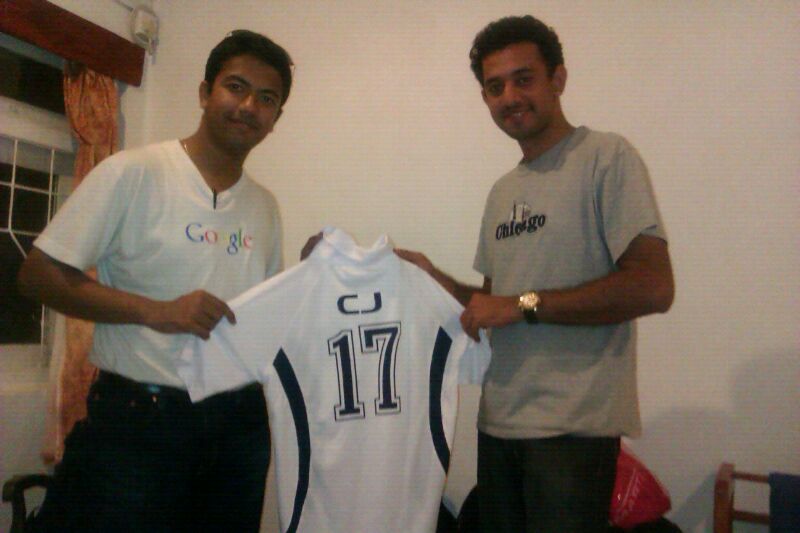
Numbers 00, and 17 were handed over their Couch Expert Cricket Club (CECC) Jerseys and the Baggy Blues by skipper Goutham Chakravarthi. 00 – Suneeth Sastry volunteered to sponsor a tablet PC for CECC to help Chief Statistician Badrinarayana Vengavasi (also part of the SL touring party) work with numbers, graphs and wagon wheels.

CJ receiving his CECC jersey from Goutham in Mt. Lavinia, Colombo

Number 17 – yours truly, who is yet to make his debut for CECC, has a clear road now to grab the first choice wicket-keeper position owing to the fact that current wicket-keeper Muthukumar Ramamurthy is about to enter the second innings of his personal life. Muthu, are you reading this?


Shridhar Pandey

It would probably be very easy to get carried away following India’s win in the first Test match against New Zealand in Hyderabad. It sure would take a brave-heart to find shortcomings out of such an emphatic win. But let us not forget the consecutive 0-4 drubbings India has had over their previous two Test outings. At the risk of being called a cynic, I would like to take this opportunity to point out a couple of areas where the Indian team still needs to pay due attention. Before that, let us have a look at the various positives that can be drawn out of this victory.

Cheteshwar Pujara justified all that was being said and written about him so far. He, no doubt, is a class act. During entire course of the Test match, he never looked like an enforcer; neither did he look like a mere survivor. He completely looked like one who belongs at that level. He might not be as aesthetically pleasing as Tendulkar or Laxman; but to call him complete (at his own level) won’t be an understatement. Virat Kohli’s half century was like a breeze of fresh air. He must be very disappointed with himself at the way he threw his wicket away for he is one player who always likes to be in the thick of things.

Taylor has an uphill task in preventing a whitewash in Bangalore. © AP

Pragyan Ojha bowled like he always does – right on the money. He may not have been successful every time he has been given a chance, but I, for some reason, get the feeling that he is someone who has not always got his captain’s backing. Ashwin yet again showed that he is a lethal weapon on a track that provides some assistance. Though he is just seven Tests old, he has shown a lot of promise. Once again, his real challenge would come when he moves out of his comfort zone and goes to countries like South Africa, Australia or England. He did not fare very well in Australia the last time he went there, but that would have been a bit too much to expect from a spin bowler who had played just three matches before that – all in the subcontinent.

There were two aspects of Sehwag that could be seen in this match; one impressed and the other disappointed. First, his slip catching was exceptional. Let us hope that he pulls off similar catches when the pace bowlers are in action. Second was his batting which was not very impressive. Though he did hit a few of his trademark boundaries on the off side during his short stint, he did never resemble the Sehwag of past.

Moving on to the pace bowlers; though they did not get much chance to bowl or assistance from the pitch, they failed to impress in whatever opportunities they got. Their Kiwi counterparts did a much better job in comparison. Zaheer Khan, who has been India’s bowling spearhead over the last few years, went wicketless – that is certainly not a good sign. Umesh Yadav did manage a couple of scalps. But his overall bowling was by no means impressive.

Suresh Raina failed to hold on to another life given to him. He is doing his chances no good. This season may prove to be his last on the Test arena if his performances continue the same way. He cannot find a place in the Test side just by virtue of his good fielding skills. The overall Indian fielding was a real pleasant surprise though – maybe the injection of young and fresh legs would have done the trick.

To sum up, a pessimist might be successful in finding out weak links in however good a Test side. But taking nothing away from the Indian team’s performance, I would like to conclude with this: they not only need to keep up the good work, but also need to focus on a few other key areas if they are to do well in South Africa in 2013 and win back the coveted no. 1 Test ranking.


 Goutham Chakravarthi

On a day were only 38 overs were possible, it was still a day of two halves for the Kiwis. The first 19 overs had them losing their last 5 first-innings wickets, with Ashwin and Ojha continuing to tie them down with nagging flight, dip and slow, but significant turn off the wickets. The last 19 were an improvement in approach and batting as they were made to follow-on by Dhoni.

Zaheer and Yadav started with pace at either end with Yadav sending back van Wyk soon. Barring James Franklin, the Black Caps seemed starry eyed by the Indian slow bowlers. Ojha’s nagging length and discerning spin had Doug Bracewell caught between slogging and defending and finally perished trying to charge Ojha only to have Dhoni uprooting the stumps.

But for dealing with the Indian medium pacers, the Black Caps’ lower-order lacked conviction and failed to provide support to the hard working Franklin. With the 30-run partnership broken between Franklin and Bracewell and the introduction of Ashwin, any hopes of avoiding the follow-on disappeared into the dark and gloomy skies of Hyderabad.

Ashwin was the undoubted star, needing only a handful of deliveries to clean-up the Kiwi tail. Soon he sent back Jeetan Patel (10), Boult (4) and Martin (0), there by ensuring India would make the Kiwis follow-on for the first time since 1956.

Ashwin would be keen to run through the Black Caps batting line-up to wrap up the test match soon.

With the various administrative changes happening in the Kiwi set-up, this batting performance on a typical sub-continent wicket wouldn’t have pleased the new coach Mike Hesson. And for a team that looked suspect against the spin of West Indies not so long ago, and coming in to this series with no practice game, perhaps this was expected.

Perhaps Mike Hesson did have a stern word with his wards at the end of the first innings even if it meant he did have a word with the third umpire on a couple of decisions through the first innings (no UDRS in this series). McCullum and Martin Guptill looked up to the task of dealing with the spin and guile of Ojha who opened the bowling for India looking to extract any bounce and bite off the wicket.

The openers looked compact and more determined even as the threat of thundershowers loomed large. As play carried on under dark skies and artificial lights, the battle the Kiwis seemed to be battling were with that of discipline.

Ojha’s nagging length and turn eventually induced the edge only for Kohli to put down the chance to give Guptill a life. Just when Guptill thought he had done the hard yards of seeing through the initial period and having had a chance put down, he was given out shouldering arms to a straight Ojha delivery. Replays suggested that the ball had turned enough to perhaps miss the stumps.

Rain came to the Kiwis’ rescue soon after with only 38 overs bowled in the day. With rains expected through Sunday, the Kiwis would hope the overnight not out batsmen McCullum (16) and Williamson (3) would show the same grit and determination they showed in the hour before the stoppage to give them a chance of saving this Test.

As the Kiwi spinner Jeetan Patel said leading in to Day 3, “It’s still low and slow with the seamers – it’s not bouncing as much – but it is starting to take some more turn, which you’d expect.” There is indifference bounce, but the turn is not sharp once the ball gets a bit old. SG balls are prone to aid reverse-swing when the ball gets old, but the pace of the wicket is slow enough for the Kiwis to handle that threat.

The rains have been relentless all across the southern portions of India and Sri Lanka. With rain and thunderstorm predicted over the next few days, it is a question of Kiwis surviving the time they get in the middle that is keeping their hopes alive in this first Test.

Dhoni and team would look to wrap-up the Test on Sunday though.