T20 Cricket: Give Credit Where It Is Due

Posted: September 29, 2012 by The CouchExpert in Cricket, World T20 2012
Tags: , , ,

Goutham Chakravarthi

All administrators I have met in Sri Lanka – Sri Lankan or otherwise – were much relieved when Afghanisthan gave India only a scare but nothing more. India’s fortunes in the tournament seems to have a direct impact on the success or failure of the tournament – read the 2007 and 2011 ICC World Cups respectively – according to a well placed administrator.

Compared to the ICC World Cups, the World T20s seem to hedge their investments better. A third of the tournament is spent playing games only when the rest of the world is sure of which eight will move on to the next round. And by the time eight becomes four, three-quarters of the tournament is done and the tournament is not a financial disaster anymore. One-day world cups with a bigger spread, either fall or rise with India’s fortunes.

The various T20 leagues that have mushroomed are seen to be deterrents to the other two forms of the game. The calendar is packed with these through the year and around the world. And, yes, corruption seems to walk hand-in-hand with these T20 leagues. Strong administration and policing will eventually decide the integrity of these leagues as will strong counseling of players by self, player associations and home boards. But corruption and greed in cricket cannot be restricted to the T20 timeline alone, for they have hampered the game for centuries.

But to its credit, T20 cricket has restored some parity in to cricket. Not long ago, it would be an exercise in patience to sit through a cricket match in India. The facilities and treatment of the fans in the grounds are among the poorest. Still, people paid vast monies to sit through the charade of concrete footsteps for seats, boundary placards for shade from scorching heat, thundering rains and bird-waste. And public toilets were, err, open dumps of waste.

T20 cricket has perhaps not changed all that, but it has changed things for the better. The game lasts shorter and the misery of the fan lasts shorter. Also, leagues and team owners seem to have taken the extra effort to improve the facilities to bring more people in even as they milk the money from the gate collection as cricket increasingly becomes a television sport. That said, the administrators still care more for the money than for spectator comfort, but it is much better than what it was this time a decade ago.

Women and children flock to T20 cricket and in it remains T20 cricket’s biggest triumph. Often Sunday cricket practices include a short game of 20 overs-a-side where the parents watch their wards perform in my part of the world. Perhaps the bigger leagues are dressed with better toppings – with music, refreshment, games and an evening out – of the simple game it is: fast, high adrenaline and short.

The connoisseur might smirk at it and call it names for it may not be a true test of one’s abilities. It is still a test of many abilities. It is still cricket. And runs and wickets matter as they do in other forms. And wins are wins.

The thrill of sixes and fours might not whet everybody’s appetite, but they are the skill necessitated in this format – perhaps like tie-break specialists in tennis where ones with greater serves felt at ease.

It is still perhaps the best vehicle to take cricket to a larger audience globally even as the top nations struggle to be competitive. Even with many leagues and various strategies, the game throws up more surprises than a Dan Brown paper back.

The many positives T20 cricket has brought into the game cannot be ignored.

It cannot be forgotten that it has also made the game more popular and more expressive for players and the paying public; perhaps more convenient also for all parties concerned (administrators inclusive).

While the administrators and players playing the game have as much responsibility in keeping the sanctity of the game, so do the scribes and television broadcasters that bring the game to the many million living rooms of the games fans. The fans decide what they like to watch – some like more colour and grandeur, others intrigue and soberness, and some others both. It becomes the duty of the custodians of the game to ensure the fans of the game are not left cheated in the end – selling the game to corrupt and selfish officials, players and bookies.

If cricket is as much about bonding between players, back slapping in encouragement, swinging to the fences in need of quick runs and knocking down timber in need of wickets, dancing in the streets after a victory or buying the team a round of drinks at the end of a good day’s work, T20 cricket is all that as well.

Give credit where it is due. T20 cricket is here to stay.

This is a published article in Island Cricket


Goutham Chakravarthi

Though the rains in parts of Sri Lanka have been persistent, the tournament is finally gathering momentum with the beginning of Super Eight stages. Insofar only Afghanisthan added some colour to the tournament with their brand of brash and volatile cricket. Having seen a few of their players and staff at a restaurant in Colombo, they seemed to be thrilled to be a part of the tournament and seemed eager to do well.

Afghanistan’s progress has been rapid but, as has been seen in this tournament, their cricket still is raw and borders more on the emotional than on the rational. With time, the hope is that they improve their game whilst not losing the flair that has warmed the hearts of many who have seen them in this World Twenty20 tournament.

The heart-stopping tie that Sri Lanka eventually won in the super over is a reminder of the thrills T20 cricket can provide fans, spectators and players. Fists were seen pumping at the end by the batsmen in the middle and their teammates in the dug out. The next moment, the smiles were wiped off their faces when it turned out that New Zealand captain Ross Taylor had managed to knee a run-out off the last ball.

Akila Dananjaya impressed with his mixture of offies, leggies and googlies.

It was an evening where fortune changed sides more often than rains starting and stopping in the southern coasts of Sri Lanka. Taylor’s knee might have aided the match going in to the super over, it tested the umpires and players; and all will be glad for the experience, should they get in to a similar situation later in the tournament.

Earlier, Angelo Mathews and Ajantha Mendis had shaken off their injury scares to make it into the final XI. But the attention was on Akila Dananjaya once his name appeared in the starting line-up. His spin menu included flighted leg-breaks, googlies and offies. In short, it is enough to keep the English team up at night before their game against the Sri Lankans.

However, given the history of off-spinners from the sub-continent whose actions have often been scrutinised, Dananjaya’s might well be questioned.

The theory that established Test nations have worked out Mendis further gathered ground, as he was sent for 48 runs off his 4 overs — his worst T20 figures coming into the game. The theory that established Test nations have worked out Mendis further gathered ground, as he was sent for 48 runs off his 4 overs — his worst T20 figures. Mystery injuries have also clouded the career of this mystery spinner, and how much faith the Sri Lankan management has in him for future games remains to be seen.

Rangana Herath is a very fine bowler after all, and with Dananjaya holding his own even with the onslaught very much on, the management might be tempted to have the experienced Herath back in the team. With the pitch at Pallekelle offering more than enough turn, as was seen in Premadasa in the India-England game, it will not be a surprise to see more teams resorting to spin for both attack and defence.

The batting looked in rich form with Tillakaratne Dilshan finding fluency. Sri Lanka’s side is packed with several allrounders, so there is a school of thought — as Taylor pointed out — that they might lack batting depth and be too top heavy. So far, it has not proved to be a problem with the likes of Jeevan Mendis and Thisara Perera holding their own with the bat. Mathews has proved to be a reliable finisher and Lahiru Thirimanne is proving to be one of late as well.

West Indies and England are the other two teams in the group, and given England’s form against spin in the recent past and their form against India and West Indies, it will be a surprise if Sri Lanka do not find themselves in the semi-finals.

The objective would be to have peaked as a team by then and hope to have a couple of their match-winners in red-hot form. Sri Lanka have found themselves within reach of winning ICC tournaments many times in the recent past, and they will be one of the teams favoured to win.

Mahela Jayawardene’s men displayed the ability to handle the mental side of the game well in the super over finish today, and the hosts will hope to be at the finals this time too in order to have another crack at crossing the final hurdle.

This is a published article in Island Cricket.


Chandrasekhar Jayaramakrishnan

We noticed a couple of Pakistani fans in the resort where we were staying in Mt. Lavinia. They`d just checked in the previous day, and we sensed an opportunity to pick their brains on suggestions that Pakistanis is among the favourites to lift the trophy this year.

Arshad and Zoheb live in Birmingham, UK and are here in Sri Lanka until the finals. They`re very confident that their team will repeat the feat they`d witnessed in England back in 2009 – when Pakistan, under Younis Khan`s captaincy, were crowned World T20 champions.

Arshad feels that their strength lies with the top order batting – a solid start, he feels, could be the difference between a par score and a mammoth total. Zoheb, on the other hand, backs the bowlers to even defend a miserly score, if such a situation arises. Understandably, he picks Saeed Ajmal as the bowler who could hold the trump card to take Pakistan all the way.

Zoheb would have had concerns in the manner in which the Bangladeshis piled up a challenging score of 179 yesterday. That skipper Hafeez backed his own abilities at the start of the innings seemed bemusing – given his lack of effectiveness. He might have done well to take himself off the attack earlier.

This paved the way for Shakib – arguably one of the better Asian all rounders today – to craft an outstanding innings that took Bangladesh to the total they eventually gathered. The only glitch was a series of amusing misunderstandings with skipper Mushfiqur Rahim when calling for runs – a string of errors that couldn`t stop keeper Akmal and Afridi from sharing a laugh.

Although I would imagine they wouldn`t have had half a heart to smile when Sohail Tanvir dropped a dolly offered to him by Rahim at mid-wicket. I must have looked at the replays half a dozen times and the comicality of the drop never fails to make me laugh. That he pointed to the lights and pulled down his shades afterwards marked out what is idiosyncratic of fielders who drop catches – what brings one laughter can leave another bewildered. I have a strong belief that this video will have a healthy shelf life on YouTube.

Arshad, on the other hand, would`ve taken heart out of the Pakistani`s batting performance. He`d pointed out a healthy start as a key factor in either posing large totals, or chasing larger ones. Imran Nazir`s batting style makes it easy for the audience (and predictably, his team mates) to accept that his audacious strokes are what lay the foundation in the top order – given the snail`s pace (in the context of T20) at which Hafeez historically paces his innings. I guess they understand each other`s game, and this seems a method that the Pakistanis are certain of in working to their favour.

As they progress to the Super 8, tougher tasks lay ahead. To have India, Australia and South Africa in the same group is enough to ingrain fears of an early slip, but unpredictability is what drives T20 cricket forward today. And it will continue to.


Chandrasekhar Jayaramakrishnan

The only agenda for the day was to stop by the Premadasa (yes, once again) for the game between West Indies and Ireland – for once, a fixture that couldn’t be classified a dead-rubber. Both these teams had lost to Australia, and even though there was great disparity in standards on paper, we weren’t too keen on missing out on a chance to witness an upset (in case).

The West Indies have been touted as favourites by a good share of the fans that we’d run in to over the course of the tournament. More so, for their possession of big-hitting batsmen. Yes, their pacers did trouble Ireland yesterday (c’mon Ireland!), but given the start Ireland had, 129 seemed a score twenty runs too many. Tougher opposition await – as West Indies painfully realized during the game against Australia.

The Irish, on the other hand, have used primeval vocabulary via Trent Johnston to question the ICC’s intentions regarding the lack of opportunities that they’ve been getting at the international level. It is a shame that their performance this tournament has obscured Johnston’s dismissal of the ICC as being flaccid – for their usage of the term ‘minnows’ being a derogatory one for Ireland.

Irish fan Jack Tanner wants more consistent performances

We ran in to Jack Tanner, an Irish fan who resides in South England – fully geared with the Irish flag waving for every run scored. Jack remains hopeful, yet sceptical, about Ireland’s chances to win games on a consistent basis.

Cricket, in Ireland, is several rungs below Football and Rugby when offered as a choice for a youngster to take up. It is understandable – the game doesn’t have a history in Ireland as it does in England. Jack says it is fathomable to witness players switching allegiances to England in search of opportunities to play at a higher level – in other words, consistent international Cricket.

In conversation with the Irish fan Jack Tanner.

Boyd Rankin, the tall fast bowler from Ireland (who missed out yesterday due to an illness) has been vocal in expressing his desire to represent England if given a chance. This exodus doesn’t depict healthy signs for Irish cricket – clearly, as Jack said, it is about time Ireland start winning games consistently to show the ICC that they deserve the status that they’ve been after. The odd performances (Pakistan 2007, England 2011 – among others) don’t help.

It is a shame that the rain gods had to intervene to send the Irish home. In truth, a score of 129 was never going to suffice against the West Indian batting. But it’d have been interesting to see a full game on the cards with qualification at stake. Ireland doesn’t bow out a proud team this tournament – Phil Simmons has a colossal task ahead, and definitely not an easy one.


Goutham Chakravarthi

With the ICC Women’s World Twenty20 also taking place in Sri Lanka, the Galle International Cricket Stadium is a hive of activity these days. The man responsible for getting the stadium in shape for the women’s league matches starting later this week is former Sri Lankan Test cricketer Jayananda Warnaweera. Apart from being the curator at the venue and the secretary of the Southern Province Cricket Association, Warnaweera is also on the executive committee of Sri Lanka Cricket (SLC).

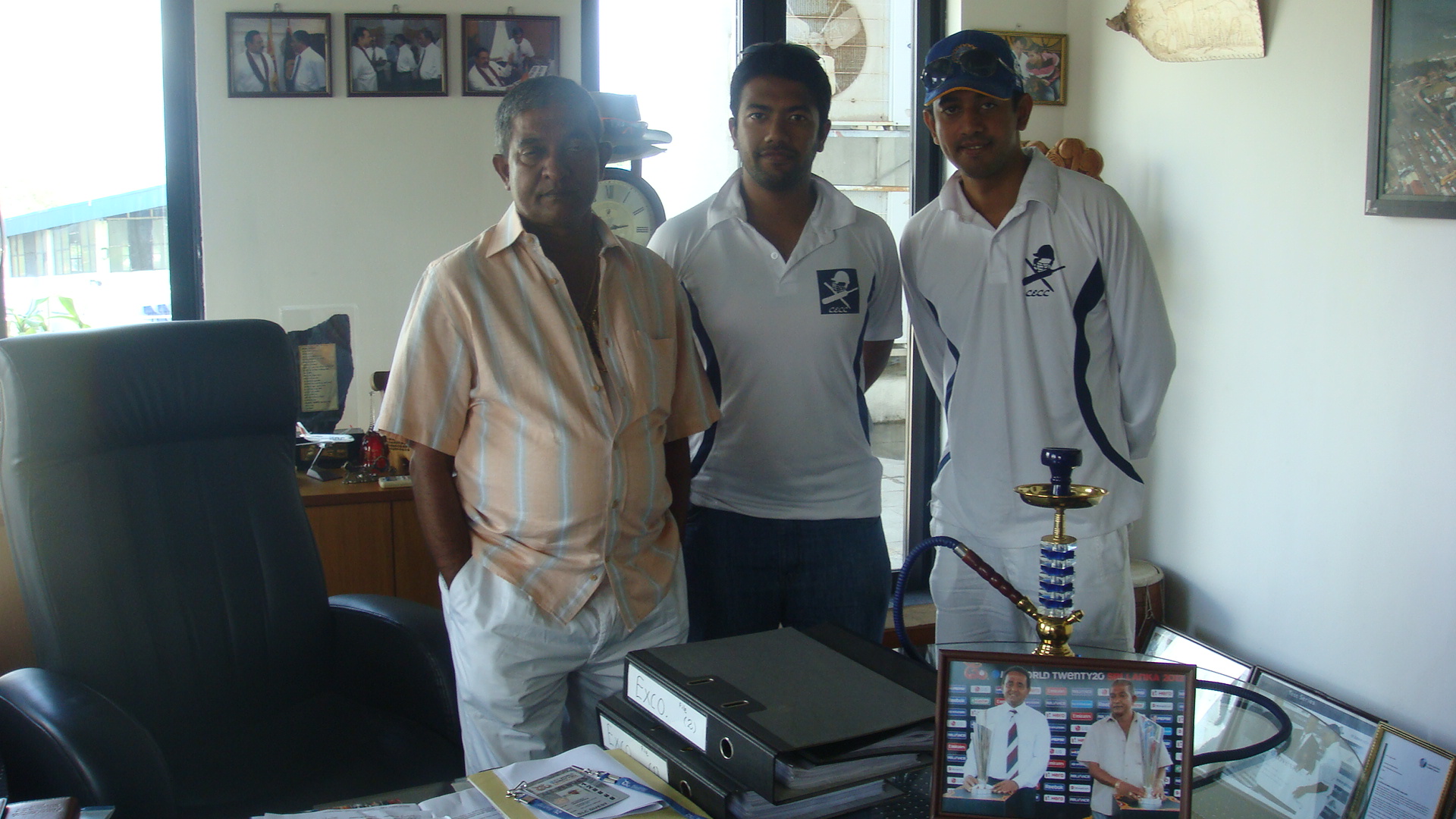
I am not a great fan of T20 cricket: Warnaweera. He is seen with CouchExperts Chandra and Goutham in this picture.

You played for Galle Cricket Club, and you were among the first to represent Sri Lanka from here. Who are the others?

Like New South Wales in Australia or Mumbai in India, Colombo is the cricket epicentre for Sri Lanka. I played cricket from here for two-and-half decades and was the first to break into the Test team from Galle. It paved the way for others like Champaka Ramanayake and Upul Chandana later. Even Marvan Atapattu is from here. Now, Upul Tharanga from Galle is in the national team as well. So, we have consistently been producing Test players from Galle from the time I broke in. Unfortunately with Galle, like with other outstations being limited in terms of opportunities, a lot of these cricketers move to places like Colombo after school and in search of job opportunities.

Are there steps taken by SLC to ensure talent remains in their regions?

There are various measures being evaluated to ensure we retain people in the local provinces. Chief among them are proposals at the provincial level where eligibility for representing the province will be earned only if you represent a club from the province. There are many such ideas being considered and we hope to provide long-term solutions.

We are about a week from the start of the women’s league games, a lot of work is being done here at the stadium already; how is the interest with ladies cricket here and what kind of numbers do you foresee for these games at Galle?

This is an ICC event and all ticket-related things are handled by the ICC. The good thing is these games are free of charge for the spectators. Sri Lankans have been known to follow the men’s game more and it is the same everywhere. But we still expect to see five to six thousand people to show up at the ground for every match

How do you rate Sri Lankan women’s chances?

In Sri Lanka, not many women play cricket although the interest seems to be on the rise. Understandably, the interest is more in Colombo area than in outstations like Galle. The hope is that with this World Cup being here, and if we do well, it will hopefully generate a lot of interest in the women to take up the game.

You were instrumental in getting the stadium ready first in 1998 and you then played a pivotal role in getting the stadium ready post tsunami. How difficult was it?

The tsunami left the stadium in ruins and we had to do a lot of work to get it up and running. Upwards of 500 million rupees was spent to have the stadium renovated. There were obstructions from the archaeological department that the new building construction would block the view of the historical Galle Fort. I am glad that we were able to get past all that. It was the ground where Shane Warne got to 500 wickets and my good friend Murali retired here a hero after getting the last Indian wicket to get to 800 Test wickets. There are many happy memories at this ground.

Being a former Test player, would you have liked to be part of these T20 tournaments across the world? Do you fancy them?

Personally, I am not a great fan of T20 cricket. Test cricket will always be the pinnacle not T20 cricket. Not even one-day cricket. You need skill and endurance to succeed in Test cricket and that is not the case with T20 cricket. Yes, commercially it is great for cricket. But from a personal stand point, not my choice.

When I run through your stats, I see that you regularly bowled 30-odd overs in an innings. Yet we see today’s bowlers, with all the coaching and scientific approach, spending more time recuperating than playing. Why is that?

In my time, fitness had to do with match routine not gym routine. Unfortunately, most of the youngsters are gym-fit and not match-fit. We didn’t know much else to do other than to bowl for long hours. We built ourselves to bowl and last sessions and days. Perhaps today’s bowlers are not that match fit.

Who are the best young players coming out of Sri Lanka that have caught your eye?

I am impressed a lot by Akila Dananjaya. He will be a very good bowler for Sri Lanka. Dinesh Chandimal has the ability to be a very good player for Sri Lanka. I hope he can go far and achieve a lot.

Who were the best players you played against?

Vivian Richards comes to mind first and then Mohammed Azharuddin. Among bowlers, there were many — Kapil Dev, Michael Holding, Imran Khan and Wasim Akram to name a few.

Who was the most difficult batsman you bowled to and why?

Mohammed Azharuddin. He was wristy and aggressive; and was very difficult to set fields to. He had good hands, and could put spinners off their lines and lengths quickly.

The best captain you have played with or against?

Imran Khan was the best and so was Arjuna Ranatunga. I would rate Mahela Jayawardene and Kumar Sangakkara amongst the best captains in the recent times as well.

As a former off-spinner, who do you pick as the best off-spinner in the world currently?

Both Saeed Ajmal and Graeme Swann have been very good for their teams in the last few years. Both are very fine spinners. I am also very impressed with R Ashwin as he seems to have a lot of variations and seems an intelligent cricketer. With age on his side, and the maturity experience will bring him, he will be a bowler to watch out for in the years to come.

Do you agree with foreign coaches coaching national teams? It seems to be the norm with all international teams these days?

I do not have a problem with local coaches coaching the national team. Sometimes, language can be a barrier for foreign coaches to communicate with the team, especially the young ones. Some teams with good and bright seniors can overcome this. Sometimes, it is seen to be an advantage, as it is seen as not showing favouritism as well. The best man for the job should always coach any team.

Finally, who do you think will win the World T20?

It is a very open tournament. South Africa are a strong team and so are Pakistan. Sri Lanka have the team to win and so do India.

This interview was first published in Island Cricket.