Chandrasekhar Jayaramakrishnan

Every time I see South Africa crashing out of ICC Tournaments, I find myself placed amidst the conundrums of existentialist thoughts. I’ve always admired the way the Proteas go about their business, and my unequivocal backing was justified when AB De Villiers took over the skipper’s mantle.

Though neither wholly innocent nor wholly naïve, he admitted to his team giving their ‘very best, but simply not good enough’, albeit losing to a better unit those days. In simple words, the Proteas had complied with every facet guaranteeing victory but the opposition had more check boxes to tick – which they did in its entirety.

All this, AB dealt with persuasively – a reminiscence of what prior captains have done at the end of ICC tournaments. But for a change, his odiousness towards his team being referred to as ‘Chokers’ has taken a reversing – he’s been blatant enough to admit that the dubious tag being carried may have some substance behind its origins. Had it not been for their large funds of astonishing scorecards, history would have judged them more kindly.

History hasn’t judged me kindly either – I’m always at the receiving end of cheeky texts whenever the South Africans choke. I’ve backed them ever since I started following cricket. And when times become hard (and let me point out that I back Liverpool FC), I’m always asked that obnoxiously unanswerable question: Why?

Taking South Africa to a title triumph in limited overs formats will be priority for Kirsten and Co.

If I were to let my mind navigate around thoughts with respect to a profession I choose, I’m quite certain that such anxiety would’ve compelled me to have considered chronic job-hopping. But sport is different – and that is what makes it unique. In sport, it isn’t ideal to subscribe to the “love your job, not your company” philosophy – the minute you embed yourself to supporting a team, it is a bond that none can break.

As an Indian, I find it natural to support my nation at the International Stage. And as the old cliché goes, you can’t choose your relatives but you can choose your friends. That is one of the reasons so much of what I have come to think of as logical and passionate support was really worked out during the first few years of my exposure to sport.

I was drawn in to admiring the South Africans primarily because their fielding unit stood out from the rest. As kids, we naturally incline towards worshipping players who defy gravity to exhibit stunning catches – and the South Africans were (and still are) the best in the business. And what sticks to your mind as a kid, sticks for a long time to come – even the antics of Hansie Cronje didn’t deter me away from rooting for the South Africans – apart from India that is.

Following them has taken me through the high of witnessing a record ODI chase accomplished, and sink through the perils of D/L Math extracts that caused enough offence to sack Shaun Pollock in 2003. And their laconic trysts in the latter stages of ICC Tournaments still continue to bemuse many. Is it really as much a case of pressure as it is about ill-luck? Not always. Innings collapses aren’t necessarily what the doctor orders – it is what they have brought on to themselves. Only a D/L sheet with numbers as illegible as a doctor’s prescription would’ve caused the fiasco of 2003.

I was fortunate to meet Dr. Peter Kremer, a former Sports Psychologist with the Victoria State Cricket Association, during my stay in Sri Lanka. We met at the Premadasa during the game between Ireland and Australia. I never got a chance to talk to him about South Africa, but I do recall him mentioning a particular challenge he’d consistently faced during his tenure – players getting in to their comfort zones. The easiest thing, he said, was for a player to throw his hands up, admit that he isn’t good enough to sustain at higher levels, and continue to ply his trade in familiar waters.

Now before you read between the lines here, I don’t mean to say that the South Africans have almost swallowed a sense of inevitability that they could be the best team around without an ICC Trophy in their cabinet. You cannot question their effort, or commitment. But their ability to react to pressure has been under constant scrutiny.

Having ceded to mental issues in ICC tournaments, de Villiers will have to play a pivotal role in turning it around for the Proteas in the immediate future. Image: Reuters

You might not like the physics of gravity but you can’t change the fact that objects fall to the ground because of it. Likewise, if the Proteas cannot find a way to embrace pressure (and expectations), that elusive treasure – spelt an ICC Trophy – could be very hard to come by. I’m not qualified enough to comment on their methods, given that from a thousand miles away, I’ve got very little exposure to their system. But a consistent run of familiar collapses, less true this particular tournament given that they were straight-forward ‘KO’ed, only raises further question marks.

The current system, which is certainly better than the alternatives that seemed to have propped up during the transition stage, has undergone changes, and with Gary Kirsten at the helm, they have a player who has tasted ultimate glory as coach. Kirsten’s methods in India are well documented – he focused on three things: simplicity, simplicity and simplicity. And when you tend to fragment issues that appear complex on face value, the constituents are largely simple.  His record of 0-9 in Super Eight matches with India and South Africa now in three World T20s is a cause of concern and he will be the first to know. You can expect him and his crew to have analysed selection, approach and mindset from these games to be better prepared in two years’ time.

In Hashim Amla, they have undoubtedly one of the most polished batsmen (all three formats included) in International Cricket. He hasn’t looked out of place in any of the formats over the best part of the last two years. He exudes a certain class that few men possess, and a temperament that even fewer share. I’ve written about de Villiers before and my opinion on AB hasn’t changed – I would only wish that South Africa find a ‘full-time’ wicketkeeper in Tests, for AB is too valuable a batsman to suffer from the excess baggage of having to keep in Tests. But again, Test Cricket is out of context given the theme of this piece.

Similarly, the bowling department boasts of the most lethal fast bowler in international cricket, ably supported by resources who wouldn’t find it hard to walk in to the playing XI of other nations. Their bag of big hitters – from David Miller to Albie Morkel – is aptly full, and their spin department could do with a bit more flair. Tahir, at best, has looked average when compared to his counterparts from around the world. If there is an inert area of concern, it is only the quality of their spin bowling.

Kirsten’s box of worries appear complex when judged on face value, but when you break it up in to pieces, the end result is a list of fifteen odd players possessing immense talent. They have performed cohesively as a unit – they’ve won dramatic games together, and they’ve crashed out of tournaments together. They’ve performed well at home, and they’ve performed better (in some cases) away from home.  What they’ve probably not done is to avoid playing the game of dominos together.

But the camouflage could well be the fact that the team isn’t greater than the sum of the individual parts. And that, ultimately, is Kirsten’s challenge.

Chandrasekhar Jayaramakrishnan

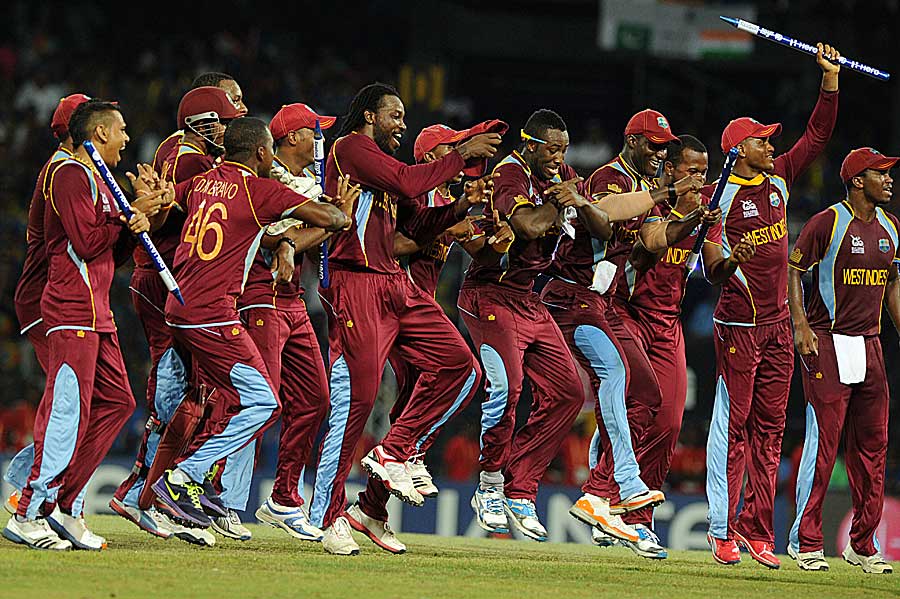
Here’s a narrative that you might not have heard in 33 years: The West Indies have won the World Cup. They have re-arrived in the ICC Wall of Fame with the force of a gale. Not just Gayle (pardon the rhetoric pun again please).

Their dance is as distinguishing as their unique style – and coupled with a new found passion that seemed to have been nonexistent until not too long ago, ’79 doesn’t seem that distant a memory now. It is easy to forget that the West Indies constitutes a set of nations that are fragmented geographically, culturally and (maybe) politically.

The victory is made more poignant and credible given the hurdles that had to be crossed by Darren Sammy and his men. Revisiting the incidents would remove the sentiment behind this piece, for when the mood is calypso, it is worth celebrating, not contemplating. Their vision for the future must be their distant past. It really is as simple as that.

Every final played leaves an etched memory that never fades with time. From Clive Lloyd’s assault in ’75 all the way to MS Dhoni’s pyrotechnics of 2011, the victorious team has always had a fulcrum around which the scorecards revolved. And in some cases, a moment of magic (not reflected in scorecards) – such as Kapil Dev’s brilliant catch to dismiss Viv Richards in ’83 – announces itself as the difference between glory and gloom.

Marlon Samuels, whose chronological trysts in International Cricket best remain buried, given the moment, stole the thunder from the much anticipated fireworks of Chris Gayle. Gayle had set the tournament alight with his impersonations of the Gangnam dance, a popular South Korean style that came into prominence to rank Psy’s albums above the story of the North Korean soldier who’d crossed fortified borders to enter South Korea. He had, in addition, defied presumptions to bat through the innings during the semifinals against Australia.

Unfortunately, a ploy that had worked in the semi-finals failed yesterday. As admirable as the intent is to allow Gayle to bat through an innings, natural instincts – if left unattended to – could take fortunes for a reversing. But to witness Samuels respond the way he did, albeit circumstances where the run-rates dipped to embarrassingly low levels given the format, is a testament to his temperament and approach. His straight six off Malinga, a monstrous 108m hit, remains the highlight of a battering that cut the Sri Lankan pacer’s stats to pieces.

Not too long ago, the documentary Fire in Babylon seemed to catalyze the process of the rest of the world catching up with the Caribbean in the nostalgia department. Whether it made most of us yearn for the West Indies to hit the glory days again will remain unanswered, but the neutral’s elation – coupled with observations during my stay in Sri Lanka – convinces me that it did.

Sammy’s style and captaincy doesn’t depict the theme behind the documentary – his style isn’t the typical ‘in-your-face’ attitude, but rather the approach that bridged the chasm between altercations and egos. Until yesterday, he probably had a greater share of pessimists (including myself) questioning his very place in the XI. I still do. But he deserves credit for taking up the anchor role that others refused – to accomplish a task that appeared, back then, as monumental as reversing the fortunes of today’s Greek economy.  He has had the last laugh in this contest.

Mahela and Sanga: ‘Tim Henmans’ of cricket?

But such contests, unlike many others, turn out to be a zero sum game. The West Indies’ triumph was the home team’s loss – in particular, towards two men who’ve steered them to four finals thus far. A fourth final in this century would have, in all obviousness, placed – if I could borrow the words of an economist here – an inelastic demand on their success. But at least, the economy fluctuates. Their luck didn’t. Jayawardena and Sangakkara, for all you know, may never taste the ultimate success that continues to elude them. A friend of mine recently labeled them the ‘Tim Henmans’ of cricket. I don’t doubt that they are.

Their records will have a void that has left some of the best cricketers’ records flecked – from Bradman’s ‘an iota short of a 100’ test average to Shane Warne’s top score as a batsman. It may add fuel to their biographical defensives, but it isn’t something that would compensate for the lack of a trophy in their cabinet. Not when they were so close to repeating what the Indians did in front of their fans last year.

On the brighter side, their performances have disproved notions posed by a few theorists through the course of the tournament. To begin with, the theory that Mendis would fail against bigger nations is blown away when you look at his statistics from yesterday. Add to this the youth fervor that Akila Dhananjaya brings – there is every reason to believe that the near future isn’t as bleak as it appeared to be when a few big names bid farewell.

West Indies, on the other hand, have just carved a beginning. They’re still way off the mark formats that have a stricter measurement yardstick. And if this doesn’t act as a catalyst, I can’t imagine what else would. Just like how a stable currency doesn’t necessarily reflect the prosperity of a nation, this triumph should open doors for more transparent conversations to help elevate standards in ODI and Test Cricket.

They need to have their best players playing in these formats – Sarwan included. Now, who initiates these dialogues is always guesswork, given the egos that battle each other. Unfortunately, the more sensible advocates from West Indies cricket aren’t part of the WICB. The system needs to find a way to get these personalities in, while the momentum is still on. History has shown us that World Cup wins could do wonders to boosting sporting, and non-sporting, opulence to nations.

It will be an interesting few months leading up to the New Year. But until then, it wouldn’t be a bad idea to try mastering the Gangnum. As the cliché goes, grab the trend while it still lasts. Recall something called a vuvuzela now?


Bini Sathyan

It was the most amazing innings of a T20 match and probably the innings of a lifetime played by Marlon Samuels. And that he chose to do it on the biggest stage when the chips were down and his team was literally on the mat and the fact that he decided to take on the best T20 bowler in the world to fight it out and to come out a winner makes it the most awesome come-back-from-behind of performances. The end result is that the Calypso Kings are back and are crowned the World T20 champions. Sri Lanka again ended up as the second best in 4 finals since 2007.

The T20 finals did not look like a T20 match, instead it looked like a battle for life. With West Indies electing to bat, everyone expected the Gayle storm to simply blow the opposition over. But the Sri Lankan bowlers came well prepared to absorb the impact and they did so well that Gayle looked like a man lost in the storm.

With the runs just not coming and the mystery bowlers of Sri Lanka tightening the noose after Gayle’s exit, the West Indies looked to fall flat. At 34/2 in 10 overs, no one except a hardcore West Indian fan would have expected a miracle. But the miracle did come in the form of Marlon Samuels. He just stood there in the middle leading the West Indian resistance striking at less than a run a ball and it looked like he was fighting a lost battle. But he had other plans. Lasith Malinga who was given only one over by Jayawardene and held back to be used at the death was given the ball to to take out the West Indian resistance. And the game changed.

West Indies came from behind to choke Sri Lanka to take the title. Photo: GETTY IMAGES

Everyone expected the toe crushers to come curling in to knock down the West Indians. They definitely did come. But this time the script was not the usual one. Samuels dispatched the first one for six. The more they curled in the more higher and longer he hit them. One of them from Samuels’ bat became the biggest six of the tournament. 22 runs came of the over and Slinga Malinga thought it was just one odd over. But that was not the end. By the end of Malinga’s 3rd over, half of the West Indies’ total was scored from his overs. And he ended up giving away 54 runs without a wicket. It took only a couple of overs to destroy the reputation of the best and most lethal T20 bowler. Then came Captain Sammy and delivered when it mattered the most taking the West Indian total to a fighting one.

Rampaul and Co. gave it back in an almost similar fashion to the Lankans. By the end of 12 overs, it looked a long and rough road ahead for Sri Lanka. Then Kulasekhara decided to do a Samuels in the 16th over. He targeted the West Indian fast Rampaul and hit him for a six. Rampaul responded angrily by sending in short pitched balls and Kulasekhara skilfully dispatched all of them to the fence.

This pedestrian performance from Rampaul after an extraordinary beginning almost shifted the momentum away from the West Indies. And the great man Gayle had to come and put an arm around him to cool him down. Sammy then decided to use his trump card in the next over. He gave the ball to Sunil Narine, the coolest bowler you can come across in the world. His face did not give away the carnage that had happened in the over before. Neither did his face reveal any feeling that this could be the deciding over of the match with Kulasekhara in murderous mood threatening to finish off the match. Cool, calm, composed and full of concentration he just stuck to his task and was rewarded in the 2nd ball with the wicket of Kulasekhara. Sammy went wild and so did the West Indians. The trump card worked. And now it was just a matter of time.

Bravo got to take the final catch and with that the cup and he got to celebrate his birthday with a world cup win. And the West Indians celebrated like no other. Gayle with his antics and Bravo with his dancing skills amused the crowd. Sammy was the most criticized captain of recent times but looks like no one will be talking about the negatives soon.


Goutham Chakravarthi

If you have been to Sri Lanka you’ll know that there are few nicer people than them. And if you happened to know people from the Caribbean you also realize that few are as full of life as them. In more ways, this is also a battle between two nations, one, which has produced the most natural of bowlers over the past decade and another that has produced the most natural T20 players in the format’s brief history.

Contrastingly, pundits and fans of the West Indies think their captain, Darren Sammy is a liability and is taking up Russell or Dwayne Smith out of the team while some think he has managed to keep the team together and ride through tough waters. On the other hand, the brilliant Mahela Jayawardene has maneuvered his team and made inspirational player picks and brilliant on field decisions. That he is yet to commit to a long tenure as captain long tells of issues beyond his control. Cricket outside of the field has been eventful for both finalists over the last few years.

Gayle has been the inspiration behind Windies’ resurgence. © Reuters

While West Indies have made as much news for their Gangnam dances on the field as they have for partying in their hotel rooms, their form coming in to the finals will be worrisome for the Sri Lankan management. Not much seems impossible for their batting when they click as a unit.

It is apparent to the eye from outside that Gayle is the leader of these men and his contributions in playing the anchor and the grenade launcher and switching back and forth with the same ease he breaks in to his various celebratory dance moves. It was apparent when Samuels bowled the Super Over against New Zealand ahead of Narine that he had the final say in the on field meeting with Darren Sammy.

It would be daft to think that getting Gayle out early would seal the victory for the Lions. Gayle perhaps has been the reason and belief in Johnson Charles, Samuels, Bravo and Pollard having contributed immensely in tough situations. They, along with Sri Lanka, seem to have the team covered for all situations and conditions – including having the best answers for Super Over situations.

The wickets have slowed down and will aid spinners and clever medium pacers that favour the cunning. Expect Mahela to throw surprises at the West Indies with team selection and bowling changes. His horses-for-courses team selection has proved to be inspiring: be it either picking Herath in the semifinals over Dhanajaya or opening the bowling with Angelo Mathews. It is hard not to think Mahela bowling Dilshan and Kualasekara with the new ball to Gayle on Sunday evening.

It has been a tournament where most things have gone well for Mahela barring the loss to South Africa at Hambantota. His batting will still hold the key for his team either batting first or chasing. His batting under pressure and on difficult tracks are a thing of beauty. Twice in a span of 18 months he has played champion knocks when it mattered most for his team (ICC World Cup 2011 finals and in the semi-finals the other day against Pakistan).

Mahela has been spectacular as a tactician, leader and batsman. © AFP

Also, Mahela has the knack to smell tactics and seems to be able to move away from a pre-decided plan on his instinct. It is this aspect of his cricket from which Sri Lanka seems to have benefited with him back at the helm after Dilshan stepped down.

It is, of course, silly to pin the credit of his team’s entire success on Mahela alone for his troops stand by him and in Sangakkara, he has an able ally in implementing his various plans. But it must also not be forgotten that he seems to be the type to go out of his way to pick the players he wants: Dananjaya being a point in case. Nor did he seem hesitant to pick Herath over Danajaya given Herath’s success over Pakistan in Test cricket and the captain’s opinion that Pakistan had difficulties against left-arm spin. His inspired selection proved to be a differentiating factor in the end. Nor does the very promising Dinesh Chandimal feature in the captain’s scheme of things in this world cup.

Often, it is the captain who takes the major chunk of the blame should things go wrong in this part of the world, and often it is a very fine line between being inspirational and being insipid. Mahela duly deserves credits for being innovative and bold. Long may his instincts serve his country as its captain.

As the two best teams this tournament square-off on Sunday, it might boil down to a battle of wits at the end. And Jayawardene should fancy his chances of getting his hands around ICC silverware at long last!

This is a published article in Island Cricket


Goutham Chakravarthi

Cricket at the highest level is – beyond all – a game played in the mind. Something about choking lingers longer and haunts South Africans still. Their captain even admitted to it recently. Such are the mental scars.

Apparently, after the first ball of the ICC World Cup in ’07, Chaminda Vaas confided to fearing the worst as Gilchrist laced an off-drive to the cover fielder. Since the incident Sri Lankans have reached the final stages regularly only to be pipped at the crossing-line. It can seem the most difficult thing to shake off such defeats. Some resign to defeat and some overcome those challenges. Just ask Andy Murray.

The issues with not being able to cross the final hurdle might have been dusted away in slight by its captain, but, it must rankle the team and the management after being so close so often. Often they have run in to towering players at their pinnacle. Gilchrist at Kensington Oval, Afridi at Lord’s and Dhoni at Wankhede. Their champions have soared too, but just not as high. After all, it is difficult to imagine a more pristine or dominating innings than Mahela’s in a cup final. Still Murali being taken apart in ’07 and Malinga in ’11 eventually hurt their chances.

They were billed as among the favourites before this tournament began. They have waded through the silliness of a seven-over caper, the thrills of a Super Over and the disappointment of not being able to play at their preferred venues.

Their batting at times has looked top-heavy, but their slew of big-hitting all-rounders is proving to be their biggest strength yet. Mahela has handled his resources quite shrewdly. His batting form will also hold key for the hosts’ victory bid. He knows that with the tournament moving back to familiar territory at the Premadasa, this might yet be their best chance to get past the final hurdle.

Skipper Jayawardene holds the key that will open the door seperating an ICC Final from an ICC Trophy © Zimbio

Form and reputation count for little in this format. Pakistan has shown Australia that the mighty can fall, and India shows Pakistan that enough pressure can crush any opposition.

All the four teams will believe they have a chance to win the cup. Sri Lanka will believe that with their nemesis India out of its way their time might already have come.

The little island can be proud of the quality and originality of the cricketers it produces though the game is still politically shrouded with miscreants with personal interests at heart.

True to their tradition, they have unearthed a talented mystery spinner – who seems to be made of the right stuff at first look – on whose flick of the fingers might reside their chances of the world cup itself. Criticized for being more a model than a cricketer and as seen more interested in IPL than his country, Malinga would be keen to carry his form from the last game in to the knock outs to prove a point to his detractors.

Fears are that the memories of the ’96 triumph will fade with every ICC final ending unconverted © Farm4 Flickr

Inspiration to win world cups can be found from anywhere: cancer hospitals, throwing allegations; as can be greatness: from the streets of Karachi, factories in Kandy, to the beaches of Caribbean. May be it is time Jayawardene and Co. script history for themselves. The ’96 victory gave immense joy to the nation. That was 16 years ago and many teenagers will be aching to experience the joy. The first team to do it will always hold a special place, their pinnacle put above their many struggles and failures before and after. It is not beyond the pale to imagine the inspiration, for the likes of Malinga will come from the want to prove that his heart is in tournaments that count and show. He has publicly

Mahela and Co. might well believe that their time has come to set it right. Mahela might be the shrewder captain to the hegemony of Arjuna; Sangakkara the greater batsman to Aravinda’s flashes of genius, thrill, sizzle and fizzle; yet, till the mountain the scaled and peak captured, Mahela and team will remain bridesmaids to the ’96 champions.

This is a published article in Island Cricket