Archive for the ‘World Cup 2011’ Category


Chandrasekhar Jayaramakrishnan

There are few instances that beat the experience of waking up to the sight and sound of waves splashing against rocks along the coastline. What didn’t help was the showers that followed, adding fuel to our fears of rain playing spoilsport this tournament.

Nevertheless, the appeal to walk along the beach while it rained was tempting enough to get us ready within ten minutes, and park aside thoughts of rain persisting. The present was too valuable to let go of.

We checked back to the hotel café after witnessing sunshine (much to our relief) to order coffee and tea. Unfortunately, for Goutham and Suneeth, the coffee turned out to be an indigenous version of Ragi-Malt! So much for rounding of a fine morning!

Chamara’s Lasith Verdict

We stopped by Pizza Hut for brunch (thanks to a delay – yes another one – in the taxi arriving at our resort) and realized that we were supposed to head to Premadasa and not P Sara stadium, as we’d most certainly assumed, for the warm-up game between India and Pakistan.

The taxi driver, Chamara, told us that he was another Sangakkara fan who rated Nuwan Kulasekara better than Lasith Malinga, calling the latter an actor whose only concerns were centric around colouring his hair. It was an interesting comment given the cricket fan’s perception of Malinga in Sri Lanka – you could’ve got away if you’d thought he enjoyed a Warne-like image among the public.

Rohit Sharma’s Visa

We made it to the Premadasa by the second over of the Indian innings. Gambhir, who we’d assumed wouldn’t play after reading the reports that suggested he was injured, didn’t last for too long – Umar Gul the predator who disturbed his furniture. Sehwag, with his idiosyncratic ‘just-another-game-in-the-park’ approach was victim to a brilliant catch taken by Shahid Afridi off the bowling of Saeed Ajmal.

The entry of Rohit Sharma prompted Triyambak to scream “Who gave this fellow his visa to enter Sri Lanka?!”, something that got most of us in to chuckles. The scorecard at the end of the innings would suggest otherwise, but certainly Rohit’s tryst in the international circuit, highlighted through frequently packed zip-code resembling scores with the odd show of class, would’ve irked other cricketers who’ve been shown the door after a single failure.
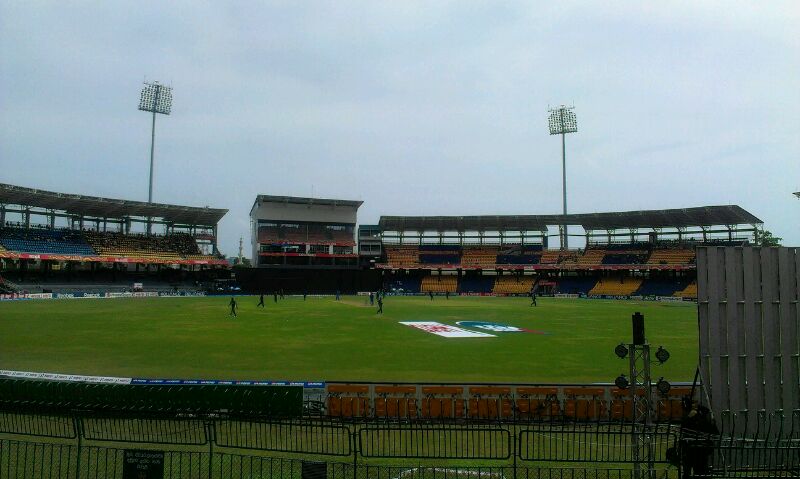
The picturesque R Premadasa stadium.

Kohli’s purple patch doesn’t seem to show signs of crashing in to a dead end, and along with Hashim Amla, he’s been having a remarkable set of two years in the International Circuit, notwithstanding the formats.

Unfortunately for us, the Indians lost their way during the second half of Pakistan’s innings and made heroes out of Kamran Akmal and Shoaib Malik – batsmen whom international bowlers, in general, would’ve fancied for breakfast, lunch and dinner.

The Cricket Shop

Goutham had got in touch with a few Gray Nicolls cricket gear dealers prior to the trip to check if he could procure gear in Sri Lanka. And a box of Kookaburra cricket balls to take back home so that the CECC boys could get accustomed to bowling/facing the Kookaburra in line with their preparations to tour Sri Lanka later this year.

We zeroed down on a pretty popular shop (through internet ratings) called The Cricket Shop, located at Urban Colombo. We chanced taking a couple of tuk-tuks – envisaging options of a cheaper ride, as compared to a taxi from the Premadasa.

The route to The Cricket Shop seemed a detour, given that the drivers had little idea of the location we were talking about. Suneeth’s concerns over the rate the driver would charge us fell to deaf ears – both parties being unable to understand what the other was saying. The only word the driver seemed to know was “No Problem.” To add to that, the other tuk-tuk had taken a different route, and Suneeth seemed certain that this was a game to rob a few foreigners off their cash.

Suneeth was in half a mind to get down and call a cab, but we figured any adventure (or mis-adventure) was an experience worth shouldering. Fortunately, we made it there eventually and ended up paying 600 Sri Lankan Rupees for the ride.
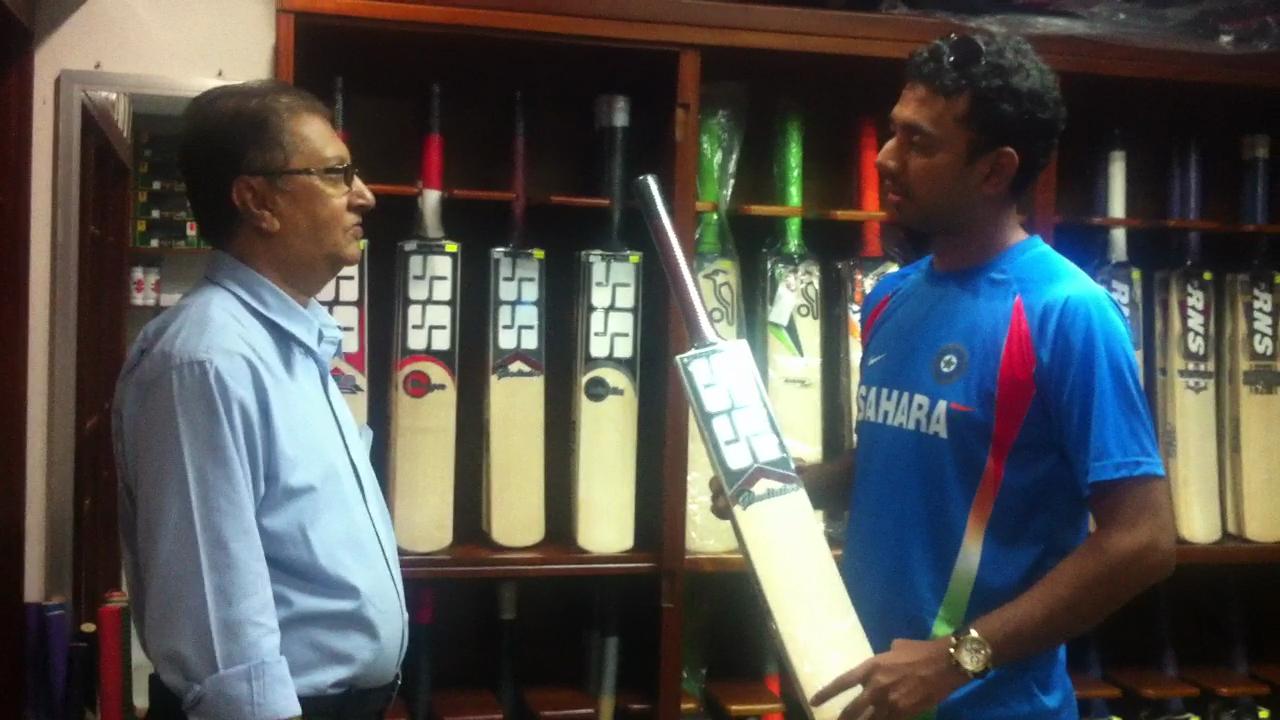
In discussion with Rila Mohamed, Director – Administration, The Cricket Shop, Colombo.

The Cricket Shop, at St Anthony’s Mawatha (Mawatha means ‘Road’ in Sinhalese) seemed the one-stop-solution for cricketers, ranging from amateur to pros, for procuring gears. The very purpose of our visit there, as mentioned earlier, was to check out Gray Nicolls gear. The cheapest Gray Nicolls willow was priced at around 45000 Sri Lankan Rupees, with a top end willow costing close to 70000 LKR.

The shop had an impressive range of display spanning Kookaburra, Stanford (SF), Puma, CA, Gunn & Moore, and SS – a fast moving brand since Sangakkara and a few other Sri Lankan crickets started endorsing it.  The shop Proprietor and Director, Rila Mohamed, was a very friendly man who took time off to explain in detail how he imports bats from India and why SS has become the brand being sought after by youngsters.

He boasts of photos and autographs from some of the best players from around the world, while mentioning that since most of the players are sponsored by manufacturers themselves, they stop by in case of an urgent need to procure a quality willow. Trust, he says is the factor that brings most cricketers back to The Cricket Shop.

Our hopes of buying a box of Kookaburra cricket balls went for a toss when we discovered that a single piece cost close to 14000 LKR. Maybe it’s time we believe in our players and understand that they, after all, can spontaneously adjust to the demands of the Kookaburra cherry when we get here.



Goutham Chakravarthi

17th September 2012

Colombo

Nearly four years have passed since I last visited this glittering island. The lack of multiple security checks at military checkpoints, a facet that seemed a norm back then, immediately stands out. One thing that hasn’t change is the warmth of the locals and the smiles on their faces.

Photo

A cyclist rides past a cut out of Sri Lankan players in the capital Colombo. © AFP

A cyclist rides past a cut out of Sri Lankan players in the capital Colombo. © AFPFrom the airport to the beachside restaurants in the south of Sri Lanka, it’s all about the ICC World Twenty20. Seaside resorts are abuzz with cricket fever, and even the cab drivers tell me they are keeping an eye on the weather forecast, praying for the rain gods to show mercy for a month.

“I want West Indies to win and I believe they have a good chance,” Abhishek Bharathkumar, an Indian national and a former age-group captain for Tamil Nadu, who is here in Sri Lanka on vacation with his family, said.

In addition to home favourites Sri Lanka, India and West Indies are also seen as favourites by the locals to win the trophy while Kumar Sangakkara, Chris Gayle, Virat Kohli, Shahid Afridi and Lasith Malinga appear to be the fans’ picks for the stars of the tournament.

Sangakkara is extremely popular amongst the locals here, understandably so.

“Kohli is my favourite player from outside of Sri Lanka. But Sangakkara is my favourite though and his three awards only prove that he is among the best in the world,” says Haroon, a shopkeeper at the airport.

Teams, stats, clubs, T20 leagues are all part of routine conversations with cab drivers and at family dinners.

The locals are also excited by the unearthing of unconventional talents Dilshan Munaweera and Akila Dananjaya, and the expectations for them to deliver are high. Sri Lankans are extremely confident the two players discovered at the SLPL have what it takes to succeed; many of them want both players to be included in the playing XI instead of warming the benches at this year’s T20 World Cup. With Sri Lanka known to offer unorthodox talent, the world will wait with equal interest to see if Dananjaya and Munaweera can use this platform to launch their careers similar to how Angelo Mathews did during the 2009 edition of the tournament in England.

The wickets here seem to be no longer inclined to help slow bowlers or batsmen who thrive on slow, low tracks. Well rounded attacks like Pakistan’s are expected to succeed and progress beyond the Super Eight stages.

“Wickets these days offer some nip to even medium pacers. I think Thisara Perera will be the player of the tournament if we go on to win the cup,” says Cathy, who is a waitress at the wonderful beachside restaurant Loon Tao in Mount Lavinia. She believes teams with allrounders who can bowl medium pace are at an advantage.

A large contingent of tourists meanwhile are keen on catching the action at the India-Pakistan warm-up game on Monday. However, the overselling of World Cup tickets still lingers as a prime concern amongst many of them.A large contingent of tourists meanwhile are keen on catching the action at the India-Pakistan warm-up game on Monday. However, the overselling of World Cup tickets still lingers as a prime concern amongst many of them.

“Ticketmaster, who are handling the ticket sales for the ICC, found that in the first few days of sales certain ticket outlets had access to the ‘blocked’ ticket database, and some of those tickets were sold to the public,” cheif executive of the Sri Lankan cricket board Ajit Jayasekara said, explaining the issue to Island Cricketrecently.

“When this computer glitch was noticed, they took remedial steps and offered alternative seating to those few people who had bought tickets from that database. The actual number is minimal and did not have an effect on the overall ticket sales.”

Even with several warm-up matches out of the way, It is hard to pick a favourite to win the tournament. The wickets will certainly have a significant say in outcome of the series, and should the wickets have nip and pace, it will be a very open tournament. Three sub-continental teams made it to the semi-finals of the ODI World Cup played in the sub-continent last year, and it is hard to see others challenge them should the wickets turn out to be slow turners.

Pakistan possess an impressive bowling attack, however, the chasm between sides shrinks to a blur in this format. Teams like Bangladesh can pose a formidable threat; both Pakistan and New Zealand will be wary of them, as they are in the same group.

The mood is festive. The most open WT20 tournament is upon us. Sri Lanka is the place to be right now.

This article was written for Island Cricket and first published there.


Venkat Vedam

1 March 2011

St. Louis


The Cup that Counts. Cricket World Cup 2011, being played in India. And yeah, Bangladesh plays some games in Bangladesh and Sri Lanka plays a few in Sri Lanka.

So, it’s more like a World Cup played in the Indian Subcontinent and the hosts each trying to make sure that they get their fair share of home-advantage – to see their team advance in the Cup and more so to suck-up all the advertising revenue that can be generated by invoking patriotic fervor in the fans of the game. Correction, fans of the cricketers belonging from their part of the world. Cricket is a lowly second priority.

Yes, Cricket is not important. Home team winning the games is important. And the organizers (ICC and the boards working for the corporations which paid millions of dollars) know that. Curators stick to the formula too. So, we have a bunch of grounds with dead-flat sponge mats disguised as cricket pitches. That’s nothing new to cricket, specially the shorter versions. But this is ridiculous. Hoping to win the ‘World’ cup through home advantage.

One of my favorite experiences watching an ODI is to see fast bowlers let it rip in the first few overs and the openers battling it out with sheer talent or just plain luck: scoring runs maniacally in boundaries like Jayasuirya, Sehwag, Matt Hayden or scoring runs cleverly by manipulating the field and taking advantage of fielding restrictions like Sachin Tendulkar, Hashim Amla or Inzamam ul Haq or consolidating if wickets were lost like The Wall Rahul Dravid, Younis Khan or Steve Waugh. And the batting teams which would come out of this phase unscathed or as victors would be best placed to dictate the remainder of the innings. And then enter spinners, to slow the things down and use their guile to tie the batsmen down – good batsmen milk the spinners, bad ones wilt and mediocre ones meander towards the slog overs.

And the rubbish pitches for the games played till now in the world cup, have prompted the teams to open bowling with their spinners. West Indies, once an evergreen factory of fast bowlers – opened bowling with their spinner Benn. So did South Africa, opening with Johan Botha when they had players like Steyn and Morkel, arguably the best pace-bowling pair in the world cricket now.

For the last decade, ever since India started taking over as the leading revenue-generator for the World Cricket and thus the financial power house of cricket, cricket has been gravitating towards being a game featuring batsmen-vs-bowling-machines. And the least useful of those bowling machines are the type called fast bowlers. The grounds have been made artificially smaller by bringing the ropes in, fielding restrictions have been extended, mandatory ball change has been introduced – to ensure teams have a newer cricket ball after 34 overs to prepare for the final assault on the already demoralized bowlers.

This fundamental shift towards a batting-only cricket is due to the way cricket is enjoyed in India. Everybody wants to bat. Bowling is not so important. Fielding is a waste of time. This mindset is alike in Gully cricket (alley cricket), school and college-level cricket, club cricket and Ranji Trophy – and carries over to the national team. And the same mindset is cultivated by the fans of the game. I mean fans of a few cricketers from their respective parts of the country. No wonder India has so many batting sensations/legends and just about a handful of world-class bowlers, much less legends.

India is a high-quality Test team – if the pitch offers some swing and bounce or if the pitch deteriorates so much by the end of the 3rd/4th day that the spinners run through the opposition. It has great batters who can handle spin of any kind and on most surfaces. Otherwise, they are only a decent bowling team. And in the shorter formats where the opposition attacks the bowlers, they degrade to a mediocre team. They’re a team of great batsmen and one good fast bowler, one spinner and a bunch of sloppy amateurs. And the one good fast bowler, is known to blow hot and cold. More cold than hot in crunch situations.

And so, the groundsmen will try their best to prepare ugly, flat, spongy surfaces to somehow make sure bowling is out of the equation altogether. Home teams trying to maximize on their advantage is nothing new. But a side so hopelessly short on bowling resources, a fan-base so carelessly ignorant about the one-sidedness of the team they support and administration trying to convert a world-stage to an exhibition of batting skills by the host team, is a shame.

Not that the Indian supporters care. I feel it’s a misconception that there is huge following for cricket in India. No, we’re not bothered about cricket. Cricket is one way of supplying ‘stars’. Like movies. Sachin is God. Ganguly “Dada” is the prince of Kolkata (and we boo other players from his team, if required). Harbhajan is a star not because he’s a good bowler, but because he’s aggressive and arrogant at times. Sreesanth is famous for being Appam Chutiya and the slap-gate and less for his rare bowling-exploits. Dhoni and Yuvraj are famous more for their fashions and the women they date than the cricketing value they contribute.

Sure, there is always a patriotic feeling attached to wanting your country to win. But more so, the idea is to see these ‘batting legends’ and ‘stars’ win. We can care less about the cricket.

We don’t have quality fast bowlers!?

OK – lets have a few spinners in the team and a LOT of Star batsmen and let us prepare flat wickets.

Hmmm – but our players are slow and can’t field well.

OK – don’t worry. Our star batsmen will score a few more runs and the stars can win.

Well, other teams have good bowlers and great fielders.

OK – don’t worry. We’ll bring the ropes in and our star batsmen will hit out of the ground, so that they cant field.

But, the other teams have good batters too and what if they take advantage of the flat pitches and small grounds?

….. SH*T

Cricket world cup should be about cricket. Leave patriotism to espionage and wars.

Cricket world cup should be about batting, bowling and fielding.

Cricket world cup should be about good all-rounded teams and not about stars, even if they’re gods or fading legends.

Two last pieces of evidence before I end this:

1. During the game between England and India, Sachin hit a SIX against Swan and even before the ball landed beyond the boundary, the camera landed on Deepika Padukone, a Bollywood actor. And later at different points during the game, the camera focused on Business Tycoons, random movie actors, Politicians and a lot of Unknown Importants.

2. After the game was over, one great Indian Cricket Fan commented on his twitter feed:

‘Between Rahul Bose and Siddharth Malya, someone shoud F*ck Deepika tonight. India deserves this’

It’s not about cricket. It’s about stars. Some Sachin, some Dhoni, some Deepika and some Kingfisher.

This India doesn’t bother cricket. If the team doesn’t win, they’ll pelt stones at the cricketers houses and sling the proverbial mud and then get back to following their ‘stars’. After all, IPL starts within a week after the World Cup.

But, it might at least enlighten a smaller percentage of the followers of the game in the country, if the team doesn’t win the World Cup. In fact, the team doesnt deserve to reach semi-finals – surely, they aren’t among the top 4 sides in the world cricket. At least the team they selected for this event. They don’t deserve to win.


John van der Westhuizen

Johannesburg

22 February 2011

The South African squad selection for the CWC 2011 was not without controversy. Albie Morkel, Mark Boucher and David Miller were just 3 of the notable omissions. That all 3 of them are considered valuable lower-order hitters has raised special concern though, with Johan Botha now poised to bat a position higher than I think any Proteas fan would like him to. AB de Villiers taking the gloves is in theory meant to free up a batting space, Albie Morkel as an all-rounder has leaked way too many runs off his bowling in the last 18 months, and David Miller did not do enough in the India series to warrant leaving any of the selected players out. It is what it is, as they say – and barring any injuries, SA will have to do without them.

To focus on the players that were indeed selected, is to notice almost immediately the number of tweakers in the line-up. With Johan Botha, Robin Peterson and Imran Tahir as frontline spinners, and the part-time yet useful skills of Duminy and Faf du Plessis, it is clear that the selectors have already stepped out of their comfort zone. In the past SA has been reluctant to veer too far away from almost total reliance on their seam attack. Since 1992, this has resulted in ZERO World Cup trophies. It was Albert Einstein who said “doing the same thing over and over again and expecting different results each time round is the very definition of insanity”. This fresh approach to the make-up of the SA attack can, to the optimistic Proteas fan, make it seem like we are in for a fresh, as yet unachieved result. First Round? Done that (2003). Quarters? Done that (1996). Semis? Done that (1992, 1999, and 2007). I am of the opinion that if SA make the final and lose, the squad would have done the nation proud. They would have conquered a new frontier, taken us further than ever before. If SA lost in the final it would obviously take 12 months to get over the heartache before coming to so rational a conclusion out loud, but I am preparing the emotional hedge, getting my mental affairs in order, just in case I have to deal with so tragic a scenario.

Of the 3 specialist spinners in the squad, I would expect to see at least 2 of them employed in every game, along with the 2 part-timers. On wickets that have shown a tendency towards taking more turn than usual though, it would not surprise me to see 3 specialist spinners picked, with Steyn, Morkel and Kallis bowling seam-up for the variety. Imagine a South African seam bowler picked for the purposes of providing variety? What has this world come to? Peterson has shown good form getting 6 wickets in the 2 warm up games against India and Australia. Tahir too has been among the wickets. Botha has proven himself to be SA’s premier spinner in this format. While Tahir is more of a strike bowler, the other 2 are more than capable of doing a holding job. Of the part timers, Duminy would most likely try to keep an end tidy while du Plessis would be more attacking. The balance on paper is frighteningly good. Throw into the mix Tsotsobe (leading wicket taker in the SA/IND series, ranked 10 in the world), Morne Morkel (ranked No. 2 ODI bowler) and Steyn (ranked No.1 Test bowler, ranked No. 8 ODI bowler) and it becomes clear that this attack is not the worst ever to wear SA colours in a World Cup.

As far as the batters go, on current form Smith is the weak link in the top order. Amla and de Villiers are ranked 1 and 2 in the world. Their prolific form in the last 18 months has been well documented elsewhere and long may it continue. Duminy has averaged 61 in ODI’s in since Jan 2010. And then we have Kallis. Someone who should know a bit about cricket, a certain Kevin Pietersen, recently described Kallis as “the greatest player ever”. For the purposes of this insert, I’ll take that as a valid remark. I will mention though, that in his last 20 ODIs, JK averages 52.5 – so he does have a vague idea how to hold a bat.

Now for the ‘weak link’: Apart from Faf du Plessis, SA appears to have no recognised finishers or big hitters for the latter stages of the innings. If the opposition get 5 wickets, the SA batting line-up appears to offer very little in the way of players capable of scoring 10-12 runs an over in the last 5-10 overs. The SA tail is exposed a little earlier than would normally have been the case in past world cups, with players like Klusener and Pollock coming in at 8 and 9 and making the closing overs count. I would be happy to be proven wrong, but as good as the trundlers mentioned earlier are at their chosen craft, they have yet to scare international teams with bat in hand.

The approach will most likely be one of seeing off the new ball, while making at least 50 in the first 10 overs, and then setting the stall for the accumulators to do their thing. Duminy and du Plessis should be able to add good runs more often than not at the end, but wickets will need to be preserved. I would imagine that at any given stage, 1 of the 2 batsmen at the crease will be tasked with batting through.

That’s the theory, all wrapped up. The skills are there, the support is there. What could possibly go wrong?

Let’s just get the squad to stick to a liquid diet in the play-offs, avoid solids completely – and please, pretty please: I hope they’ve all had training in basic first aid. Knowing the Heimlich Manoeuvre could come in handy.


Goutham Chakravarthi

13 February 2011

Bangalore

World cup brings with it many things. Inevitably each edition plays host one last time to a group of great cricketers performing on cricket’s biggest stage in the hope of going out on a high. Expectations, invariably, sky-rocket from loyal supporters. Heroes are made of performing stars and winning teams are immortalized. Inglorious exits are met with wrath and burning effigies. Heads roll and scars linger till the next significant victory is achieved. Only a blessed few get to go out as world champs. Others walk into sunset alone and hurt.

When a player should retire is his own business. Image: Deccan Chronicle

It is a strange thing this retirement. Young men in the prime of their life otherwise are asked to leave just because a younger and stronger cricketer promises to deliver. A performer of grandeur, excellence and one of mass adulation and worship is replaced with the tone of a has-been. A retiring rock star on the other hand perhaps goes on a world tour for a couple of months one last time. Yes, Test retirements sometimes are on that scale (Steve Waugh, anyone?), but how many of the great theatre artists or pop-singers are asked to terminate their profession abruptly?

Still world cups are different. Passions reach fever pitch and average ex-cricketers find the temerity to question colossal giants. Media fuel exits with the same exaggerated care they would a triumph with inane debates and over-the-top obituaries. Fans and media move on with the next game and the next victory but a great career is ended.

Cricket, with its changing fortunes and the many twists and turns, the highs and the lows, heart burns and unbridled joy – often in the same match – is rightly compared to life and its vicissitudes. Retirement is anything but life like. A routine retirement is an occasion where friends and family collate to celebrate the career. Contributions are acknowledged by grateful peers and bosses. In cricket, retirement is often demanded following a high profile exit. Whilst selection is merit oriented and at the discretion of the cricket board, retirement is the individual’s choice. Often, cricketers are pushed into it. Some give in and some retire only to be back very soon after. And some others retire in installments. Whatever the means, it is best left unto the individual.

As with this world cup, this will be the last time truly modern day giants like Tendulkar, Kallis, Muralitharan, Ponting, Jayawardene, Chanderpaul will play in a world cup. All of them would want to go out as world beaters and nothing less. As it might turn out, none of them might be around when it is the finals time on April 2nd. It would hardly count as failure as it is players like them who make cricket invigorating and such a pleasure that you and I worship every minute of it. Their biggest contribution is in leaving the game having inspired millions of others to take to it.

As the world cup gears itself perhaps for its own future in a few days’ time, these great set of players will put on their best performances in the hope of scaling the summit one last time. Cricket will go on with or without them as it should and invariably will. Some won’t get picked after this world cup and selectors and captains are entitled to their judgment. But retirement should be left unto the players themselves. May be, some might announce it a year later from their last competitive game like Sampras did. May be, some won’t. In either case, it is none of our business.