Archive for the ‘Cricket’ Category


Goutham Chakravarthi

In an attempt to make India a fitter unit, BCCI has roped in the services of Usain Bolt as India’s running coach with immediate effect. Indians are expected to train with the world 100 meter record holder for a week in their quest to give them an added edge before they head to Australia for a 4-Test series. Talking of the appointment, K Srikkanth said, “Taking a leaf from Gavaskar’s famous commentary usage of converting ones into twos and twos to threes, Bolt will help team India convert each single into a three at least – and in some cases to a five or even a seven – and thereby helping our batsmen increase their scores three-fold!.”

Talking of his appointment, Bolt, who joined the team at Vishakapatnam, said, “The last day of the third Test at Wankhede had the whole island interested and I had a couple of friends wake me up at the dead of the night to catch the game when my phone rang. N Srinivasan was on the line and I told him the super slow motion pictures were outstanding and I congratulated the BCCI on the quality of their TV production when Srinivasan told me that it wasn’t super slow motion pictures I was seeing, but Ashwin running in full throttle!”
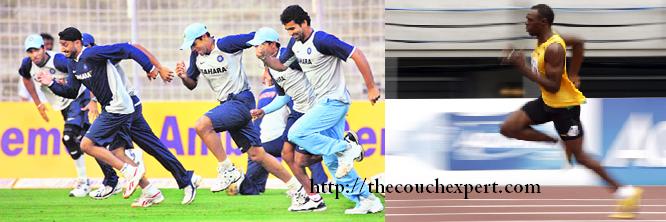
India train to sprint their way to success in Australia under the supervision of Usain Bolt

He added, “I couldn’t believe someone could actually sprint so slowly. When asked if I would help them fix the problem, I was skeptical. But when they dangled a 2 million dollar contract for a week’s training, I couldn’t resist. I asked Fletcher to send me tapes of their running training, and now I am here in India for a week to help them train.”

Of all Indians, Laxman and Ashwin seemed the most excited after their first training stint with Bolt this morning. Laxman said “I sprint the 100m in just a little under 44 seconds just behind Ashwin who does it in 41.43 seconds. Bolt has given us specific training routine that should ensure both Ashwin and I break the 40 second barrier by the end of the week. Finally, there is hope for us to look for the quick second run.”

Ashwin added, “He seemed to be able to point to the mistakes in my technique straight away. He could pin point to my technique that I seem to have followed from my childhood subconsciously – that of Rajnikanth running in slow motion in his high adrenaline fighting sequences. I am unlearning the technique and move towards the modern running method of complicated leg strengthening exercises that will give us enough power to our legs. Also the key is to ensure that the feet not being in contact with the ground for more than 0.2 seconds while in full sprint. Laxman and I, the smarties that we are, have already come-up with a formula that’ll help us get there. Expect us to run like the wind in Australia.”

Bolt is also introducing the sprint runners’ set block positioning for the non-striker while backing up. You will see the likes of Suresh Raina now crouched on one knee without the bat and both hands just behind the popping crease with his upper body in a 45 degree angle that the sprinters use to generate pace off the starting block. Bolt claims that Raina this way is able to run his twos in one-sixth of time he would take otherwise – in the traditional method. Bolt claims that this technique will ensure that there will not be many dot balls as it ensures players are quick enough to run a single even when the batsman lets go of a delivery to the keeper. He insisted that in places like Perth where the keeper tends to stand far back, Raina, Kohli and Dhoni would be able to run twos to the keeper and promised that we will see byes contributing more to team scores going forward. If the wicket-keeper is slightly slack, batsman might run a bye to him even off spinners!

Duncan Fletcher, the Indian coach said “Bolt’s insight into running and the transformation that is possible with his inputs is quite amazing. Even I have been able to move from one side of the ground to the other in less than 20 minutes now. Munaf Patel, Aashish Nehra now run quicker than they bowl. That was the easy part. We are now trying to translate this to field positions as well. The increased agility of the fielders will ensure that each fielder can now control two positions. Jadeja will now man both point and covers and Kohli mid-off and extra-cover, where as, Raina will cover the whole of the on-side and Dhoni alone now will cover for the keeper and three slips. Our not-so quicker fielders will stand on the boundary and strategize thereby giving us an unprecedented edge over all teams that have played cricket before us. Sehwag now can charge down to spinners and hit it almost off the bowlers’ hands as he is now that quick!”

With the whole of the nation very excited by this development, Bolt was convinced that India would start favourites in Australia this time. He signed off by saying, “India will run away with the cup in Australia. I think they should. If they did, don’t think there is anyone in Australia quick enough to chase them down. Let’s just hope they don’t assign the task to Laxman or Ashwin yet. They will get chased down for they are not quick enough just yet”


Prasad Moyarath

An Australian tour always provided an ultimate test of character for any cricketer and remained a tough frontier to conquer for any team. The pace and bounce of the Australian pitches combined with its bigger boundaries intimidated the batsmen from the subcontinent to such an extent that a big innings in Australia is epitomised as his ability to play quality fast bowling. Off-spinners struggling, fast bowlers bowling a wrong length, fielders struggling with their throw from the boundary, wicket-keepers fumbling are all common problems faced by the teams from the subcontinent in Australia. The Australian media are well known for their attack on opposition captain and almost all sub-continental teams have had some bitter experience in the past.

Yet another Australian tour is round the corner for the Indian cricket team. Indian selectors have announced a 17 member squad for the four test series which looks strong and well balanced in paper. But for any cricket connoisseur, this team does not inspire any confidence. Though this team has a set of talented youngsters and established stars, the way this team has been groomed as a unit and its preparation for this tough tour has raised the eyebrows of many. Having followed many Indian tours of Australia particularly the last two in 2003-04 and 2007-08, this team for me, does not look strong enough to conquer Australia even with their new look side.

Sreesanth and Harbhajan are known to get under the skin of the Aussies. They might be missed. © The Indian Express

India drew the series 1-1 in 2003-04 and lost 2-1 in 2007-08. Sehwag, Dravid, Tendulkar, Laxman and Zaheer who were part of those two tours are still there in this team. Dhoni toured Australia in 2007-08. Team with 6 experienced players should have an upper hand against a new look Australian squad. But a look at the performances of the 6 Indian experienced stars makes me jittery. Zaheer is coming out of an injury. Though Sehwag has scored a few half centuries after his come back, his performances have not been convincing. But Sehwag is unpredictable and can fire any time and India’s performance in Australia depends to a great extent on the innings he plays there. Dravid has been in great form and should continue his dream run in Australia. The whole nation is waiting for a century from Tendulkar and this expectation seems to affect the great master. Despite his big knocks in India, Tendulkar does not look to be in a good rhythm. Laxman has always produced some wonderful performances against Australians, but age seems to have caught up with him. His feet are not moving like in his younger days and with his slow reflexes, he can be a burden on the field in Australia. Dhoni has a dubious batting record outside the sub continent and his keeping has also not lived up to the expectations recently. Australians are well known for their meticulous planning and they are sure to exploit the above weaknesses of Indian stars.

It will be the first test series in Australia for Gambhir (though he impressed in the one-day series there back in 2008). Kohli is yet to cement his place in the test squad and his weakness against short pitched balls which became evident in West Indies will be exploited by Australians. He needs to display how he has rectified this short coming. Rahane and Rohit Sharma are yet to make their debut in test cricket and don’t expect to play any part in the test team unless any of the batsmen gets injured. Only one among the two spinners will play in 3 test matches except in Sydney. Praveen Kumar, Umesh Yadav and Varun Aaron will relish the conditions and it is up to them to make their presence felt. Saha will be a mere passenger unless Dhoni gets injured. India needs to play Umesh and Varun in all the test matches and knowing the leadership style of Dhoni, it looks a distant dream.

What is lacking in this “strong” team compared to the previous tours? To be honest, this Indian team lacks characters, those who have the guts to fight it out in the middle and those who can inspire others with their cameo. India will surely miss players like Saurav Ganguly, Sreesanth and Harbhajan. It is not that these players should be included in this squad, but this team lacks “something” which these players have which will help them fight against all odds.

What could have been done to improve India’s chances? The West Indian tour to India ahead of this Australian tour is a big blunder. The flat pitches here did not help the cause either. The Indian selectors and the team management never bothered to groom the players. Rohit Sharma was identified as a test batsman very late and the captain did not have the courage to play him in place of an established star even after winning the series. Same is the case with Rahane. The Indian selectors have still not identified the players to replace the 3 greats. They should have played Rahane and Rohit by resting Dravid, Tendulkar and Laxman in rotation. Now it is suicidal to blood these batsmen in trying conditions in Australia in case of a crisis. Parthiv Patel as a reserve keeper would have solved the batsmen’s injury worries considering his experience in Australia. Why the selectors don’t consider him as a batsman despite some crucial knocks against Brett Lee and Shoaib Akhtar is still a mystery. By denying a chance for Umesh Yadav and Varun Aaron to bowl in tandem in Mumbai, the Indian team management missed a golden opportunity to groom a new fast bowling pair. With a captain who wants the Indian test pitches to assist spinners from the first day onwards, this was not unexpected.

The years 2003 and 2007 left the Indian cricket lovers broken hearted due to the Boxing Day test matches in Melbourne. The year 2011 seems to end in the same note. Unless the Indian openers give a sound start and our team management gives up their defensive thinking and our new fast bowlers rip through the Australian batting line up, this Indian team don’t seem capable of presenting a happy 2012 to its fans. Good Luck Dhoni and team.


Chandrasekhar Jayaramakrishnan

It is clear from the summary of events over the last five days that the Wankhede wicket was not as much at fault as anything in bringing about the scale of the expectations surrounding Tendulkar’s milestone. Yours truly, for one, believed otherwise while witnessing a West Indian unit, with due respect, amass 591 runs. What followed was a non-verbal war between the accuser and the accused – the wicket spoke for itself, and so did the result.

The excesses of expectations throughout the cricketing fraternity have become a national problem. The media fails to see beyond the much awaited milestone, while commendable performances on the field by others have become sub-headlines to a more eye-catching, heart-on-sleeve title.  Every headline seems a verbose isomer of the other.

Hard not to associate the man with the number

The obsession with the milestone is understandable. It is easy to overstate the problem, but it is a lot easier to come to terms with the fact that it will happen, and that time will show us when and how. One would argue that it would have been befitting for the greatest batsman of the modern generation to have achieved this milestone in the same home ground in which his nation lifted the coveted World Cup – a ground in which he started playing as a young teenager.

But certainly, history would want to remember this milestone as one achieved under non-ideal conditions in an arena and environment that challenges the abilities of a batsman. Just like how Euclidean geometry had taught us as kids that the three angles of a triangle sum up to one hundred and eighty, the sport has continuously taught us that records and numbers do not matter if they don’t shape up for a team’s cause, under trying circumstances. There is a reason why his 114 as a young kid on a Perth wicket is remembered as one of his best innings of all time. A few others, like Anton Tchekov’s characters, at the end, have vanished into life.

That he has 99 centuries till date is a catalog of his virtues – and that he has sustained for over 22 years a tribute to his consistency. And that glaring countdown:  fully armed with preconceptions portrayed by the recalcitrant media and frenzy – a mark of disrespect to a man, who at times, has wielded more responsibility than the Prime Minister of a nation.  The game of cricket has challenged every champion in disproportionate measures – from the meager run bucket of Ricky Ponting this year to the branding of anything less than a Tendulkar hundred a failure. It is about one man’s recent past, and another’s future. And not to forget the Turbanator, who is going through a lean patch after being a fulcrum in the Indian attack for close to a decade.

As fans, every one of us has a role in mediating the mayhem that surrounds a player’s personal glory. A series victory down under would mean a lot more to Tendulkar than achieving his milestone. And it is important to remember, given the circumstances down under, that there may not be a better time to tour Australia with the hope of obtaining a result. And if both happen, well – what is left to say here? Life isn’t a movie script that one can write in advance.

After all, the inevitable day is just about adding another one to his monumental tally of tons, and not even remotely close to that day when Canadian sensors hope to detect microbial life in Mars. Why all this fuss then?


Goutham Chakravarthi

“Just learnt from a player that it is a very good batting pitch at Wankhede for last test…u know why right? : )” tweeted Sanjay Manjrekar ahead of the Mumbai Test. But how good is this wicket? No one says it is a good bowling wicket when wickets tumble? If anything the two Tests in South Africa had more Indians glued to it than the three Tests in India have. Good cricket is universally loved. And invariably they happen on wickets where ball battles bat on equal terms. But Wankhede is a disgrace.

It is but blatantly obvious that a flat track is prepared in anticipation of that 100th hundred. ©Associated Press

Cricket should have no tolerance for vested interests. It is a shame that a wicket is prepared for the obvious. It holds the game and the fans to ransom. It is no less cheating than insider trading. It shows scant respect for the game, and in this case, to Tendulkar himself. He is his country’s greatest champion and doesn’t need freebees. The man’s boyhood and adolescence was Test cricket. He is under pressure to perform. Always. His failures are magnified and studied and speculated. In his time, a country limp on wickets abroad learnt it could stand on equal terms with the opposition and even dominate. As a boy he conquered Australia. A generation followed in his footsteps and it counts among the most respected teams going around today. It is not a coincidence that India’s strongest sides have coincided with his times. And now a tailored wicket to help him get to that hundred? That’s the biggest insult his home board has heaped on him yet.

From the times when French women bunted wooden objects with a log of wood 800 years ago, batsman have been in the ascendancy. Restrictive rules: under-arm, round-arm, field restrictions and so on have limited the bowlers. But, always, they have come through with a solution. If not for those ingenious minds that propelled cricket we would still be playing under-arm cricket. Bless John Willes and Edgar Wellsher for daring to bowl over-arm and change the game for ever. Googlies, swing and reverse-swing ensued. So have doosras, but still bowlers are not given their due. Bigger bats, restrictive field placements and dodgy laws impede bowlers. A bent arm is cheating and an extra bouncer unbecoming of the gentleman. There are more restrictions than American immigration checks. And now these dead wickets.

It is difficult to imagine a more batsman-friendly era than this: protective gear, ordinary bowling, flat wickets, big bats and small boundaries. Perhaps only the 1940s can count to be its equal with an insane amount of runs being scored. Routinely 600s would be replied with 700s resulting in run feasts, dull draws, inflated records and poor cricket. It is often the case today barring the results.

The quality of the bowlers coming through is a case for concern for the health of the game. Hardly a corrective measure is taken to address it on a global scale. Wickets to suit home teams are as old as the game itself, but it serves little purpose. The game is more important. It is meant to be a battle of equals – of bowlers bluffing batsmen with spin, dip, guile and scary pace and batsmen responding with restraint, judgment, courage and great skill. Alas, it is often not the case.

State cricket associations in India prepare wickets to their fancy and their hour of need: weaker oppositions are welcomed with under prepared tracks in the hope of full points and stronger teams with flat decks to rule out a result. The system is as corrupt as some of the others in the country. Cruelly, must-win-games for home sides finish in less than three days. And no one cries foul or is there an honest body to prevent this. Happily the body that runs cricket in India is more worried about television rights and even television production. All they want from its state associations are their votes. The game can cop all it wants, but it is only worried about its commercial interests. No empire stands the test of time. Neither will the BCCI.

Wankhede is a disgrace. They have sold cricket and nation short. And disrespected Tendulkar.


Goutham Chakravarthi

Greatness in sport is a strange thing. It has no cut out definition. But it can come from anywhere – from the streets of Karachi or the hills of Kandy. Nor is it predictable to a pattern.

As a kid growing up Javed Miandad was a man who I believed to be the all conquering god of batting. He had smashed Chetan Sharma for a six on the last ball to win a one-dayer for Pakistan and ever since, he was one player all budding Indian batsmen secretly admired and hated. I was no different. He was the epitome of a scrapper and street fighter. A cagey man and an astonishing batsman, he was a great batsman. Perhaps a shade less than Viv among his contemporaries. Viv imposed his pride and will on the game like no one since.

Kallis is the best all round cricketer since Sobers

Not always is greatness bestowed on a cricketer very early. It is not a mere test of ability, but of character, endurance, will and the know how to seize a moment. Champions are recognized for the long haul. Every champion has holes: more so with batsmen as they are measured often against one failure each time. Occasions such as world cups and tests against arch rivals often determine their fate. A Lara is remembered for his immortal unbeaten 153 against Australia in Barbados whereas a Gatting for getting out playing a reverse-sweep in a world cup final. Often, that is the lasting legacy of cricketers: what they do in the critical hour. Every one has a highest peak. For some the highest peak of failure outweighs their highest peak of success.

In that regard, some are not given the due they deserve. Like Rahul Dravid, Kallis doesn’t get his due. Like Dravid, Kallis never got the coverage he deserved when he got to 12,000 Test runs. It is a shame.

Make no mistake, he is a colossus. As a batsman alone he counts among the best five batsmen to have played the game in the last 20 years. As an all rounder, he is the best since Sobers.

Some keen observers point out that Kallis likes to look after himself: a clever way of saying that he plays for averages. Often he is criticized for that in the one-day games. The entire South African team ignored him at breakfast following the world cup defeat against Australia in 2007. His numbers are staggering in all formats and in all levels. His longevity and consistency are startling considering his work load as a bowler, a very skillful one at that in his pomp.

A man of strong basics, he has built his game on sound technique. Australians tried exposing holes in his drive, which, in turn was an examination of his mind and not of his game. Unnerved and solid, he has passed the test. As he has all around the world scoring runs on dry wickets and on the wet ones, against swing and seam, and against spinners on dust bowls. Not to mention seeing his team through in tough situations. Yes, there will be eternal argument in not seeing his teams through in world cups, but to pin the failures of a generation of South Africans on one man is preposterous.

I often believe the many struggles all cricketers go through are in the hope of achieving something substantial and special – as players and as a team. Long after they are done playing the game, it is moments of collective peaks that bring them a sense of satisfaction. And Kallis has often been at the center of many of the brightest moments of South Africa’s cricketing success. Perhaps he is comfortable now than before. He seems a lot more willing to impose himself on the opposition. He even lets out an occasional smile and shares a light moment with the opposition.

It is hard to imagine anyone as good as him who has got lesser recognition. He has won more games for South Africa than any other (most Man of the Match awards in Test history). Yet his calm is mistaken for insecurity and weakness. He knows his game and knows what it takes to succeed. If anything, his last few years have been better than ever before. Perhaps a lesser bowling load and a shift down the batting order have helped. Age and form will eventually catch up, but at current evidence, they seem many summers away.

When he is done playing the game, the game will remember him as among its very best.