Archive for the ‘India in England 2011’ Category


 Goutham Chakravarthi

 1 August 2011


Two remarkable days of Test cricket took a back seat with Vaughan’s supposedly humorous suggestion that Laxman had applied a coat of Vaseline to escape thin edges from detecting on Hot Spot. If that directed all the wrath of Indian supporters towards Vaughan’s twitter feed, the events surrounding Ian Bell run-out threatened to disrupt the entire series.

Ian Bell's run-out that wasn't: the incident that became the talking point of the day

The run-out incident

Spirit of the game is a convenience for some players. Players play by the letter of the law and stick to it and wait for the umpire to put the finger up even after nicking to first slip! Teams appeal for LBW even when they might know that the batsman may have hit it (Harbhajan Singh in India’s first Innings) or when the ball may have pitched outside leg stump. Even fielders sometimes don’t signal boundaries when they know that they were over the boundary while retrieving the ball hoping that camera angles might not be conclusive and they get away with it. Let’s go back to this incident.

Ian Bell, in an interview at the end of the day, did mention that he wasn’t going for the 4th run, but admitted to being naïve on his part to think it was Tea already. But, when asked if he would refrain from repeating it in the future, he only repeated him in being naïve on this instance and would have felt hard done if Indians stuck to their original decision that had him dismissed throughout Tea. But credit to him that he did acknowledge that he was out per the laws of the game and appreciative of his opposition captain and team chose to reverse the decision.

The entire tea session was a soap opera. Shane Warne brought the spirit of the game into discussion and it snowballed from there. Former cricketers were divided in their opinions and a history of such incidents have ensued different decisions from other teams in the past. Let’s look at them:

1. Muttiah Muralitharan in Christchurch (2006-07)

As you will see below, Muralitharan in his haste to congratulate Sangakkara upon completing his hundred, doesn’t wait for the throw to reach the ‘keeper, but turns to congratulate Sangakkara only to have the bails whipped and be given out.

2. Grant Elliott at The Oval (2008)

New Zealand cried foul following this run-out incident where Elliott is given out after colliding with Sidebottom. After the umpires offer Collingwood and England an opportunity to withdraw the appeal, England don’t, resulting in scathing criticism from Vettori and Kiwi players.

3. Collingwood at The Wanderers (2009)

In a bizarre turnaround of events, Collingwood found himself at the receiving end of this run-out against New Zealand in the ICC Champions Trophy in South Africa a year later. This time, New Zealand and Vettori withdrew the appeal.

As we can see from the above incidents, India could have stuck to their original decision and the world may not have understood, but would have had no choice but to accept it. As Rahul Dravid put it in his end of day interview, the team would have felt bad had it been one of its own players and they took a unanimous decision to reinstate Ian Bell.

Let’s hope it calls for more honesty from the players for the remainder of this series.

Ian Bell’s Century

Ian Bell looked every inch the supreme player the whole of England touted him to be when he first appeared on the scene. He was decisive in his footwork and delightful in his stroke play. He has been in remarkable form this year and continues to mesmerize opposition with strokes befitting an artist. This has been a hard fought series with England finding that extra when needed – Ian Bell in this innings.

This could well be the innings that finally breaks India’s back in this match and the series and usher a new dawn for England as the no.1 team in the world. England might have found a dominating no.3 in Bell and might want to keep him in that position for he has the game to provide early momentum for England. He is perhaps also their best player of spin and therefore will influence how well England travel in the Indian sub-continent. Increasingly, with Cook, he is becoming their most important batsman for their fortunes in the next few years.

Back-to-back tests telling on Indian bowlers

Praveen Kumar is only into his fifth test match. You can’t fault him if he feels 20 tests old for he has borne the brunt of this attack this English summer. He has shown remarkable ability with the ball and has taken wickets and kept the runs to a trickle. But all the bowling over the last two weeks are telling on him and the rest of the bowlers. With Zaheer breaking down at Lord’s and now Harbhajan rendered redundant with a stomach injury the legs are running out. As well as they may have tried their best, England have had answers this innings and Prior in the evening session ran twos hitting straight to the fielders in the deep.

Prior and England will look to pile on the misery on the fourth morning and inflict scars for the rest of the series. England have broken India’s back. Now, they will look for the kill.


 Muthukumar Ramamoorthy

 31 July 2011


As much expected by the fans of India and as much feared by the dressing room of England, the first few hours of the first session went Indians’ way despite the loss of the Very Special Laxman – but before which he made sure that he gave enough support for the Wall to become even taller. It seemed so obvious that Laxman really played into the same kind of delivery that he missed nipping it marginally the previous delivery – from a spectator view it was clear lack of concentration. Following Laxman the master blaster Sachin once again started off with great confidence and middled the ball so sweet. Trent Bridge can supposedly be said as the little man’s English home soil.

Wish Sachin could have played longer than he did before lunch and had scored 40-plus leaving the English bowlers worried going into their dressing room for lunch. It was indeed disappointing to see Sachin having played that shot. Having left the good balls, it was another delivery that he should have probably let go. It was once again the very previous ball after leaving it go, the master went down the track where it was pitched and symbolized the angle of the ball by waving his hands. Knowing the trajectory of Broad’s brilliant swing so well, a champion batsman falling to such a shot would have left those fans holding placards waiting for his 100th 100 annoyed.

Rahul Dravid produced a master class on Day 2 at Trent Bridge

Thus far, it was so magical to see Jammy bat and Stu’s bowling – pitching it up and swinging with only Bresnan pitching a little short of fuller length and hitting the good length area of the partially green deck. As soon as Raina came into the crease all the seamers started targeting the chest area as expected! Raina would still need a lot of patience rather than knowing to duck or hook. His body language was so evident that he was tested with the short pitched deliveries and he desperately wanted to put away anything falling fuller or close. If Mukund played to get out to a sitter by a very first delivery of Anderson, Raina was undone by his own hunger for runs – giving away his wicket for another sitter and brought Yuvi inside the park who is again fighting for a place in the XI.

Besides thanking his seniors, Dravid and Laxman, for having played so well and rubbing off the shine of the ball, Yuvi must also have thanked the nature as the sun was out mostly during his stay in the crease making a better batsman friendly pitch. Having got into the XI only through injuries for others, Yuvi played to his strength and did his best to create confusion for MSD and others to decide the XI for the next test. Dravid’s century was much supported only by the free strokeplay of Yuvi off the old ball. Their century stand not only ensured India going past English’s score but promised a big lead.

All was well for the Indians until the new ball was taken. It required another Laxmanesque technique in Yuvraj to survive the brilliance of Broad and Anderson in their initial spells with the new ball. It was a beauty of a delivery that every bowler would love to ball to a southpaw and what tested the temperament of Yuvi. Broad did so well to get rid off Yuvi who was threatening the Englishmen inching towards the 3 figure mark. But thanks to Yuvi for having got India a slender lead before his exit.

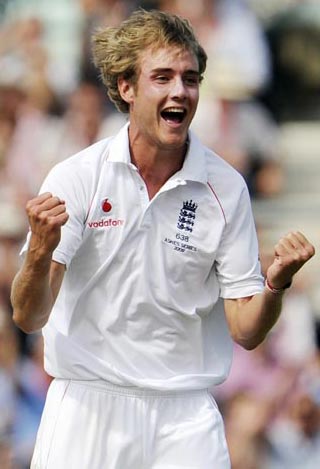
With a hat-trick to blow-away the Indian lower order, Stuart Broad produced magic in front of his home crowd.

It was nothing of a delivery from Broad that sent the Indian captain Dhoni back into the dressing room. With the ball still new, the seamers still doing good using the beauty of the pitch, one would have for sure let the ball go if he had watched from the dressing room what the #2 batsman Dravid had been doing for more than 200 mins in the middle.

It was Dhoni’s reckless shot marked the beginning of the Indian batting collapse falling like 9 pins. Adding to it, Harbhajan’s next ball exit to a very poor decision from the umpire must have ignited the anger of the Indian fans for the reluctance of BCCI on UDRs. Taking lead over it, Broad was so magical on his home turf and claimed the first hat-trick disturbing Praveen’s furniture!

Imagining what could have been the state of mind of a man standing at the non-striker end who had been playing since overnight nobody would. Say the Wall threw his wicket looking for runs with only tail left. Broad finished the formalities thereafter through the reflex of Bell with a mega catch.

Looking back, though the English bowlers were brilliant in their spells, tested, troubled…. It seems more that the Indian batsmen threw away wickets at crucial times. There wasn’t so much of beauty and perfect wicket taking deliveries by the Englishmen. Indian seamers looked much better than English in this regard. Proving this, Ishant bowled a beauty by making Cook go back without sweating at all.

Another day slipped from the hands of India where they could have easily said “Advantage India”; hardworking local lad Broad helped the English side back in the contest making it to be a close contest!


Chandrasekhar Jayarama Krishnan

Head of Cricket, CouchExpert

30 July 2011


Dravid’s love affair with the Battle of Survival ascends when the original rationale for the contest between bat and ball – with the additional threat of a Trent Bridge turf war – intensifies. On a wicket that contained enough juice to make even a top batsman’s plight ignominious, Dravid’s approach towards every ball was reminiscent of a gallant soldier’s focus while guarding the borders of an endangered nation.

On a day of engaging Test cricket – involving a world class ton from Dravid, a spell of devastating consequence from Stuart Broad, dropped catches and an Umpiring blunder – it almost made the common fan wonder why five day cricket is still a topic of morose sentiment.

The script couldn’t have been written better: the world’s most technically equipped batsman fighting under the most testing of English conditions, a local hero picking up six that included a scintillating hat trick, and Kevin Pietersen dropping Yuvraj Singh at gully when the latter was on 4. And the third session of play demonstrating cricket’s own version of a Domino Effect.

The Wall’s 34th test ton, equalling the record of the greats Brian Lara and Sunil Gavaskar, adds to his tally of an inert century as an opener, a position that he doesn’t enjoy batting in, yet one which he takes up for the team’s cause. Memories of his purple patch during the tour back in 2002 flooded through the gates of Trent Bridge like a tsunami, commemorating the achievement of this batsman who has faced the maximum number of balls in Test cricket.

Intelligent cricket is often about respecting the conditions, especially for a batsman on conditions like these. Dravid’s willingness to leave and defend under cloud cover on Day One was equally matched by the intent to put the loose deliveries away on a relatively sunny second day – both being offsets of an outstanding technique and immense concentration.

Not to forget VVS Laxman’s contribution in ensuring that his veritable partner was in the right frame of mind to build this valuable innings. If the last fifteen overs of Day One was a lesson on survival, the good news from the middle on first session of Day Two was what the Indians had been touting for, almost entirely due to the excellent complementing efforts of Dravid and Laxman.

Dravid's 117 at Trentbridge will rank alongside his feats at Headingley, Adelaide and Rawalpindi

If Hogwarts School of Wichcraft & Wizardry taught cricketing magic, Laxman’s batting is one which would be invoked by a verbal spell that would read Gracio.  Such was the fluency of this master batsman that it allowed Rahul Dravid, at the other end, to play the game that naturally comes to him.

This new force seemed to transcend traditional Nottingham culture of seam and swing. Both these batsmen emphasized strong responses in difficult situations, using experience and role playing. Even the cruelest of Dementors would have found it impossible to suck these happy memories from an ardent cricket fan – such was their exhibition of batsmanship!

This display is something the current young crop of Indian cricketers must think about if they want to leave a distinctive mark on the sport, inspire a new generation of cricketers and succeed in the largest arena of Test cricket.

It was a shame to see Laxman getting out the way he did – a delivery that he certainly wouldn’t have poked at in the previous evening. While statistics would say that Laxman’s average record in English conditions persisted, the criticality of the knock – one that cannot be quantified – was as immense as any innings one would associate with the stylish Hyderabadi.

England’s bowling included sporadic spells of brilliance from Anderson and Bresnan, who supported a more consistent Broad in their quest to dig through the Indian middle order. Graeme Swann, predictably, with a bandaged left hand and unsuitable conditions for spin, had a day to forget with Yuvraj, back into the Indian test team after a long duration, targeting him in particular. The Indian southpaw’s valuable contribution, ably supporting the solid Dravid, certainly puts him contention for another berth in the starting XI for the subsequent tests.

The Indian lower order batting, once again, failed with the display appearing to be almost criminal, when compared to the value that Dravid put on his wicket. The Indian captain’s dismissal, especially, will evoke a lot of wrath from the fans.

Broad’s hat trick, which included the Indian captain, Harbhajan Singh and Praveen Kumar as victims, did not materialize without its own share of controversy. The Indian team’s reluctance to move with a fully fledged DRS back-fired as a Harbhajan Singh inside edge on to his pads went unnoticed by the umpire Marias Erasmus, who adjudged the batsman incorrectly, not for the first time this game, out LBW.

The local boy's hat trick was the first of its kind at Trentbrige

Nevertheless, Broad’s final tally of six wickets painted an image of a man who shared no resemblance with the one who was being victimized by the media prior to the start of this series. His contribution with the bat, as demonstrated at the Lords and the first innings at Trentbridge, did plenty to add to his credentials of portraying himself as a genuine all rounder.

Dravid would have had every right to be disgusted with the batting display of the lower order when he Bresnan had him caught at third-man in an attempt to search for runs, having been left with the tail. In hindsight, a lead of 59, after Dravid’s marathon display, should leave scars of remorse amongst those who didn’t apply their minds as they rightly should have.

With England commencing their second innings, the sport proved that it has a funny way of biting you as a player – as Broad’s presence ascended, the form of the Ashes hero Cook exponentially descended. After surviving a close LBW shout to Ishant Sharma, Cook was the first English batsman to be dismissed when a leading edge flew to Yuvraj at backward point. The law of averages, much to Cook’s dismay, applied itself on the England opener.

The course of this Test could well be decided on Day 3, especially with the injury of England’s talisman batsman Trott, and the fact that he’ll no longer play a part in this test.

But Day Two’s contribution to Test Match cricket will be those vivid images and memories of Rahul Sharath Dravid, battling through a hit on his wrist and later, cramps, to conjure one of the greatest innings of all time. What a champion!


 Goutham Chakravarthi

 30 July 2011


A green pitch and an overcast day covered with wet clouds greeted the two sides at the toss which both captains didn’t want to lose for it wasn’t the pitch even Dr. W.G. Grace would stick his thumb into and say, ‘A hundred for me lads’. With injuries plaguing his team and with an unsettled batting order, Dhoni was relieved to win his second toss in a row and insert England.

Sreesanth made a fine come back by picking three English top-order wickets

It can be difficult to assess bowling performances in helpful conditions. Largely, Praveen Kumar settled into a good line and swung it both ways with magical control. Ishant, buoyed by his performance in the second innings of the Lord’s test, galloped to the wickets and hurled tough questions at the English openers. Between Praveen Kumar, Kevin Pietersen and Marias Erasmus, they ensured the news channels got enough fodder for the evening bulletin. Tantalizing cricket was played where fortunes oscillated between bat and ball when stumps were drawn for lunch.

The afternoon session warmed many Indian hearts as their bowlers ripped through the English middle order with great skill and discipline. They could have got more as the bowling had the batsmen in a fix: batsmen were drawn to play away from the body with the bat aslant from the swing of the ball. The pitch offered the ball more than what the bowler offered the ball when hurled to the pitch, and as a result, a tough and fine middle order was left to lick its wounds for the second time in successive innings. Sreesanth, his omission from the first test and his late swing, was debated at length in the Sky commentary box.

The test erupted into life in the final session with two free spirited locals deciding to take the attack to the enemy camp. A dumbstruck opposition recoiled and let the game drift. In a most entertaining hour post tea, Swann and Broad smashed a hitherto impressive Indian attack to smithereens. And till the maverick Praveen Kumar got one to spit on Swann and almost broke his left hand, the show looked impressive to carry on for a while longer. Broad continued in his merry way in producing a sparkling half-century in front of his home crowd, an innings that could prove to be vital in the final analysis of the match if England manage to sneak ahead with a lead after the completion of the Indian first innings.

Dravid and Laxman, key to India overhauling England’s 221, survived a testing spell of skillful bowling from Broad and Anderson. They showed their skill in encountering a difficult pitch with movement and unpredictable bounce. They took body blows and survived close shaves. Lucky as they were, they showed how to survive on this wicket. They, with Tendulkar, will be crucial for India’s chances now in this Test.

England will fancy their chances on the second morning.


 Goutham Chakravarthi

 29 July 2011


It is now a power struggle. It is proving to be one mighty battle for power between England and India: BCCI vs. ECB, English press vs. Indian press, ESPNStar com box vs. Sky com box. Of course, also the small matter of battle for ICC’s no.1 ranking in Tests.

Michael Vaughn wrote a piece on how to get Tendulkar out at the beginning of the series. Now, one Test into the series, Nasser Hussain has written a piece on how Anderson is proving to be too smart for Tendulkar. Simon Hughes wrote an article on how to get the better of all Indian players (bordering on something like get the batsmen out and don’t lose wickets to Indian bowlers!). Scyld Berry swears Tendulkar wouldn’t have crossed his highest score of 37 at Lord’s had he even batted the whole of the last day of the first Test. Boycott calls it the beginning of the end for the Indian team as no.1, but, Botham is already convinced that England are the new kings.

A story such as this is what media is after.

Not to be outdone, Sourav Ganguly called the English attack pretty much the same as the one he faced in 2007 and how India will tough it out and win this series. One Test in to the series, he is convinced that India will get better – a thought reflected in another former captain Anil Kumble’s recent article. Meanwhile, Sunil Gavaskar has appealed to the Indian media to get behind the home team like the Australian press and stop being negative about them (in other words, you or I can’t have an opinion of our own).

Long gone are the days when journalists described batting as art and poetry or the art of re-constructing a bowler’s clever plot in beguiling a champion opposition bowler. It is hyperbole madness today with media looking for quotes and stories. A Manjrekar calling Dravid “not talented” is a bigger story than a gutsy, carefully engineered Dravid hundred. A journalist who ekes out “Ganguly divides the team” from the coach is put on a higher pedestal than a wonderful analyst reporter who picks a pattern to a team’s issues with leg-spin bowling.

Bloggers and journalists have been working overtime to prove their points-of-view. Some English writers have even put this English team on par with Clive Lloyd’s West Indians and Steve Waugh’s Australians. The health of their bowling riches is compared to the ancient flourishing civilizations on the banks of river Nile and their seemingly endless supply of talented young batsmen are expected to back-fill any holes in their batting should there be such a need. Some credit the African and Asian immigrants’ contribution in the English uprising in the world rankings. The standard of county cricket is apparently on the rise while simultaneously they are taking a swipe at the state schools for not contributing even one English player since Collingwood.

On the Indian side, cricket enthusiasts have been digging-up stats of tours where India start poorly and stacking the series end result to be convinced that there is going to be a turn around. Health and injury history of Zaheer Khan have been researched more than will the protein pattern matching at the Indian Institute of Science. A team’s seriousness of the first test is being questioned and even alleged to be used as match practice by Sanjay Manjrekar. Never the ones to miss an opportunity, the whole of England is hell bent to point at the IPL for every Indian failure anywhere else – from the player fitness to mental fatigue.

The same can be extended to how both the cricket boards operate. Both like power and both don’t have a history of being very affable when wielding it. Like ECB’s willing and what proved to be a fatal association with Standford and now the enormous urge to protect its players from theIPL, BCCI is no different with wanting its stars playing in IPL – even at the cost of an international tour – and not the other T20 leagues around the world. Both like taking pot-shots at each other, don’t expect it to be very different should one of the two teams lose on the field either on a dodgy umpiring decision or the proverbial “player integrity” over a match altering low catch.

The team that stands tall at the end of the series will be regarded as among the finest by its fans, ex-players and its media while the losing team will face the wrath of their fans, ex-players and media. You see, they all need the men on the field to give them the bragging rights over their counterparts.

God save the team that wins. God save the team that loses.