Archive for the ‘India in Australia 2011-12’ Category


Chandrasekhar Jayaramakrishnan

Grafter or not, Ricky Ponting’s 41st ton did not resemble a large set of the other forty but it was an innings certainly built through with perseverance and grit. It is tempting to wonder if Ponting’s approach is a reflection of knowing the squalor that would arise if he’d gone about batting the way he normally does. But his innings today certainly didn’t lack class.

Clarke’s stories, recent and not-so-recent, are strikingly different ones. His presence at the crease of late barely resembles the Clarke who, until not too long ago, struggled with his feet movement and approach for a period of time that could well be termed lengthy. He’s had his own share of issues in dealing with knife-wielding Brutuses behind his back, but he’s skipper now and is leading from the front in a series that is fast approaching a 4-0 whitewash.

He now appears a lot more frugal than his predecessor Ponting, and his views are minimalist. He spent the best part of the day trying to catch up with Ricky, and overtaking him by the time stumps were called. He had his share of luck while coasting through to 140, something Ishant would’ve sneered at given how his day turned out.

Sydney all over again. Image: Sportlive

A day’s play that would have left a hopeful Indian fan frothing at the mouth has drawn nothing more than a remorsefully apathetic response, almost as though this was expected. As the cliché goes, the mature heads will know that things are not always what they seem. At least, from the perspective of a source from the visitor’s dressing room who seemed to reckon that with the score line already 3-0 against them, things can’t get worse.

One can’t attempt to try and defend the indefensible. Just as the introduction of Ashwin as early as during the fourth over of the game seemed to light things up, more due to Umesh Yadav’s inconsistent start with the new ball, Sehwag’s ideas lacked the durability required to bundle out a supremely confident unit on a placid track. He’d have been fairly satisfied going in to lunch with three wickets fallen, but would have found it hard to sport a smile after that.

Ashwin did well to restrict Warner from cannoning off to a start that he’s so accustomed to, thereby building the pressure needed to get the southpaw in to committing an error. Marsh’s misery continued to haunt him as he looked like a rat lost in a maze, unable to get anything right in what could probably end up being his last Test in some time to come. Never before has an Australian Number Three looked so unconvincing. He’s certainly exhausted the large quantities of trust and patience which he might have found during the build up to Adelaide.

And that is Australia’s fear right now. It was the underlying theme of Sydney – that the veterans performed, and the youngsters didn’t. Although it is too early to conclude so at Adelaide, a few of them, to their credit, did justice elsewhere. A spot in the eleven now appears perennial for a few with great appeal. But with Brad Hogg returning to International Cricket (T20) at forty, Ponting could well set his sights on another nine hundreds by the time he decides to hang his boots.

Dat Two, as history suggests, will offer plenty more runs to trouble the scorebooks. But for this Australian side, this series, with a fragile bowling opposition, no total appears unimaginable.

Goutham Chakravarthi

India came in to the series after a drubbing in England but were still the favourites. The talks of ageing players on their last legs was more an Australian worry than India’s. A month in to the series, it is the story of a 40 year old Brad Hogg making a come back in to the national reckoning that is doing the rounds and not that of the other old guns having to hang up their boots. It is the turn of the India’s older batting superstars to face the heat. And in all probability it should be the last time we see them all together.

It is strange but also true that much of India’s great success in the past decade was largely due to the determination and collective efforts of a group of dedicated and proud cricketers. While the administrators were busy marketing one-day cricket and later T20 cricket, the selectors seemed more interested in looking after themselves than Indian cricket. In the process, though selection has become a paid job, it is but fair to conclude that it is the players who put the Indian cricket on a pedestal. And now, with the last bunch of those from the great generation on creaky legs and wonky backs, neither the administrators nor the selectors seem to have an answer to India’s problems.

While it is true that India perhaps picked its strongest squad for this series, much of India’s success overseas had to do with its batsmen being able to put up strong scores on the board. Taking 20 wickets was never India’s strongest suit and it needed the big scores to give itself a chance. And it is remarkable as to how they put themselves on top of the world with an average bowling unit at best.

India's strength for a decade now is suddenly its weakest link. Image: The Daily Telegraph

The islanders down south have taken their first steps to clean up their mess by sacking their coach and appointing a new captain. They have revamped their selection committee. India seems to be bullish about its slump and fails to acknowledge its shortcomings. It is blatantly obvious that India has failed to groom its youngsters for the future. Neither the administrators seem bothered nor the selectors. That India will not look to the future in Adelaide is a resounding slap on the all faces of those who care for its cricket.

Adelaide is a no win situation for India with neither the selectors nor the stand-in captain showing any inclination for the need to change. The strength of this side has been its seniors for a decade now. It now seems as though even the selectors seem reluctant to do anything to upset them. Or that they are simply not bothered. It is painful and disrespectful for the ones who care about Indian cricket that the ones that run it seem not bothered about its future.

Irrespective of what transpires at Adelaide, India cannot have the same set of players representing it going forward. A transformation needs to take place between now and in two years’ time, when India set foot off their shores for challenges abroad, a new team, settled and well oiled with Test match cricket over two years should represent it. How India chooses to rebuild will determine how serious it is about its cricket image. It might have to be the players again who lead the change. And once again, it might be a senior who makes it easy on the selectors by announcing his retirement at the end of this Test.

There’s more to lose in Adelaide than just the Test.


Chandrasekhar Jayaramakrishnan

The Border-Gavaskar Trophy finds itself back in Australian shores once again. It has been over a decade since this series was won so convincingly, although fingers will point/will continue to point at India’s incompetency. The indignation in the visitor’s camp hasn’t seen a single day of untroubled repose yet. Which is why the essence of the Adelaide Test will lie more on Australia’s battle with themselves than anything else around.

The 3-0 score line is only a number that highlights the success achieved thus far, not an acknowledgment of the goals set themselves. The Australians have settled for the mere truth:  a few individual performances has overshadowed many meager stats from players who, now, find themselves at cross roads of their career – given that a few of their names don’t automatically find their ways into Arthur’s Playing XI when given a fully fit pool to select from.

Shaun Marsh and Brad Haddin, the same names that propped up during the build up to Perth, have done little to boost their credentials to get them away from the relegation shortlist.  They’re going to have to find themselves away from a lean patch that increasingly resembles Greece’s financial muscle. Perceptions that people have about their abilities (lesser empirical in the case of Haddin, given that at 35, ability isn’t what one is judged by) doesn’t seem to match the statistical reality required to warrant a place in the national side.

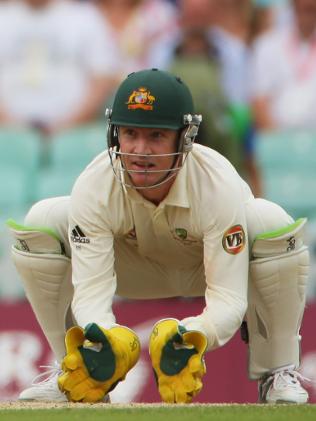
Combine the perception of a mid-thirties age bracket with a very lean form with both bat and gloves, and it leaves Brad Haddin beatable, something that even he has acknowledged publicly. The scanners over his performance are worth having, and the only way to put an end to his debacle is to address his uncertainty over shot selection.

Haddin looks most likely amongst the Australians to get the axe post-series

With Clarke appearing to be a leader further to the right of Genghis Khan, the Adelaide Test would prove more important to a few individuals in the Australian team than to those in the visiting camp attempting to grab a consolation victory. Australia’s rebuilding phase has created avenues for talent to sneak in to, and only the bowlers seem to have answered the call of duty thus far. Ed Cowan’s performance, from the batting unit, hasn’t done his reputation any harm – although whether he’d be in the reckoning for a place in the Top 3 is subject to further debate.

Reports of a hard, dry surface ‘favoring’ the visitors (not in the literal sense) will matter little to Nathan Lyon who returns to the side on the same ground where he served as a groundsman not too long ago. No better time, and venue, to justify the faith shown in him by the selectors.

4-0 looms.


Prasad Moyarath

It is time for desserts, sweets and ice creams. A team of young and enthusiastic chefs who are specialists in these items are being flown in to appease those who are disappointed with the quality and taste of their main course prepared by some expert chefs renowned for their tasty main course. The management and admirers of these chefs look bewildered and they pin their hope on this new team to deliver quality and tasty food in their frantic efforts to restore their shattered pride. Can tasty desserts make people forget their horrible main course?

Selectors may have missed an opportunity to build a nucleus for 2015 World Cup by picking old stalwarts in the squad

This was the dilemma plaguing the BCCI and their selectors when they selected a team for the two T20s and eight ODIs involving Australia and Sri Lanka. The team selected looks a perfect blend of youth and experience. The baffling part of Indian cricket is the fact that a few cricketers are allowed to pick and choose their matches and tours while the others will be picked and chosen as per the whimsies and fantasies of the selectors. 39 year old Sachin Tendulkar included in the squad as he made himself available while the promising Ajinkya Rahane thrown out. Zaheer Khan is back. Sehwag included despite his horrible form. Are these three going to play any part in the 2015 World Cup in Australia and New Zealand? Have not the selectors squandered a wonderful opportunity to blood at least three youngsters in these testing conditions and build a nucleus for the 2015 World Cup team? Debate can go on but nothing more can be expected from this selection panel whose decisions have been criticized and questioned in every nook and corner of the country after the continuous Test debacles outside the subcontinent.

Though Sri Lanka is the third nation in the triangular tournament, they cannot be ignored as a weak opposition considering the fact that they are coming after a tough tour of South Africa. Their players will be better accustomed to the bouncy pitches than the Indian players who were either injured or playing Ranji Trophy matches in the dust bowls in India. Australians are well planned as usual and will be a tough nut to crack in their home conditions. This gives a picture of the tough task ahead for the current World Champions to conquer Australia.

In the big grounds in Australia, Dhoni’s captaincy skills are going to be tested. Athletic fielders like Raina, Jadeja, Kohli, Tiwary and Rohit need to be placed tactically to contain the runs. Running between the wickets will have to be improved. Suresh Raina’s vulnerability to short pitched bowling will be exploited. With Sehwag and Gambhir not in good form, there is every chance of the middle order getting exposed to the swing and bounce of the two new balls from both ends. The selectors seem to have anticipated this problem and their decision to include Parthiv Patel as a reserve keeper is a testimony for that.

The two new balls from both ends will surely play a decisive role in Australia than in India. Will the ageing Tendulkar survive the rigors of an ODI series with the new rule not permitting runners? Umesh’s performance in the Test series has clearly proved what extra pace can do in Australia. With Ishant and Varun unavailable, the selectors could have included Ashok Dinda in place of Vinay Kumar for his speed. In Vinay, Praveen and Irfan, India has 3 similar bowlers and the Australians gave a glimpse of what to expect from Vinay Kumar by the way they treated him in the WACA Test.

The Indian selectors have again selected a ‘strong on paper’ team more suited for Indian conditions like they did for the Tests but unlike the Test team, this team has some characters who can give a fight to the opposition. Praveen Kumar coming back after an injury, Irfan making a come back, Sachin and Zaheer having question marks on their ODI fitness, Dhoni, Sehwag, Gambhir and Vinay Kumar low on confidence, the Indian team management needs to get the right combination from the day one to make their presence felt in Australia.

Some bold decisions will need to be taken and some youngsters will need to be persisted. Umesh Yadav needs to be handled with care and it is a pity that there is no fast bowler in this team to replace or support Umesh. This Indian ODI team does not inspire confidence and optimism in the Australian conditions and I foresee the Indian top order batting and medium pace bowling creating more headaches than other areas in the coming days. Let us wait and watch.


Chandrasekhar Jayaramakrishnan

Apologists for depreciating cricketing standards in India have finally run out of excuses. Some of the post-mortem findings, coupled with ‘expert’ opinions, are the kind of things ardent fans want to stay away from – the media bringing out character-revealing natures, some fabricated and some true, of our heroes’ personalities and core interests.

But what, unjustly, is getting camouflaged is the lack of coverage by the Indian media on rising Australian standards. After all, Michael Clarke, amidst immense pressure during the build up to this series, had artillery with young, raw and largely untested players coupled with a few experienced seniors going through lean patches. That the Aussies decimated the Indians the way they did is a credit to their attitude and work ethic.

Barring Shaun Marsh and Brad Haddin, every Australian can afford to hold his head up high. Marsh has age on his side, whereas Haddin appears to be at the twilight of his career and much of it is stuff that he already knows – the willow isn’t generating enough sound to undertone his “be afraid … very afraid” warnings through politically correct advertisements in television media. His keeping skills, in addition, have been subject to much criticism over the best part of the last year.

Unlike India, the imbalances that need to be unwound in the Australian squad are far lesser. For one, albeit the talent possessed by Shaun Marsh, he doesn’t appear to be a Test number three. He is an organized batsman, no doubt, but he often bails out to deliveries outside off stump – those he’d have happily dismissed in the shorter formats. Test Cricket is a different ball game all together, and it might help him if he polishes his Sheffield record (not a mandate these days) to grab the spot with both hands with significant 4/5 day experience. After all, history has shown that even batsmen with unlimited talent but insufficient temperament have created their own recipes for prolonged failure in Test Cricket.

Reinventing the wheel with Sheffield Cricket will make Marsh a stronger candidate at three © Zimbio

Phil Hughes and Usman Khawaja are examples of two batsmen from the very recent past who are busy reworking their techniques, temperaments and whatever else it may take to cement a spot in the Australian XI. Marsh isn’t far behind in terms of ability, although his domestic record may not seem all that overwhelming when compared to the other two youngsters. After all, Marsh looked a certain fit at three before he succumbed to injury in South Africa. This could, for all, be a bad phase he’s going through but when everyone makes merry and you miss out, you certainly feel the pinch a lot more obviously than otherwise.

Haddin’s story is a different one. The injury to Tim Paine may have created a sense of false security that he isn’t ready to be overthrown yet. He certainly isn’t moving as well as he’s expected to behind the wickets, and looks lost as a batsman. Poor shot selection has been his nemesis on many an occasion. He could place his faith in the confidence angels but his sustenance, despite the excellent team results, will only border on optimism if he doesn’t make a mark at Adelaide.

It would only take a radical reversal of course for the Aussie to potentially falter at Adelaide. Despite the middle order misgivings at Perth, the Aussies will feel that there is no willingness to face up to the necessity of having to face a threat at Adelaide given how the visitors are wounded and beaten – and that some of them may just be a touch too old to get up and resume battle.

The Indians, on the other hand, claim to have made plans to gradually phase out the senior players to accommodate the influx of youth from talent pools around. The reluctance to phase all of them out at once compares to a family that takes out too large a mortgage to consequentially suffer from making the monthly payments. However, with the Test Cricket schedules looking sporadic over the next couple of years to come, there is sufficient time to gauge the prospect of more than one veteran being replaced pre/post Adelaide.

Whoever comes in at Adelaide will be well aware that the Australian bowling unit missiles are as good, and potent, as any other subsonic missile around. Nothing has deterred the attack from disciplined bowling. It only took Mitchell Starc a few sessions with Wasim Akram to do what he did at Perth – and that spells trouble for any opposition. Neither did Ryan Harris show any signs of a bowler who’d just returned from a long lay-off due to injury. The Aussies, in a nutshell, have demonstrated that the ingredients for success are blatantly obvious: discipline, channeled aggression, enviable work ethic and consistency across the unit to build a competitive squad. This has got Australian cricket moving again – and all the Australians moving again.