Author Archive


Chandrasekhar Jayaramakrishnan

The best captains often walk a fine line between leadership and performance. And as the South Africans swept the Kiwis 3-0 in the ODI series, the moment seemed quaintly out of time. As much as the World Cup defeat last year to the Kiwis would’ve hurt them, the whitewash seamlessly fits in to the scheme of things falling under skipper AB de Villiers.

The tour to New Zealand has offered a whiff of fresh air. From Richard Levi’s pyrotechnics, to the bounce and brilliance of de Lange, the series has encapsulated many a solid performance (notably Amla’s solidity at the top of the order and AB de Villiers’ raising claims to take over the batsman-ship baton from Jacques Kallis) to throw a glimmer of hope under a new regime.

The convincing manner in which the ODI series down under was wrapped (partly due to New Zealand’s new-look outfit) has more to reveal – opening with Wayne Parnell in the final ODI is a reflection of the scales in which confidence is being measured in their dressing room. Parnell, a player who hails from one of South Africa’s poorest province, had got his break during the days when the quota system had enforced the administrators to invest in his scholarship to a sporting high school in Eastern Cape. He looks likely to be one of South Africa’s all-rounder mainstays for many a year to come, even if a few statistics point elsewhere.

3-0, easy as it comes.

In the fan’s gaze, this phase of South African cricket is in the midst of a now-familiar cycle. The foundation for their ‘success-to-be’ is likely to be built on the captaincy structures laid by de Villiers, often regarded as a paragon for versatility. Like his predecessors, de Villiers will realize that he will have no excuses for failure at all: his country has a brilliant set of athletes to choose from, even though it has traditionally found it difficult to provide the rudiments of success expected out of it in major tournaments.

The distress surrounding their ICC campaigns have historically been deeper than exhaustion. As skipper, de Villiers would do well to make efforts to escape the grilling claustrophobia of ICC tournament post-mortems. The repealing of the quota system after the post-apartheid pendulum cycle has soft-pedaled any attempt to point fingers towards cricketing structures. After all, a thorough analysis on a topic that had received most public notoriety can reveal invisible histories that the quota system, with its focus on abstraction, had hidden.

Of course, Graeme Smith’s peremptory approach during his reign had made things look a bit more secure, but did little to erase the ‘chokers’ tag that has been dubiously associated with this brilliant outfit. Smith was a captain who was pretty optimistic about the public’s perceived ability to accept excuses. But he was smart enough to know that if you’re telling the fans something they don’t want to hear, an apt convincing counter-offer was needed to balance things.

Most fans have respected the past South African skippers for their effort, but have often been left confused and disappointed by the results. It is possible that de Villiers will continue to do what worked for them in the past. Historically, South African cricket’s problems had lied largely with its administrative deficiencies. But now, with a large set of bottlenecks out of the way (at least, if the news coming out of their local media is to be believed), de Villiers has an easier road to rally his troops along.

Of course, as the battle mode shifts to a five-day mode, a more familiar leader in the form of Graeme Smith will lead his team out on the seventh of March. But it is well worth keeping an eye on AB, for he is the right man to take South Africa forward for the best part of this decade.


Chandrasekhar Jayaramakrishnan

Siege warfare has been their stock in trade. For Australia, this series was a case of truth being stranger than fiction – in the good sense. Consistency across four tests reaped benefits earlier not thought-of, and it certainly wasn’t a case of a chain being as strong as its weakest link when a few individuals failed to step up to the occasion. Not a single test seemed likely to enter the fifth day, with the exception of the final one that might have not lasted so long had Australia enforced a follow on.

The worst thing about India’s 4-0 whitewash down under was the inevitability of it. That a large set of the players looked withdrawn and out-of-sync (every time the cameras focused on them) didn’t help the cause either. Astronomical numbers gathered over years of batting is what constituted the middle order, but there was little evidence to suggest that this was the barometer by which their performance was being gauged.

As unpopular as this view will probably be, the proverbial rant surrounding why Rohit hasn’t played a Test yet will continue for some time to come. After all, when wickets fall at intervals so short that the same old advertisements are shoehorned every five minutes (in some cases, ironically featuring the stars that are on the field – or ones who had just lost their wicket), little can be said in defense of their numbers, irrespective of how large they are.  They are statistical quirks, no more, and cringe-worthy.

How meekly the Australians made a team of eleven Indians capitulate throughout the series ranks alongside General Friedrich Paulus’ surrender at Stalingrad in 1943.  Never before had a German Field Marshall surrendered to enemy forces. And the Indian fans’ displeasure is as much as that, if not more, experienced by Adolf Hitler back then. The Australians have dominated the series with an air of perfection that would have made Michelangelo knock of the Sistine Chapel ceiling on a Sunday afternoon to target a work of art likewise.

Playing a Test in Australia is never a pleasant experience – precisely why it is so fervently anticipated. The IPL might have forged opportunistic alliances between these two nations (among many others), but nothing further seems to have transpired. The Indians’ only comforting presence in the Australian dressing room would be that of Shaun Marsh, whose IPL image contrasts that which he has built during this series, albeit the formats being grossly different. Marsh is an unlikely candidate to catch the plane to the Caribbean, come this April. He has cut a lonely figure, resembling a Greek window-shopper unable to buy runs.

Australia’s biggest gain over the series (apart from unearthing/refining an outstanding pace attack) has been the resurgence of Clarke as both a batsman and skipper. For some, Clarke’s Midas touch could’ve come as a greater shock than American Presidential Candidate Mitt Romney’s tax returns. Just as it seemed during the build up that Clarke’s perceived image would receive boo-eliciting responses to every remark he makes, given how unpopular he was among certain sections of the public, the response couldn’t have been more timely and stronger. That he had Ponting by his side all along the course of this series is a tribute to how the two of them have responded to immense pressure.

Now who is more subservient of the two? © Sportsbanter

Premonitions over their roles and future in the Australian setup have finally been buried. With Brad Hogg making a comeback at 40, it would be hard to stop a rampaging Ponting from continuing to play on until he experiences another lean patch like he did in 2011. As will Mike Hussey fancy his chances in hanging around the International setup for some time to come – given how the influx of promising youngsters hasn’t quite worked out the way that the selectors might have anticipated. It would require a Marsh-esque run with a virgin willow for either of these two batsmen to have their performances under intense scrutiny once again.

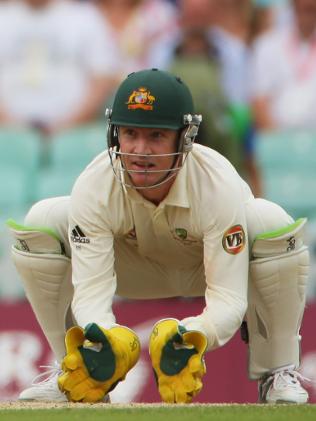
Haddin’s forgettable patch has rightfully seen him relegated, as much as claims may state that he was rested. At 35, it seems that his path henceforth is a foregone conclusion. The absence (injury) of Paine brings in a whiff of fresh air via Matthew Wade, a youngster who has shown potential to dazzle crowds with his reassuringly simplistic approach to the game – more reassuring than Mickey Arthur’s claims that Haddin is on the right track for Ashes 2013. In truth, Haddin was only marginally better than being hopeless.

Wade’s outing in International Cricket has been much anticipated

Wade, on the other hand, will be in action as early as tomorrow when the two teams face off against each other in the first T20I at Sydney. He’ll feature alongside a few veterans, a few new names, a quirky Marsh and his younger brother Mitch (possibly), under the leadership of George Bailey after Cameron White’s inconsistent form relegated him into oblivion.

Australia sits at a disappointing fifth in the ICC T20I Rankings. A new stadium, a new home outfit; the Aussie fans will hope that it is the same old result though.


Chandrasekhar Jayaramakrishnan

Grafter or not, Ricky Ponting’s 41st ton did not resemble a large set of the other forty but it was an innings certainly built through with perseverance and grit. It is tempting to wonder if Ponting’s approach is a reflection of knowing the squalor that would arise if he’d gone about batting the way he normally does. But his innings today certainly didn’t lack class.

Clarke’s stories, recent and not-so-recent, are strikingly different ones. His presence at the crease of late barely resembles the Clarke who, until not too long ago, struggled with his feet movement and approach for a period of time that could well be termed lengthy. He’s had his own share of issues in dealing with knife-wielding Brutuses behind his back, but he’s skipper now and is leading from the front in a series that is fast approaching a 4-0 whitewash.

He now appears a lot more frugal than his predecessor Ponting, and his views are minimalist. He spent the best part of the day trying to catch up with Ricky, and overtaking him by the time stumps were called. He had his share of luck while coasting through to 140, something Ishant would’ve sneered at given how his day turned out.

Sydney all over again. Image: Sportlive

A day’s play that would have left a hopeful Indian fan frothing at the mouth has drawn nothing more than a remorsefully apathetic response, almost as though this was expected. As the cliché goes, the mature heads will know that things are not always what they seem. At least, from the perspective of a source from the visitor’s dressing room who seemed to reckon that with the score line already 3-0 against them, things can’t get worse.

One can’t attempt to try and defend the indefensible. Just as the introduction of Ashwin as early as during the fourth over of the game seemed to light things up, more due to Umesh Yadav’s inconsistent start with the new ball, Sehwag’s ideas lacked the durability required to bundle out a supremely confident unit on a placid track. He’d have been fairly satisfied going in to lunch with three wickets fallen, but would have found it hard to sport a smile after that.

Ashwin did well to restrict Warner from cannoning off to a start that he’s so accustomed to, thereby building the pressure needed to get the southpaw in to committing an error. Marsh’s misery continued to haunt him as he looked like a rat lost in a maze, unable to get anything right in what could probably end up being his last Test in some time to come. Never before has an Australian Number Three looked so unconvincing. He’s certainly exhausted the large quantities of trust and patience which he might have found during the build up to Adelaide.

And that is Australia’s fear right now. It was the underlying theme of Sydney – that the veterans performed, and the youngsters didn’t. Although it is too early to conclude so at Adelaide, a few of them, to their credit, did justice elsewhere. A spot in the eleven now appears perennial for a few with great appeal. But with Brad Hogg returning to International Cricket (T20) at forty, Ponting could well set his sights on another nine hundreds by the time he decides to hang his boots.

Dat Two, as history suggests, will offer plenty more runs to trouble the scorebooks. But for this Australian side, this series, with a fragile bowling opposition, no total appears unimaginable.


Chandrasekhar Jayaramakrishnan

The Border-Gavaskar Trophy finds itself back in Australian shores once again. It has been over a decade since this series was won so convincingly, although fingers will point/will continue to point at India’s incompetency. The indignation in the visitor’s camp hasn’t seen a single day of untroubled repose yet. Which is why the essence of the Adelaide Test will lie more on Australia’s battle with themselves than anything else around.

The 3-0 score line is only a number that highlights the success achieved thus far, not an acknowledgment of the goals set themselves. The Australians have settled for the mere truth:  a few individual performances has overshadowed many meager stats from players who, now, find themselves at cross roads of their career – given that a few of their names don’t automatically find their ways into Arthur’s Playing XI when given a fully fit pool to select from.

Shaun Marsh and Brad Haddin, the same names that propped up during the build up to Perth, have done little to boost their credentials to get them away from the relegation shortlist.  They’re going to have to find themselves away from a lean patch that increasingly resembles Greece’s financial muscle. Perceptions that people have about their abilities (lesser empirical in the case of Haddin, given that at 35, ability isn’t what one is judged by) doesn’t seem to match the statistical reality required to warrant a place in the national side.

Combine the perception of a mid-thirties age bracket with a very lean form with both bat and gloves, and it leaves Brad Haddin beatable, something that even he has acknowledged publicly. The scanners over his performance are worth having, and the only way to put an end to his debacle is to address his uncertainty over shot selection.

Haddin looks most likely amongst the Australians to get the axe post-series

With Clarke appearing to be a leader further to the right of Genghis Khan, the Adelaide Test would prove more important to a few individuals in the Australian team than to those in the visiting camp attempting to grab a consolation victory. Australia’s rebuilding phase has created avenues for talent to sneak in to, and only the bowlers seem to have answered the call of duty thus far. Ed Cowan’s performance, from the batting unit, hasn’t done his reputation any harm – although whether he’d be in the reckoning for a place in the Top 3 is subject to further debate.

Reports of a hard, dry surface ‘favoring’ the visitors (not in the literal sense) will matter little to Nathan Lyon who returns to the side on the same ground where he served as a groundsman not too long ago. No better time, and venue, to justify the faith shown in him by the selectors.

4-0 looms.


Chandrasekhar Jayaramakrishnan

In a dramatic twist of events leading up to the Adelaide Test, former Indian skipper Saurav Ganguly has done a Shahid Afridi and has announced a sensational return to International Cricket, citing Paul Scholes of Manchester United as an inspiration to make this decision.

“Coming from the state of Bengal, football is followed with an equal intensity as cricket is. I have been playing football with a cricket ball for some time now, combining my two loves, and it has helped me sight a cricket ball now like a foot ball. When a friend of mine called me from Kolkata and said that the streets are flooded with posters calling for my return and citing Scholes as an example, I told myself that if Scholes does it, then Sourav does it too” announced Dada at a press conference outside Perth airport.

Dada returns from the saloon to save Indian cricket

“And it wasn’t just about Scholes. It was more. I averaged 53 this domestic season and even blew out Delhi’s tail in a terrorizing spell of less-than-medium-medium-slow-reverse-swing bowling where I took 3 for 1 off 7 deliveries. Besides, I am in fine nick playing Howzat cricket online. Of course, I wanted to step up for what I represent – Pune Warriors. They haven’t got anyone playing this series. Yuvi is out injured, as is Tim Paine,” he added.

When asked whether he’d be captaining the side at Adelaide, a thoroughly pleased Saurav said “I would have thought that was obvious. Now that Dhoni is suspended, I will be filling in. Coming to think of it, why do you even think Dhoni was suspended in the first place?”

When questioned on how he feels his form is, Dada looked pleasantly surprised. “I scored 135 against Haryana – any of you read that? Haryana is Kapil Dev’s state, and I’ve literally scored 135 runs against one of the greatest all-rounders the game has seen. Do I need to justify my selection anymore?”

Tom Moody, who was present at the vicinity, was pleasantly surprised by the nature of the announcement.

“I had no idea Saurav would do something like this,” said Moody when questioned whether his co-commentator during the series had shown any signs of interest in returning to International Cricket. “All he kept mentioning was Dinda, Dinda and more Dinda – Dinda bowls faster than Umesh, Dinda bowls craftier than Zaheer, Dinda can spin the ball better than Ashwin, Dinda is taller than Ishant, heck, he is even taller than you Tom … and every now and then, he questioned why Dhoni wasn’t bringing Dinda in to the attack.”

ESPN STAR Network, on the other hand, acknowledged that they were informed about the decision made by Saurav by his agent the previous day.

“Dada’s agent called us the previous day to inform on his decision,” said an unknown representative of STAR. “He has a commentary contract to honor – and he said he’ll stand by it. He will commentate while on the field in Adelaide – while batting, bowling and misfielding. He will even stop the cricket when the replays are being shown so that he could dissect them to closure and call the umpire names should he get a decision wrong – in the capacity of an expert. It is understood that it will not be considered as dissent. He will also hold up play till all commercials in the ad breaks are complete and ensure cricket resumes only after that.”

Meanwhile, a delighted Harbhajan Singh was seen running around Jalandhar, bare-chested, twirling his shirt with more vigour and spin than his bowling has seen in a decade. He was heard screaming that his shin had healed miraculously and reckoned he was worth his place in the Indian team as a batsman alone given his overseas batting record is as good as any of the Indian top-order. Also, re reckoned that he will unleash his new mystery delivery – the reverse-spinner – on Ponting & co very soon.

Reactions from the Indian camp are awaited.