Author Archive


Goutham Chakravarthi

India hadn’t won the Boxing Day Test in its three recent attempts before this tour. They didn’t this time either. They come to Sydney with a similar track record: no wins in their last three attempts. And the last of those Tests will be remembered as the bloodiest among all India-Australia tests. It wasn’t cricket. Reputations were scarred. Careers suffered – both cricketers and umpires. Cricket burned.

Thankfully, the relationship between the two sides are more amicable these days and some credit for it should be given to the IPL. Four years have passed, and Symonds and Harbhajan are now teammates and reigning champs of Champions League T20. But Symonds might still feel let down by his Aussie teammates and the board with the incident four years ago. It affected him and eventually ended his Test career. He never made peace with the incident and felt more let down by his board and his teammates.

Neither India or Australia are the top Test team any longer, but cricket between the two sides, for most part of the Boxing Day Test, was exhilarating. It is a great moment for SCG as it is all set to host its hundredth Test. And Tendulkar’s quest for his hundredth ton has now reached Sydney (On the occasion of Sydney’s hundredth Test, Sydney Morning Herald listed the top 10 innings played there and Tendulkar features twice in it).

India have won only one Test in 1978-79 in Sydney in all their tours (in 9 attempts) of Australia so far. That it is supposed to be the ground that suits them the most in Australia is not translated in to more Test wins at least. When India walks in to the SCG on Tuesday, they will know that it is still their best chance of putting it across Australia in a generation.
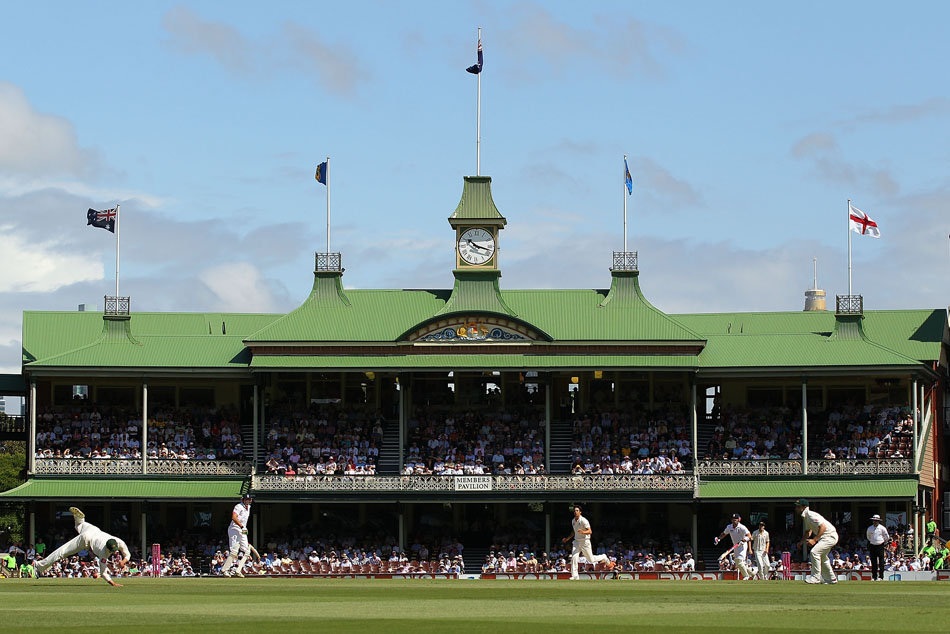
SCG is all set to host its 100th Test. Photo by Cameron Spencer/Getty Images

India’s batting has shown up to be brittle over the last year. A famed batting order has been tamed. And as much can be inferred from their recent performances, it must not be forgotten what they are capable of. Each of them have defined some great batting moments of the decade gone by, and some, like Laxman’s 281, have redefined the fortunes of their country.

Sometimes, it takes an enormouns effort to change the tide. Viv Richards’ decline in his last three years of his career were offset by Richie Richardson’s backfoot strokeplay and the emergence of Walsh, Ambrose and Patrick Patterson. The swagger never really disappeared and Australia seemed to be more worried about hosting the first three Tests on bouncy wickets before going to Sydney and promptly lost the series before the Sydney Test came along in 1988-89. Yes, it was an Australian side still re-building and West Indies was still the overwhelming champion concealing its cracks rather well.

But this is more the opposite for Indians. They are not fighting Steve Waugh’s Australia of 2000. Their batsmen made their names with performances against the great Australian sides and then some others. This is more a case of a heavyweight boxer returning to the ring after being felled by a young challenger. Often, adversity was tackled and overcome. But apparently, not so over the last year. The mind knows what it takes to be the champion again, but it also wonders if the punch is as strong as before, if the reflexes are still good enough to sway out of strong punches and if the legs can survive twelve rounds of boxing.

Sometimes, you need to take a blow and stand the ground to know that you can still do it. It was the same for a young Virender Sehwag playing the Boxing Day Test in 2003. He was peppered with bumpers, and after an hour of ducking and weaving, he was hit on the head by a Lee missile. He stood his ground and scored one of the most celebrated near double hundreds in Australia. He would later say that getting hit made him realize that there was nothing more for him to be afraid of. He was hit and he was still there. He realized he could take it. And he realized he could scare the opposition as much as the quick bowlers scared him and his teammates. Perhaps that one ball was all it took to shape his career in the remarkable way it did.

There are more worries and question marks over India than Australia going into this Test. Once the game starts, it only takes one inspired moment of cricket to change things around. A top draw batting order will fight its battles individually and collectively and a celebrated captain has confessed to having been conservative when he had the chance to finish off the battle with the right call.

Remarkably, bowlers have come through well in the first Test, and the captain and the supporters will hope the fitness and form will continue through the remaining Tests. Australia still remains a fragile batting side and it will keep the Indian bowlers interested even when a strong partnership is flourishing.

It is still a battle of two teams capable of lot more than what they have achieved of themselves over the last one year. Series are won over jelly beans, and careers made in a single Test. India should believe Sydney’s hundredth has one inspiring moment in it that will change the fortunes for them.

More than that, let’s hope the cricket helps erase the pains of 2008.

You can read the match preview from the Australian perspective here


Goutham Chakravarthi

The rain had stopped and the MCG bathed in sunshine. There was no trace of moisture in the wicket, nor dramatic movement in the air or off the deck. And a champion batsman had managed to survive a hostile spell of quick bowling by a wholehearted local with grit and luck the previous evening. And a magician who once made an Australian Prime Minister jog from his home to the SCG to see him bat waited in the dressing room. All signs pointed to a day of hard toil for the home quicks. But, then, cricket writes it own script. And then, a swinger who was resigned to thinking that his playing days were over produced a swinger’s version of a perfect ten to send back a champion batsman.

It was a fine day for cricket. It has been a dramatic Test already. Fortunes have oscillated more than in a Federer-Nadal classic, and the less-than-perfect performance by both teams, both batsmen and bowlers, has meant that the result of the Test is still as hazy as future of world economy.

On a day dominated by fast bowlers, Umesh Yadav picked four wickets for India. ©Getty

The first session saw Australian quicks bowl much better than they did for most part yesterday. The consistency in their lengths and their discipline in line meant the pressure was constant on the batsmen. Like the heart of a good story lies in its plot, the wicket played its part in a remarkable day of bat versus ball. With tall and quick bowlers able to generate steep bounce off a good length, it kept them interested. Inevitably, Laxman perished after being kept scoreless for what seemed an eternity. Only the introduction of Lyon seemed to release some sort of pressure, but the quicks kept it tight and soon Kohli and Dhoni were out in familiar fashion. And soon the rest of the batsmen too. The heart and the effort shown by the young Australian quicks augurs well for the home side for the rest of the summer. However, their consistency will be a factor. India’s second innings holds answer to that.

It was always going to boil down to India’s (in)ability to take 20 wickets that was going to determine its fate in the series. That Australia has a dodgy batting record and prone to collapse would have raised optimism. And you needn’t be a cricketing sage to have figured out how crucial Zaheer Khan is to this attack. His mastery over his art is mesmerizing, but his presence at mid-on talking to Ishant and Umesh seems as important.

Zaheer’s opening spell had the inexperienced Australian top-order in check and Umesh Yadav reaped the benefits of Zaheer’s tight bowling at the other end. And Ishant produced a quick spell with pace and bounce that on another day would have tagged him a cluster of wickets. His 149.9 kmph off-cutter to knock over Clarke in a spell where he constantly was around and over the 150 kmph mark augurs well for India given the scare of his ankle injury coming into this Test. Zaheer came back to trigger another collapse to leave the Test wide open.

Two champions of the game, ironically both on the selectors’ radar for the chop, stepped up to the challenge and constructed an important partnership in the context of the game. The impressive Indian bowling unit went past the bat on numerous occasions, but the champions held strong, attacking at every opportunity. That none of their younger teammates crossed double digits makes the partnership that much more valuable. Should Australia go on to win this Test, this partnership would have played a pivotal part. And perhaps the dropped catch by Dravid late in the day. His catching in the slips to spinners has been abysmal this year.

May be the bowlers will hold the ace on day four as well. May be, we are in for another Australia-India classic. Laxman might be itching to put his stamp on another famous chase. Perhaps a Tendulkar masterpiece to on another Test involving Australia. Or may be, the two locals, Siddle and Pattinson will have the last laugh. Or, may be something else. In any case, it promises to be worth it to wake up at 5 am IST to catch the action.


Goutham Chakravarthi

Teams were beaten even before they set their foot on these shores over the last two decades. Bowlers targeted batsmen and former players and media targetted the captain. Crowds were one sided, and invariably, so were the contests on the field. Insofar, this tour has been anything but that.

Two days into the series, the talk has largely revolved around DRS in the Aussie press. No talk to players and ex-players targetting opposition. Even newbies like Kohli and Yadav are left alone. If anything, a scathing attack was made on the pace of Ed Cowan’s batting in the first innings. Mental disintegration on and off the field that was the norm is now missing. It is a fair reflection of the times. It is still a marquee series, but it is still a battle between a side arresting its downward slide and another that is trying to rebuild to reclaim the top spot. It will be fought to the end, but the winner will not be crowned the champion as it was the case for much of the last decade.

Sehwag and Tendulkar scored aggressive half centuries in India's strong reply to Australia's 333.

Sehwag and Tendulkar scored aggressive half centuries in India's strong reply to Australia's 333.

Like Australia’s faded aura, cricket vocabulary seems anything but right with regards to its bowling. Words like attack, guile and spell sat well with the writers and bowlers of the past, but it chokes your throat to say that when you see Hussey and Warner as part of a bowling unit.  It was touted as much a battle of the young Australian quicks high on velocity and potential against an ageing yet formidable batting side. By lunch on day two, a determined lower order had taken the Australian tally to 333. The wicket had considerably quicked, and notably there was less happening off the wicket. But, good carry and enough movement off the wicket promised a lot in store for the remainder of the day.

Ivan Lendl was among the first to play mind games. He didn’t do it by targeting his opponent through the media space, but used his well-toned physique and the locker room to carry out the task. He would walking around the locker room doing skips stark naked. With Sehwag, there is no fear of such physical intimidation. But with bat in hand, he is designed to destroy bowlers. He is the barometer of courage for bowlers. He plays his game, and often with a smile. May be, Pattinson will not second that after his altercation with Sehwag. But India got what it wanted out of Sehwag – a quick and positive start for Dravid and Tendulkar to build on. Sehwag’s was a chancy innings, but promised more good in the remainder of the series.

The innings of the Test so far came from Tendulkar. With immense brouhaha surrounding his hundreth 100, he played with freedom and decorated the MCG with spectacular strokeplay. He was rarely in any trouble and put on a show. A repeat of his 2007-08 showing with the bat might well pull the series in India’s favour this time, but that is a discussion for later. The MCG crowd gave him a rousing reception and he didn’t let them down. With the day drawing to a close and a partner suffering with cramps, he closed shop early only to be bowled by the fiery Siddle who was the sole hope in a largely flat performance by the Australian bowlers. India will sleep comfortably in the knowledge that Dravid is still unbeaten, even if luckily so.

Both batting units have put up a good show thus far and the wicket has flattened out. It promises to be good for batting for another two days. But given the recent history of both batting units that is skewed towards more than the occasional batting collapse, there is still plenty to look forward to in the Test.


Goutham Chakravarthi

HUMOUR/FANTASY

Two hundred years from now, Ed Cowan will be recalled as the game’s greatest batsman, ahead of everyone else. That’s if all video tapes of his batting ceases to exist and only the written text remained. Ed Cowan is the epitome of Conflict of Interest syndrome as being the game’s best active batsman-writer. He is his own critique!

He is a regular guy – un-Australian in every way – slightly round, slow between the wickets and a boring batsman who yells “no run” every time he puts bat to ball. And he is a writer on top of all this.

Numbers and angles to prove his perfect method

Cowan made all of 14 when the stumps were drawn for lunch. Healy on the Channel 9 box was fast asleep and called him the greatest bore in the history of all Boxing Day tests. Cowan sat by a serving of pasta, and readied his headline for the next day. It read Greatest Boxing Day Debut Ever. Then he went out to bat again.

He left deliveries on length, on line, on bounce, on angle, on just about anything. He ran between the wickets at the speed of a Laxman. In between all that he played a couple of strokes when he was bored. In Cowan’s words, he wrote of it himself thus:

It was the most assured performance of a debutante in front of a Boxing Day crowd of over 70,000 people. Finally an Australian batsman played the first session of a Test as it ought to be played in over 25 years. He got his foot to the pitch of the ball while driving – once he got his foot so far down he was able to convert a Umesh Yadav bouncer into a full toss – and bent his knees and elbows at right angles giving Euclid and Pythogoras cricket’s equivalent of the right angle on a platter. His concentration was unflappable – even when Yadav said “you are gonna get out by I am”, he barely bothered to correct his language – and technique tighter than skin-tight pants

Even the legendary statistician Mohandas Menon was impressed as Cowan gave him mind numbing numbers to crunch. He noted that Cowan tapped his bat on the ground a record 1921 times, 300 more than Alastair Cook during his marathon knock of 293 earlier in the year. Menon also noted the symmetry in Cowan’s batting. He said:

Cowan is a statistician’s delight. Symmetry to his batting is poetic. He gets down on one knee to drive and makes the perfect angle with his body and ground. He makes a perfect rhobus with his lower body and his knees and elbows bend in perfect right angles. He has given Test cricket its most perfect cover drives in history. A perfect cover-drive will henceforth be known as a Cowan Drive.

Having revolutionized cricket with its most perfect drives ever, Cowan is all set to become the first person to compose his article whilst batting during the second innings. You will see Cowan write and re-write his piece waiting for the right words to form the perfect Cowan Drive. Channel 9 will set-up a panel to debate Cowan’s claims to be the greatest player-writers of the modern game.

Cowan was unavailable to comment on the matter as he is busy writing his autobiography that is to be released at the end of the first Test.


Goutham Chakravarthi

Numbers

India have more than held their own against Australia since 1995 when Australia became the numero uno side in the world. Since then, India is the only team with a positive Win/Loss ratio of 1.2 (12 wins, 10 losses in 28 matches) against Australia among all Test nations with England a distant second with a Win/Loss ratio of 0.56 (13 wins, 23 losses in 44 matches). India has not only played on equal terms over these years, but are the only team to have consistently competed with Australia through the last 17 years, both home and away.

Team Matches Won Lost Tied Draw W/L Ratio
England 44 13 23 0 8 0.56
India 28 12 10 0 6 1.2
South Africa 26 6 17 0 3 0.35
West Indies 31 6 22 0 3 0.27
Pakistan 20 2 16 0 2 0.12
New Zealand 20 1 14 0 5 0.07
Sri Lanka 16 1 10 0 5 0.1
Bangladesh 4 0 4 0 0 0
Zimbabwe 3 0 3 0 0 0

Table: All teams vs Australia (home and away) since 1 January 1995

Stats can only tell you so much. In this case, it quite clearly tells you that India have done well over Australia in this time. But only 2 of those 12 victories have come in Australia (2 wins, 6 losses in 11 matches) giving India a W/L ratio of 0.33 behind England whose W/L ratio stands at 0.42 (6 wins, 14 losses in 23 matches with 3 of those victories coming in the last series).  Restricting the performance in Australia to the last 11 years, you see that India have competed almost on an even keel with a W/L ratio of 0.66 (2 wins, 3 losses in 8 matches), with England second best with 0.4 (4 wins, 10 losses in 15 matches)

Team

Matches

Won

Lost

Tied

Draw

W/L Ratio

England

15

4

10

0

1

0.4

India

8

2

3

0

3

0.66

South Africa

9

2

6

0

1

0.33

New Zealand

9

1

5

0

3

0.2

Bangladesh

2

0

2

0

0

0

Pakistan

6

0

6

0

0

0

Sri Lanka

4

0

3

0

1

0

West Indies

7

0

6

0

1

0

Zimbabwe

2

0

2

0

0

0

Table: Teams in Australia since 1 January 2001

Indians have also racked up the highest score (705/7 dec) in this period and their team scores more runs per wicket (37.07), almost 5.25 runs more than the next best team, England (31.85).

Battle of the weakness

Even taking into consideration India’s no show in England earlier in the year, its batting continues to be its strong suit. Stats above show that they have done well in Australia in the last 10 years, and, largely, its top performers over these years are still part of the team – Sehwag, Tendulkar, Laxman and Dravid. This series proves to be the battle of the weakness that’ll largely determine the outcome of the series: India’s bowling vs. Australian batting.

Spicy wickets might give India its best chance of a series victory. ©AFP

India’s ability to take 20 wickets will determine how the series might pan out. So, green wickets might prove to India’s best chance of winning. Durban, Leeds, Perth and Cape Town victories were built on favourable bowling conditions. Indians will back their experienced batsmen to put one over the sporadic Australian batting should it boil down to that.

Favourites

Not since 1978 have India come into a series in Australia as favourites. This time they are favourites only slightly, but not overwhelmingly so. Australia’s depth in pace reserves gives it renewed optimism to put one across the very experienced Indian batting side. The freshness in the attack will also be the factor Indians will look to exploit. Sehwag’s first knock of the tour might be crucial for the outcome of the series. And should India keep the Australians on the field for a day and half, it might break the Australian backs pretty quickly.

Injuries

Injuries to bowlers might well decide the fate of the series. Zaheer Khan and Ishant Sharma are crucial to India’s chances and both come in to the series with dodgy ankles. Zaheer has some cricket under his belt, but it remains to be seen if he will last the course. Ishant’s fitness and form will be crucial given the impact he has playing Australia, especially Ponting and Clarke.

It is difficult to see Ishant and Zaheer playing all four tests. Spicy wickets and a fit Zaheer and Ishant are India’s best chance of winning this series.

Prediction

2-1 India