Srivathsa Munirathnam
Before I begin this piece let me make one thing clear; I like the Dutch football team – in fact they are my second favorite after Spain and I just love watching them play. Any team that plays attractive football catches my eye and Holland have always done so. Also when a side plays such sublime and delightful football it is hard not to like them. Another reason why I root for them is their galaxy of stars which comprise of the likes of Arjen Robben, Wesley Sneijder, Rafael van der Vaart, Robin van Persie in the side and coached by Bert van Marwijk – who led them to the 2010 FIFA World Cup final. So it comes as a major disappointment and a shock to see such a talented side crash out of the 2012 UEFA Euro 2012 without a single win to their name. What went wrong to such a star-studded bunch? Why didn’t they perform as a group? The answers lie in the below mentioned paragraphs.
The Dutch have always been a mercurial and unpredictable side. On their day they can beat the best in the world and lose to the absolute minnows when things aren’t going to plan. In a way they can be compared to the Pakistan Cricket team – a similar bunch of talented individuals who have rarely done justice to their immense potential. In fact the Dutch side have a lot in common with the Pakistan side – both teams have match-winners but are driven by their huge egos which makes it impossible for them to gel as a team and get it right on a consistent basis. But one thing is assured when both of them play as a unit they are nigh impossible to stop.
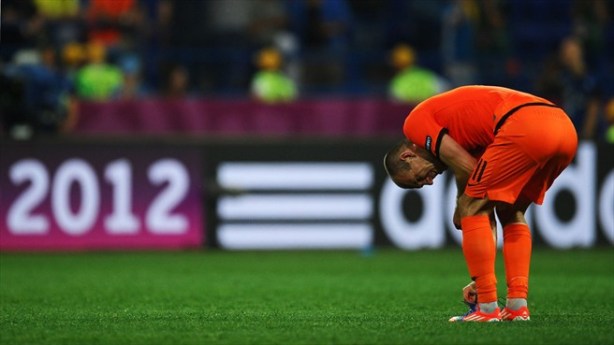
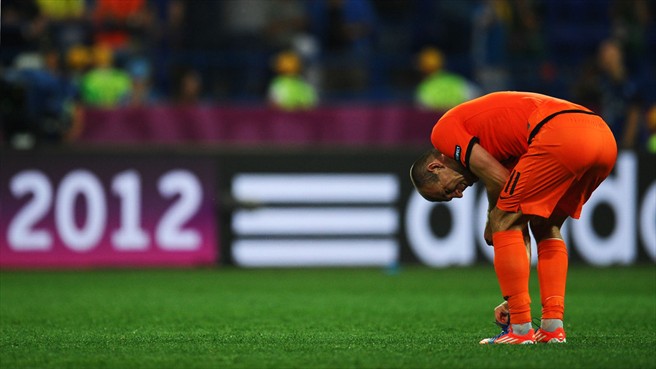
Arjen Robben reacts as Netherlands lose their first UEFA EURO 2012 Group B match ©Getty Images
Consider this line-up: two creative playmakers in Robben and Sneijder who can be compared to the likes of Xavi and Iniesta in terms of their playmaking skills. The English Premier League’s player of the year in van Persie who is one of the best strikers in the world and who has built a fearsome reputation with Arsenal. Then you have the likes of van der Vaart – another talented mid-fielder and complemented by the likes of Ibrahim Afellay, who plays for Barcelona and Klaas-Jan Huntelaar who had a brilliant season with Schalke. Stekelenburg in goal is another top goalie and you have the perfect recipe for a successful side. But in a team sport such as football it is not always the most talented side that ends up winning, but the most co-ordinated one.
Bert van Marwijk’s bizzare selections cost the Dutch:
van Marwijk came into the tournament as one of the best in the world and by the time the tournament was done his reputation had taken a beating. He made some bizzare tactical decisions which eventually cost the Dutch. Some of his moves included starting with a defensive mid-fielder like van Bommel in place of a more attacking minded van der Vaart proved costly. In the opening game against Denmark Marwijk started with Afellay on the left hand side who failed to create any sort of impression.
Perhaps Marwijk’s biggest mistake was to play van Persie behind the lone striker, van Persie, was a mere shadow of his former self playing out of position and proved to the biggest disappointment of the competition. RVP as he is called, likes to play alone as a lone striker and has done so with deadly effect for Arsenal. What made Marwijk to play him like Messi? When RVP has two creative playmakers in Sneijder and Robben to feed him one-on-one balls why wasn’t he allowed to play alone? RVP proved so inefficient in the game against Portugal that he was almost playing as a defensive mid-fielder trying to set up Huntelaar and was even back defending when his side needed.
Also the decision to play Huntelaar and Afellay certainly lacked any logic and the results were there to see. In fact Huntelaar was almost a non-entity in the game against Portugal and had only one shot on target – which came when the game was almost over. Also the move to start with van Bommel who clearly is past his prime angered Van der Vaart and by the time Marwijk realised his folly the Dutch were staring at elimination.
Another big decision that Marwijk took was to blood the 18 year old Jetro Willems at left back – incidentally the youngest ever player to play in the European Championships . Willems was like a rabbit caught under the head-lights and made blunder after blunder. In the game against Germany he was caught out of position repeatedly and his inexperience on the biggest stage showed. Why did Marwijk go in with such a rookie into such a big tournament? Even if he did why did he play him when there were far more experienced personnel on hand. Clearly this was one decision that backfired badly and by the end of the Portugal game the Dutch defence was in shambles.
Marwijk failed to control the dissensions in the Dutch camp which allowed things to go out of hand. When Robben was substituted in the second game against Germany he went the other way and jumped over the hoardings to show his displeasure. Agreed that the Dutch are a difficult side to manage with such an array of stars but Marwijk’s man-management skills left a lot to be desired. Is it the end of the road for him? Most certainly yes would be the answer.
Disunity and disharmony cost the Dutch big time:
Any side which has superstars often are difficult to deal with. Their big egos need a lot of careful managing. The Dutch side’s failure to win a big tournament apart from the ’88 European Championships can be attributed to one thing – lack of team unity. In fact some of the Dutch side openly accept the fact that they all are not friends with each other. But once you step on the field the common goal is to perform as a team which the Dutch failed to do so.
Reportedly Van der Vaart was unhappy that he was sidelined in favor of van Bommel and was the one who started it all. One can never be sure how much truth was there in those rumors but the Dutch certainly didn’t play as a team. This quote from van Persie sums it up – ‘when he plays for Arsenal, all the others play for him whereas the reverse is true when he dons the Oranje strip.’ The sight of Robben not passing the ball when his team-mates were in a favorable position doesn’t speak highly of the skilled winger. Robben wasn’t the only one, even Afellay was guilty of selfish play in the game against Denmark which surprised one and all as Afellay plays for Barcelona – a side whose primary goal is unselfish play and who teach their wards to pass the ball and not go for personal glory.

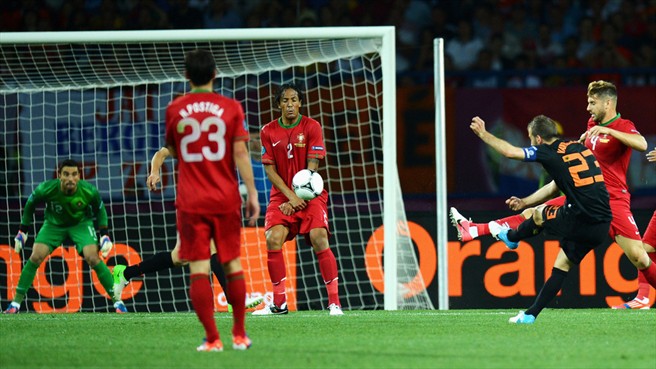
Rafael van der Vaart scored a wonderful opening goal against Portugal but the Dutch still went on to lose 2-1. ©Getty Images
When players like Robben don’t fall in line with the team ethos then there is little a team can achieve. In fact it was quite perplexing to see the majority of the Dutch players aiming for personal glory when a simple pass to the unmarked striker could’ve produced a goal. What does this prove? That no matter how talented a team is, if it doesn’t play as a team then there is only one way it can go and that is go downhill.
Failure of the big stars proved to be the end for the Dutch:
If van Persie was a huge disappointment, then the much hyped Robben and Huntelaar were a complete disaster. Robben who is known as the ‘selfish Dutch’ for his penchant to go for personal glory unmindful of the team’s needs barely managed to create any sort of impression. Either he hung on to the ball too long or dribbled unnecessarily without delivering his killer crosses. And his act after being substituted in the Germany game was a disgrace. Robben may be one of the best wingers on the right hand side but his showing in this tournament was nothing short of mediocre.
Another huge disappointment was van Persie. Having come into the tournament on the back of an award winning season with Arsenal, much was expected of the big man. But he rarely touched those heights as he failed to lift his game. Maybe he was tired after a long season with the Gunners or he was played terribly out of position, but still he did his reputation no good with two ordinary efforts against Denmark and Portugal. The same RVP who would bury chances with Arsenal was now fluffing simple one-on-ones with the keeper. His failure to put away at least three golden chances against Denmark proved to be the final nail in the coffin for his side.
With one of the best sides gone out of the tournament – they were in fact rated third best to win the tournament after Spain and Germany – it remains to be seen when this talented bunch can finally do justice to their talent. But one positive to come out of this disaster is that all the aforementioned players are more or less in the same age bracket (25-28) and two years down the line they have another chance to redeem themselves at the 2014 FIFA World Cup. Will they do so? As the cliche goes – only time will tell.

 In the second edition of Kick-Off!, we are joined by Chandrasekhar Jayaramakrishnan, Niranjan K and the and the star twins Gautam Rajagopalan and Gaurav Rajagopalan and the star mid-fielder Sairam Vijai (who took the Bangalore-leg of Pepsi T20 Football tournament by storm) as they take a look at the Euros that has already seen three semifinal berths taken, with the final QF to be played between England and Italy today. We also hear the sorrows of a Dutch fan, the delights of a German fan, the optimism of an English fan and a Spanish fan who says he fears the Germans! We also hear the panelists’ take on the Quarter Final to be played between the Three Lions and the Rossoneri later today.




 The CouchExpert