Author Archive


 Goutham Chakravarthi

On a day were only 38 overs were possible, it was still a day of two halves for the Kiwis. The first 19 overs had them losing their last 5 first-innings wickets, with Ashwin and Ojha continuing to tie them down with nagging flight, dip and slow, but significant turn off the wickets. The last 19 were an improvement in approach and batting as they were made to follow-on by Dhoni.

Zaheer and Yadav started with pace at either end with Yadav sending back van Wyk soon. Barring James Franklin, the Black Caps seemed starry eyed by the Indian slow bowlers. Ojha’s nagging length and discerning spin had Doug Bracewell caught between slogging and defending and finally perished trying to charge Ojha only to have Dhoni uprooting the stumps.

But for dealing with the Indian medium pacers, the Black Caps’ lower-order lacked conviction and failed to provide support to the hard working Franklin. With the 30-run partnership broken between Franklin and Bracewell and the introduction of Ashwin, any hopes of avoiding the follow-on disappeared into the dark and gloomy skies of Hyderabad.

Ashwin was the undoubted star, needing only a handful of deliveries to clean-up the Kiwi tail. Soon he sent back Jeetan Patel (10), Boult (4) and Martin (0), there by ensuring India would make the Kiwis follow-on for the first time since 1956.
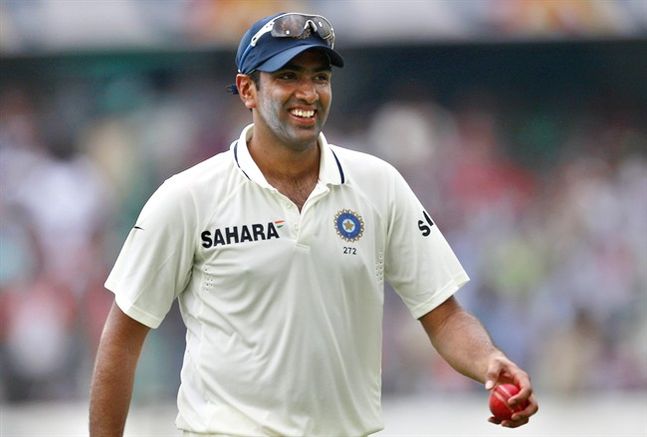
Ashwin would be keen to run through the Black Caps batting line-up to wrap up the test match soon.

With the various administrative changes happening in the Kiwi set-up, this batting performance on a typical sub-continent wicket wouldn’t have pleased the new coach Mike Hesson. And for a team that looked suspect against the spin of West Indies not so long ago, and coming in to this series with no practice game, perhaps this was expected.

Perhaps Mike Hesson did have a stern word with his wards at the end of the first innings even if it meant he did have a word with the third umpire on a couple of decisions through the first innings (no UDRS in this series). McCullum and Martin Guptill looked up to the task of dealing with the spin and guile of Ojha who opened the bowling for India looking to extract any bounce and bite off the wicket.

The openers looked compact and more determined even as the threat of thundershowers loomed large. As play carried on under dark skies and artificial lights, the battle the Kiwis seemed to be battling were with that of discipline.

Ojha’s nagging length and turn eventually induced the edge only for Kohli to put down the chance to give Guptill a life. Just when Guptill thought he had done the hard yards of seeing through the initial period and having had a chance put down, he was given out shouldering arms to a straight Ojha delivery. Replays suggested that the ball had turned enough to perhaps miss the stumps.

Rain came to the Kiwis’ rescue soon after with only 38 overs bowled in the day. With rains expected through Sunday, the Kiwis would hope the overnight not out batsmen McCullum (16) and Williamson (3) would show the same grit and determination they showed in the hour before the stoppage to give them a chance of saving this Test.

As the Kiwi spinner Jeetan Patel said leading in to Day 3, “It’s still low and slow with the seamers – it’s not bouncing as much – but it is starting to take some more turn, which you’d expect.” There is indifference bounce, but the turn is not sharp once the ball gets a bit old. SG balls are prone to aid reverse-swing when the ball gets old, but the pace of the wicket is slow enough for the Kiwis to handle that threat.

The rains have been relentless all across the southern portions of India and Sri Lanka. With rain and thunderstorm predicted over the next few days, it is a question of Kiwis surviving the time they get in the middle that is keeping their hopes alive in this first Test.

Dhoni and team would look to wrap-up the Test on Sunday though.


Chandrasekhar Jayaramakrishnan

It probably isn’t unfair to say that the berth atop the ICC Test Rankings, historically, hasn’t been a paradise for teams that have scaled it. Idealists would find it easy to argue that the current and former number one teams have had questionable, if not in entirety, rises to the top – England’s failure in the sub-continent, and India’s predominantly home-series wins adding alibi to their theories.

English fans, now, find themselves being stopped short of being wildly idealistic. What seems profound here is that despite victories (and draws) against tough overseas opponents on foreign soil (barring their quest in the sub-continent), England finds itself basked amidst vicissitudes of press coverage stating ‘too much cricket’ as an excuse for their exponential dip in form in the ongoing series against the Proteas. Isn’t this true for almost the entire set of test playing nations, or at least the top six nations?

World records may not hold great importance if it doesn’t help achieve a significant team result. © BBC

True, just like how the blackout in Northern India has highlighted our dependence on diesel, there have been enough presumptions with regard to England’s dependency on seam-friendly tracks. It wasn’t too long ago in the timeline when the English selectors (rather Andy Flower) had a pleasant headache over the pace bowlers they needed to leave out of an eleven being fielded. Even KP’s antics did little to overshadow the confidence that they had built as a test unit under Andrew Strauss and Andy Flower.

But, isn’t it common these days to witness sparse differences in standards between teams (or if we extend this to organizations in general) vying for pole position? It is healthy, as a fan, to witness intense battles between teams that look not only strong on paper, but have the firepower to back it up on the field.

A nascent advantage of the billions of cash reserves in the Middle East has been the creation of stronger clubs (through foreign ownership) to compete against the cliché of names one usually comes across in the European leagues. Chelsea, for one, given how they’d been a dominant force not too long ago under the billions of Roman and reign of Mourinho, finished sixth last season – it wasn’t ‘too much football’, but stronger competitors.

Fortunately, cricket is witnessing the same. Just to drift slightly off here – as much as I’d love to call the current New Zealand team a touch below par, the resurgence of West Indies (too early to say?), owing to the return of Chris Gayle at the top of the order, has been a welcome sight to most of us.

In paper, they may hardly seem like teams being overworked. Chris Gayle, players competing in the IPL, WICB issues have, in the past, camouflaged substantial on-field press coverage (barring the Ramdin ‘paperwork’ during the series against England). The change in tutorship at New Zealand has received a little more space than an obituary in newspapers here. But they’re competing all right.

Coming back to the perennial issue highlighted earlier – packed calendars don’t help. Agreed. Much has been written in the footballing circles about how players get jaded after a long season (domestic, league, continental competitions adding to the toll) followed by international commitments. And by the time they’re done with it, the new season beckons – it isn’t uncommon to see players who’ve undergone the wrath of such schedules sit out of contention for the best part of August.

Cricket is equally, if not more, demanding in terms of fitness (probably more mental owing to the long stretches of tours away from home). Unlike football (and I’m sure football purists would disagree here), there’s very little space for error in the game of cricket – a lapse of concentration could cost a batsman his wicket, a fielder a catch and a bowler a wayward  line/length. Add to all this media hype and expectations (something which I believe dearly affects teams like England  and India, more than other teams around) – the end result is a volatile cocktail.

So, have teams at the top been victims of everything (and everyone) but themselves? It is as much about hype and expectations, as it is about packed schedules. The modern day sportsman is trained (through a combination of well-structured training programs catering to the mental aspects of sport) to cope with expectations of a nation, and the glaring eyes of the world.

But few cross the line that differentiates the best from the rest. A double hundred in a dead-rubber test on a flat wicket deserves to be dwarfed to insignificance when compared to a half century on a trying wicket that saves a test. Only when the cricketing community starts setting such standards and yardsticks, will we see the crop of players rise up and deliver.

Let me recall an interesting anecdote I heard from a source (this isn’t fiction) regarding Don Bradman’s reaction, when quizzed by an Australian journalist, after Brian Charles Lara had scored a record breaking 375 against the touring Englishmen in Antigua. The Don, apparently, had replied ‘Okay’.

Assuming that age had caught up with the Don, the journalist repeated his question (understandably more pronounced) to get the entirety of the message across. The Don, once again, without batting an eyelid, replied ‘Okay’  When quizzed further, The Don had said: ‘On a flat wicket, against a scrawny bowling attack in a Test which wasn’t heading towards a result, what more can I say?’

The journalist decided to pose his question thus: ‘Sir, how much do you reckon you’d have scored had you been in this situation?’. The Don thought for a while and said ‘Maybe 260 … or 270.’ Presuming that age had taken a toll on his thinking, the journalist asked ‘Sir, but he scored 375. You’re saying you’d have 260. And you’re not rating his knock too.’

To which The Great Man replied: ‘I’m 85, he’s just a 23 year old kid.’

Maybe, that is what greatness is about.


Goutham Chakravarthi

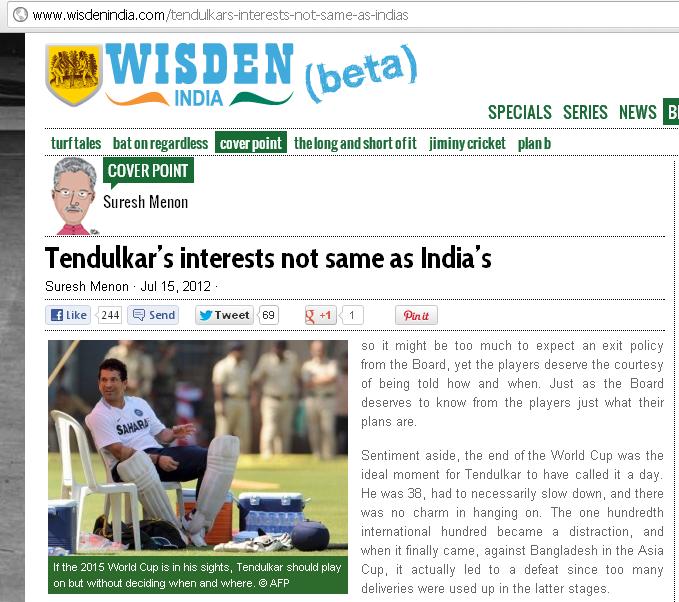
Earlier today, Suresh Menon’s  article appeared in Wisden India with the heading ‘Tendulkar’s interests not same as India’s‘. This is not about my view on Tendulkar’s retirement or any retirement for that matter (of which I have already shared my view). This is more about the very headline of the article. While what much of the article around Suresh Menon’s well documented opinion of how Tendulkar’s career is now controlled by his commercial interests, I felt this time, it went from being just his opinion to a verdict or judgment of sorts – that he claims Tendulkar put his interests ahead of the India’s seemed not a mere inference of sequence of events or a likelihood. Menon was certain. He wrote, “clearly Tendulkar’s interests are no longer the same as the country’s, certainly not in one-day internationals.”

The sequence of events leading up to this article is fishy.

A sequence of events surrounding this article and coming from Wisden India now has got me thinking if there might have been an ulterior motive to him writing what he did. Read me out.

First, let’s start with Wisden India itself. Bloomsbury announced late last year their foray into India through Wisden India. This year they have now become fully functional. With an ambition ‘to be a single consolidated voice of Cricket, and to be known as the ‘Home of Indian Cricket.”, they seemed serious (It is a competitive market with Wisden India facing stiff competition from ESPNCricinfo and Yahoo! Cricket) and they roped in big names including the likes of Dileep Premachandran as Editor-in-Chief and Suresh Menon as Editor Cricketers’ Almanack.

So when almost exactly a month ago, Wisden India awarded Tendulkar with the Wisden India Outstanding Achievement award it seemed a good way market itself in the process. It was also announced that Wisden India would hold five more such dinner events involving Sachin Tendulkar over a period of three years. It was apparent that Wisden India had invested themselves in brand Tendulkar.

So when Tendulkar pulled out of the one-day series against Sri Lanka citing he needed to spend more time with his family, predictably, media space was abuzz if he ought to be able to pick and choose the series he plays in. Following the pull out, Wisden India’s when Editor-in-Chief Dileep Premachandran decided to write that selectors ought to be the ones that decided who should be picked and who shouldn’t. Here’s where things got a little fishy. At least, to me.

Surprisingly, the article appeared in the UAE based The National and not in Wisden India. Of course Dileep Premachandran contributes to The National and also The Sunday Guardian. But an article on Tendulkar and selection didn’t warrant a feature on the site that aspires to be known as the ‘Home of Indian Cricket.’

Perhaps the investors on the Tendulkar brand for three years didn’t want to jeopardize by carrying a story that seemed to sort of accept that it may not have been a wise investment. Or that it might jeopardize relationship with the player himself. Whatever it was, it appeared as though the investors got their way.

But it didn’t escape the fact that the article did appear on UAE based The National. Did it mean Wisden India would refrain from carrying out any ant-Tendulkar stories for another three years?

No, apparently not. At least from this article earlier today. Whether it means Wisden India do not want to be seen to be favouring a certain player, or if it was a case of a decorated and high-profile writer wanting to show that he couldn’t care less for his employer or their investment and would get his own back  against the both of them are all possibilities.

In any case, opinions are points-of-view based on facts and inferences. Like Suresh Menon disagreeing with Sanjay Manjrekar’s opinion that Dravid was not talented for example. Or his example that Dravid and Boycott were examples of  constructive and destructive selfishness respectively. Infering from shrewd observation like how the investment industry is linked with Tendulkar is what alalysts like Suresh Menon or Mike Atherton are very good at.

But to be certain of Tendulkar’s interest not in line with his country’s seems beyond a mere opinion. More a judgement of character. And it cannot be pinned on a player just because it appears the whole cricketing commerce revolves around him. And it sits uneasily on me more to do with the sequence of events leading up to this article.

While we want our writers to be unbiased and critique for what is best for the game, we wouldn’t want them to influence us with views that may be intended just to prove a point. Cricket is struggling enough to fight corruption, maladministration, and player agents and con men influencing player selection.

We don’t want the small circle of our best and honest writers use their power to fight their personal battles.


In the fourth edition of Kick-Off!, we are joined by Chandrasekhar JayaramakrishnanNiranjan K, Akshay Balachandra and the twins Gautam Rajagpalan and Gaurav Rajagopalan  to discuss on where the current Spanish team stand in comparison to the Brazilian team of the ’70s. Also, the panel assess Team GB’s strength and throw their verdict on whether Stuart Pearce was right in ignoring Beckham for the Olympics. That, and more, on the fourth edition of Kick-Off!

Introduction Music: Composer and singer – Rakesh Salian

Guests: Niranjan KAkshay BalachandraGautam Rajagpalan and Gaurav Rajagopalan

Host: Chandrasekhar Jayaramakrishnan


In the third edition of Kick-Off!, we are joined by Chandrasekhar JayaramakrishnanNiranjan K, Sairam and Akshay Balachandra to discuss the build up to the Euro 2012 finals at Kiev. The panel discuss the road taken by Spain and Italy to the finals, and assess whether Spain’s possession based football is equipped well enough to out-wit Italy’s mid-field Maestro Andrea Pirlo and problem-child Mario Balotelli. Will Spain have enough in them to become the first team to win three consecutive major trophies?

Introduction Music: Composer and singer – Rakesh Salian

Guests: Niranjan KSairam and Akshay Balachandra

Host: Chandrasekhar Jayaramakrishnan